---
title: "#216: From Coast Guard to CIO — Craig Hopkins on Purpose-Driven Leadership in San Antonio"
description: San Antonio CIO Craig Hopkins shares why “we’re not IT professionals, we’re operational leaders,” how small behaviors compound into culture, and what it really means to build teams with purpose. From Team of Teams to One Mission, this episode is packed with practical frameworks — a true masterclass in purpose-driven leadership.
image: https://techtables.com/hubfs/Screenshot%202025-08-21%20at%205.35.28%20AM.png
---
[Skip to content](https://techtables.com/podcast/216-from-coast-guard-to-cio-craig-hopkins-on-purpose-driven-leadership-in-san-antonio#main-content)
[All posts](https://techtables.com/podcast/all)
August 21, 2025
# #216: From Coast Guard to CIO — Craig Hopkins on Purpose-Driven Leadership in San Antonio
 Joe Toste · 24 minute read
[mailto:email@email.com](mailto:email@email.com)
🎬 Recorded live at The Cannon as part of the 2024 Houston Podcast Tour.
### 📬 **The TechTables Newsletter**
TechTables connects public sector technology leaders — CIOs, CISOs, and CTOs — through darn good conversations and peer-driven community. The best place to start is the newsletter.
**Subscribe now.👇**
### **Episode Summary**
What if the secret to transformational leadership isn’t being the smartest person in the room, but being the “humble gardener” who grows others? In this episode, San Antonio CIO Craig Hopkins shares why “we’re not IT professionals, we’re operational leaders,” how small behaviors compound into culture, and what it really means to build teams with purpose. From Team of Teams to One Mission, this episode is packed with practical frameworks — a true masterclass in purpose-driven leadership.
### Featuring
[Craig Hopkins](https://www.linkedin.com/in/craig-hopkins/), CIO, City of San Antonio
### Timestamps
([02:00](https://www.youtube.com/watch?v=MNSvJ36Ncl0&t=120s)) From Coast Guard to CIO: Finding Purpose in Service
([04:00](https://www.youtube.com/watch?v=MNSvJ36Ncl0&t=240s)) USAA’s 20-Year Leadership Lab: Five Careers, One Company
([08:00](https://www.youtube.com/watch?v=MNSvJ36Ncl0&t=480s)) A Costly Lesson at Sea: How Tragedy Shaped Craig’s View of Leadership
([14:00](https://www.youtube.com/watch?v=MNSvJ36Ncl0&t=840s)) Team of Teams: New Rules of Engagement for a Complex World
([16:00](https://www.youtube.com/watch?v=MNSvJ36Ncl0&t=960s)) One Mission: How Leaders Unite a Team of Teams
([19:00](https://www.youtube.com/watch?v=MNSvJ36Ncl0&t=1140s)) Behaviors → Character → Culture: How Small Actions Shape Organizations (for Better or Worse)
([25:00](https://www.youtube.com/watch?v=MNSvJ36Ncl0&t=1500s)) The Humble Gardener: Why Great CIOs Cultivate People, Not Control Them
### **Links Mentioned**
[Team of Teams](https://a.co/d/3m0jvua): New Rules of Engagement for a Complex World by General Stanley McChrystal
[One Mission](https://a.co/d/itQDOWW): How Leaders Build a Team of Teams by Chris Fussell
### 🔥 Want more from the 2024 Houston Podcast Tour? Check out *four* *binge-worthy* episodes you can’t miss.
[#208: Texas County Women Leading 6M+ Residents: From Flooded Data Centers to AI Innovation Lab to Building Unbreakable Teams](https://techtables.com/podcast/208-texas-county-women-leading-6m-residents-from-flooded-data-centers-to-ai-innovation-lab-to-building-unbreakable-teams)
[#205: From Hurricane Harvey to Beryl: Houston's "One Family" Emergency Response](https://techtables.com/podcast/205-from-hurricane-harvey-to-beryl-houstons-one-family-emergency-response)
[#204: Why Texas DMV Chose $6M in Planning Over $150M (Plus TDLR's 25-Program Modernization)](https://techtables.com/podcast/204-why-texas-dmv-chose-6m-in-planning-over-150m-plus-tdlrs-25-program-modernization)
[#203: UHCL's 6-Week Leadership Pivot + AI Student Concierge + NASA Innovation Culture](https://techtables.com/podcast/203-uhcl-6-week-leadership-pivot-ai-student-concierge-nasa-innovation-culture-houston-2024)
Whenever you’re ready, there are 3 ways you can connect with TechTables:
#### **1. 📬 The TechTables Newsletter**
Thanks for reading TechTables! Get early access to new episodes, insights, upcoming events, and more — straight to your inbox.
Join now: [https://www.techtables.com/](https://www.techtables.com/)
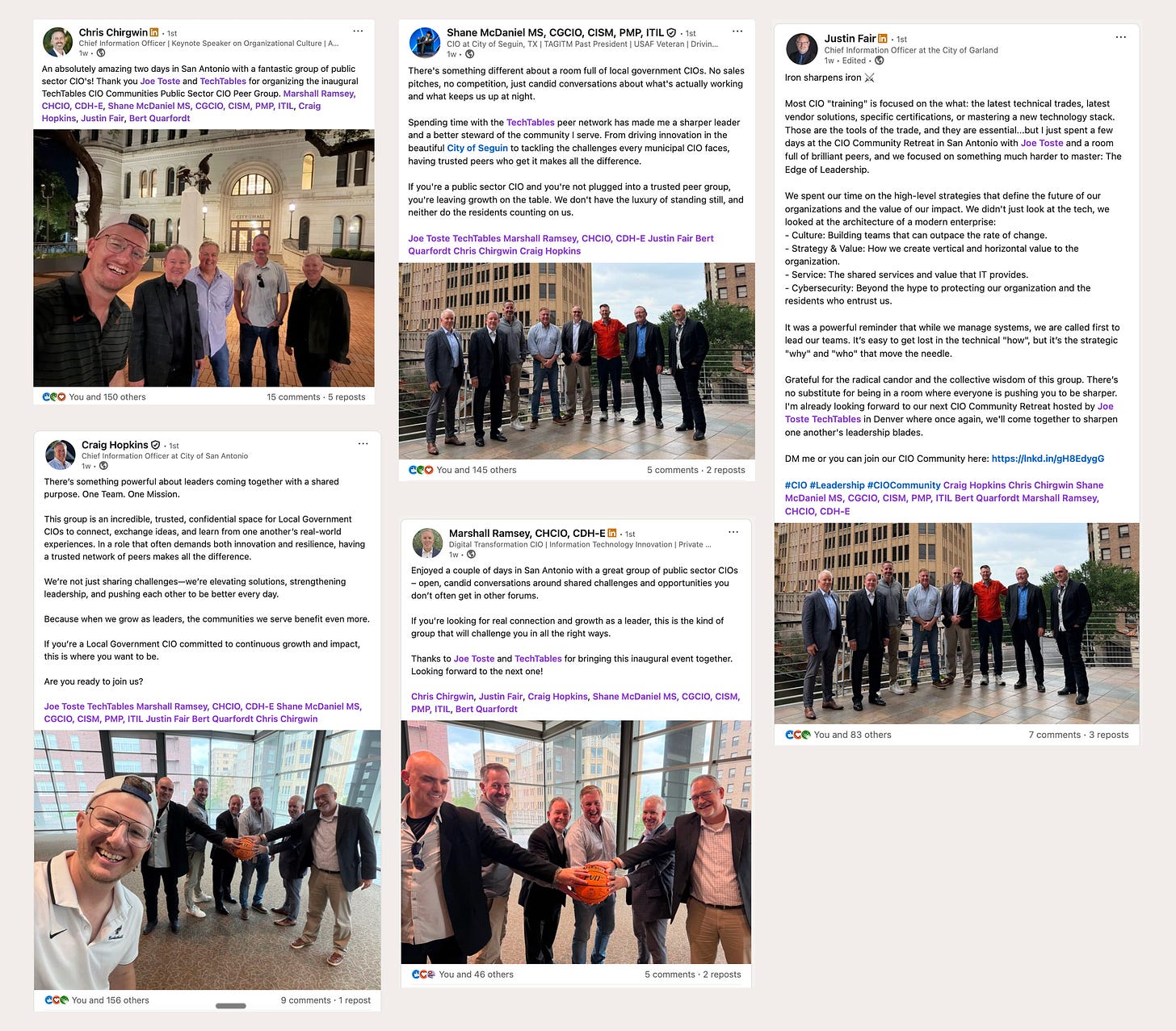
2\. 🤝 Are you a local government CIO who wants to become a better leader?
Check out our high-trust, vendor-free peer group built for local government CIOs tackling real challenges, honest conversations, and an authentic desire to become a better leader — our next retreat is November 2026!
Learn more → [https://techtables.com/communities-local-government](https://techtables.com/communities-local-government)
### 3. 🤝 The Better Together Series (Virtual & On-Site)
The narrative-driven series bringing together industry partners and public sector CXOs. Discover the compelling stories that unfold when we stop working in silos and start building together.
»»» Email [joe@techtables.com](mailto:joe@techtables.com) to learn more.
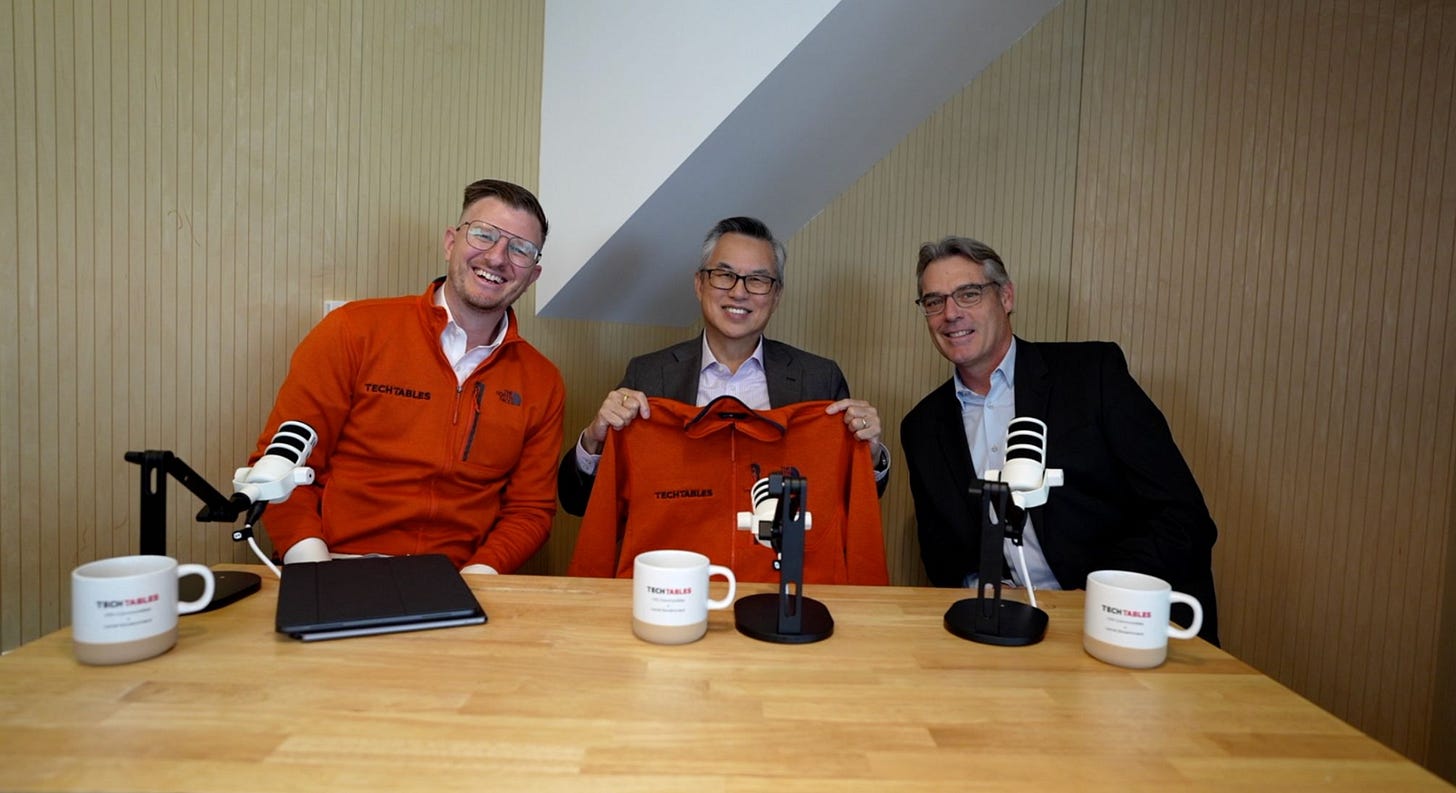
> TechTables Better Together On-Site with Peter Loo, CIO, LA County & Hannes Scheidegger, Chief Global Delivery Officer at Info-Tech Research Group
### Platinum Newsletter Sponsor:

Join TechTables & Info-Tech Research Group at [**Info-Tech LIVE 2026 - New Orleans**](https://preview.convertkit-mail2.com/click/dpheh0hzhm/aHR0cHM6Ly93d3cuaW5mb3RlY2guY29tL2V2ZW50cy9uZXctb3JsZWFucy1saXZl) (February 3 - 4, 2026) and/or [**Info-Tech LIVE 2026 - Las Vegas**](https://preview.convertkit-mail2.com/click/dpheh0hzhm/aHR0cHM6Ly93d3cuaW5mb3RlY2guY29tL2V2ZW50cy9sYXMtdmVnYXMtbGl2ZQ==) (June 9 - 11, 2026)!
Learn more about upcoming Info-Tech events here: [**https://www.infotech.com/events**](https://preview.convertkit-mail2.com/click/dpheh0hzhm/aHR0cHM6Ly93d3cuaW5mb3RlY2guY29tL2V2ZW50cw==)
### Gold Newsletter Sponsor:
****
> **[SentinelOne](https://assets.sentinelone.com/ghe/sentinelone-empowers)**—Learn how SentinelOne empowers this state to stay secure.
>
> **[Verizon Frontline](https://www.verizon.com/business/solutions/public-sector/public-safety/)**[—](https://www.verizon.com/business/solutions/public-sector/public-safety/)The advanced network that keeps first responders connected when it matters most.
>
> **[Carahsoft](https://www.carahsoft.com/)**—The Trusted Public Sector IT Solutions Provider™, supports government agencies and education/healthcare markets. Contact your Carahsoft rep today to access special discount pricing exclusively through the TechTables + Carahsoft partnership!
Transcript
Joe Toste: Really excited today to kick off with Craig Hopkins, Chief Information Officer for the City of San Antonio, returning guest to the podcast.
Craig, welcome back to the show.
Craig Hopkins: Thanks for having me here. It's fun to be in Houston.
Joe Toste: It's fun to be in Houston, but I didn't even know we were in Houston because. Wait, is that San Antonio right there?
Craig Hopkins: I figured there was going to be a lot of Houston folks here. And since you lied to me and told me we're doing this in Austin and then moved it to Houston.
That I would take an opportunity to at least bring you a little of San Antonio \[00:01:00\] city of San Antonio swag water bottle and the best coffee in the world cafe au lait, San Antonio brew.
Joe Toste: Oh, I love it. So I'm going to take this with me, put this off to the side. Jack, we got new water bottles. Maybe Jack got water bottles.
These are a little tiny. So thank you. Of course. No, I really appreciate it. Picking up from episode 38. I want to kick off just on your leadership journey. And for those who don't have the context, maybe just a brief background on the USAA piece, and then leading into the city of San Antonio.
Craig Hopkins: Yeah, so I've mentioned this a couple times this morning. It's a fun leadership story that I love to tell, especially when I get to mentor a lot of young folks. They'll typically say, Craig, how do I get to be CIO? Or at USAA, I was a senior vice president. How do I get to be promoted up to a senior vice president?
And I literally will say, I don't know. I, my journey is not a traditional journey. And so if you're looking for set a checklist and put milestones on events and a career path. I'm probably not the one who can help you with that, because that's not the \[00:02:00\] journey I had. My quick journey for the team is I grew up outside of Boston New Englander by birth.
All my family is still in New England. We'll be heading back for Thanksgiving for the first time in a while here and shortly. And decided I needed to go somewhere warm where I could play baseball year round. So I went to the University of Arizona in Tucson. Loved it. Had an incredible time for a year and a half until they told me I couldn't play anymore because I wasn't going to class.
So I started as a college dropout, right? That's what I always go back to in my roots is what did I learn from that year and a half in my leadership journey? And one was I was all over the place and I was not ready for college, right? Go back to Massachusetts, get a job. Doesn't go well. Like every young kid who thinks they're indestructible.
Life is not going as planned until my father finally says to me, you need to do something with your life, son. This is not it. And I met a guy who was chief in the United States Coast Guard reserves. And he took me up to Gloucester, Massachusetts, put me on a Coast Guard boat. It's absolutely beautiful.
If you've ever been to Gloucester, Massachusetts, up in that area, that the area is \[00:03:00\] beautiful. And took me to Boston, put me on a big ship. And I realized this was something I could do with my life. And he told me, Craig, it's only four years. Your life is so screwed up now. It'll only be better after four years, right?
And what he told me was, you'll find purpose. I didn't know that at the time, but I trusted him. So four weeks later, I'm in boot camp, Cape May, New Jersey. I'm a member of the United States Coast Guard. And I did my four years, and I did a lot of incredible things in the four years I was there. And I found purpose.
I found those two things that have carried with me is purpose and team. And that's what I needed in my life at the time. Jumping ahead, my wife decides as we get married, she doesn't want to live the military lifestyle, so I get out of the Coast Guard. Two years later, she joins the United States Navy, and I follow her for 11 years as a dependent husband.
She was a Lieutenant Commander, so I still salute her. I was enlisted at the time. And we had a wonderful journey with her career as well, which brought us to San Antonio, to Fort Sam Houston. So we get orders to Texas, right? And the first of all, what the hell is the Navy doing in Texas? If you're not in Corpus Christi, what else is there to do?
She winds up \[00:04:00\] at Fort Sam and we had just have a great indoctrination into San Antonio, just an incredible city. And she winds up spending the next four years there and then gets out. And I got connected with USAA. I started as an IT systems analyst backtrack to the story. I did eventually go back to college, lots of night school.
Lots of extension centers seven universities over 11 years to finally get my master's degree. But persistent, right? The need to do that. So when I walked into USAA, I had an opportunity to start fresh. And we as a family started fresh there as well and raised our family there.
So 20 years at USAA, financial services for the military. I tell people I had five very different careers there. I had the blessing of not having to move companies. I could do everything in the company. I was Chief Digital Officer Chief Strategy Officer, Chief Procurement Officer, ran global operations, did a few of those things, and just had an incredible opportunity to grow my personal career, my leadership career, and promote.
I got to promote up to Senior Vice \[00:05:00\] President. But the thing about USAA that was the best was it was a culture that was purpose driven, right? So it lined up to me what I was looking for in leadership, and it was then easy for me to then turn that to others and help mentor for that. And then it gave, and it also was a culture that was enabling, right?
I had great mentors. I had great, I always called them cover in the military. If you're a ground troop, I was never a ground troop. And you are on the ground that in fear, you want to see an A10 flying overhead. That is your cover. So we used to call them our eight tens, right? Could you call in your eight 10 at any time?
And they would take care of you on the ground if you needed. And if USA had a great culture of that, and once you felt it, you would do it for others as you went forward. I was I really had the opportunity to build my leadership story through USAA. And then in 2017, when I left, I thought I was going to retire.
Actually my wife and I built our retirement house in Michigan and then decided that we need to stay in San Antonio a little longer. And then somebody called me and said the city needs a CIO. First of all, I've never been a CIO. I've \[00:06:00\] been in it in and out and who the hell would want to work for government, right?
That was a literally my first view of that. Have you ever seen parks and recreation? Everybody's lazy, right? Bureaucracy. Nobody wants to be there. You just have all these biases about government. And all I knew about government was paying my parking ticket when I got a parking ticket one time.
Boy was I wrong. Absolutely wrong. And when I took the job and showed up in the first three weeks there, I saw people that were absolutely purpose driven, mission driven, wanted to be there, but were looking for an A10 cover. They didn't feel covered, right? And they felt like they were on their own, fighting against the machine.
And once I was able to say to them, let's build a culture in our organization where we're going to cover each other and treat ourself like teammates and family, then people started to thrive because they wanted to be there. They wanted to make things change. One of the simplest stories there is I would sit in a meeting early on and somebody would say I'd say what's the problem we're trying to solve.
And the answer would always be, we don't have any budget. I go, that's not the problem. \[00:07:00\] What's the problem you're trying to solve? We don't have the resources, right? They come up with all the typical constraints. So I finally said to them, let's change this culture. I have all the money and all the resources.
How would you solve this problem? And people suddenly were unhandcuffed and they would start to think about the way we could solve this problem is by blah, blah, blah, blah, blah. When they feel unconstrained. I did not have all the money and all the people, right? But the assumption that I could get them and help them with that created this culture.
That kind of that journey has now taken me to this role where I'm really more focused on operations than vertical IT. And I'm very focused on this ability to create a culture, not in just IT, but in our entire city, where people feel that they are empowered to go out and solve problems.
Joe Toste: I love the history and background I do want you to tell one story that I remember.
It's not in the podcast questions, but I remember vividly. It was such a powerful story of I think it was the gentleman that passed away when you were in the coast guard. Tell that story for the audience that they have
Craig Hopkins: the context? Yeah. It's not an easy story and and I'll.
I'll probably do it, just \[00:08:00\] highlight it so we stay on track here. But when I was in the Coast Guard, I was a machinery technician. At least, you're a mechanic basically, right? You pick your rate, and I was trained to take care of the engines. And I wound up on a small boat, which was motor light boats on the Great Lakes.
They also have them on the west coast of in Oregon, Pacific, Northern California. They're made to roll over in the surf. The motor lifeboats, they go out and they're rated up to 40 foot seas and they can roll over, pop back up. That's the purpose of it. We had one of those boats and I wanted to drive that boat.
But when you're a mechanic, you don't get to drive the boats and baits drive the boats. So I remember fighting for that with my chief, like I want to get qualified. So I did. I got through all my qualifications right up to the end where you got to get certified. And the chief told me.
Mechanics don't drive boats. The debt chief left, new chief came in, I got check, I got my check rider and I got, we got through there. So I became a coxin of the motor life boat and I absolutely loved it. And when you do that, you get your first crew. So think of it as a team, right? It's the first time you are really responsible for your own team.
They give you a boat, they give you three or four crewmen. They all have different roles. You \[00:09:00\] have to train them, you have to teach them the protocols. You go out. Somebody said Practice practice. You do a lot of that practicing. But at that moment, it's about me because I'm the coxswain. I got qualified.
Look at my achievement. And by the way, this is my team and my boat, and you're going to do what I say. And that's just a normal young person growing up part of their journey. And we went out and we had many missions, many sorties tows, sinkings, different things that we would normally do.
We did about 340 cases a year where we were at, which is pretty high volume to go forward. And we're in a place on Lake Michigan where there's piers coming out. And when storms come in, you can get waves breaking over the piers and it can get pretty dangerous in there. And what we would see is In the summertime, the kids would go out and play in the waves, and they'd hang on the bars, and the waves would hit them, and they'd think it was fun, but it's dangerous.
And every once in a while, somebody would get knocked into the water, and then they'd swim to the side, or they'd call us, and we'd go out and pick them up. It was, I don't want to say routine, but it was not abnormal for \[00:10:00\] that to happen. So we did get a call one time I had some new crewmen that I was responsible for, and we got a call, and somebody was in the pier, it was one of those occasions.
Let the boat out started heading out the channel. Like your teams at work, everybody has a role. Everybody is supposed to know their job. My job is to drive the boat. My mechanic's job was to make sure the engine is running. My crewman's job was to put on the swim gear. And the second crewman's job was to get in, we call it the well deck, and make sure that every, all the lines were set up so we could pull them back in.
The swimmer would go in the water. He had full life jacket on, all the stuff, and then he would swim up to the person who was in trouble, hand him a life life preserver, grab them, and then we would pull them back to the boat. It was standard procedure. Done it many times, practiced it many times. So here we go, out the channel, and I yell to the swimmer, get ready, puts on the gear.
He's the new swimmer. Only been with us about two months. We get out there, and I can see the head bobbing up and down in the water. So it's he's not really swimming, but he's not really struggling. Alright, we've got time, let's get up there. So I say, swimmer, up on the \[00:11:00\] bow. You have a set of commands you go through, put him up on the bow.
He gets up there. He's all geared up. We're all lined up. And as I can look over, I say, okay, swimmer in the water. Standard procedure. Swimmer doesn't jump. I say, swimmer in the water. Swimmer doesn't jump. Guess what I'm yelling now? Swimmer, get in the water. With probably a bunch of expletives at that point, right?
He turns around to me, pale white, scared to death. I can't get in the water. Now, at that moment, you say, okay, what do I do? Do I force him in the water? I can't. That's not gonna work. So I rip him back, tell him to gear out, put the other person in the gear, and as they're swapping gear, the boy in the water drowns in front of me.
Like a horror movie you've seen a hundred times with a person just sinking in the water, flailing their arms, until you can't see them anymore. I finally get the other swimmer in the gear, put him in the water, we do everything we can, he's gone. No, it's not a flat water. It's a lot of waves, it's very chaotic, all this kind of stuff.
We're out there for a very long period of time, nothing you can do, can't find him. We finally come back to the dock and turns out there was a family reunion going \[00:12:00\] on the beach. Fifty of his family are all standing at the dock expecting us to bring him into the dock. And we have to tell them we can't find him.
To end the story, just to go forward four days later his body washed up on the beach. And we had the opportunity to go get his body, take care of his body, and return it to his family. But when I walked off that boat, and I couldn't face the family I scooted off to the side as quickly as I could.
Cause I was furious. Not at myself, at my crewman. And I blamed him for that boy's death in that moment. And I had a chief pull me aside at that moment, and he said, Craig, it's not your crewman's fault. It's your fault. You did not train your people properly. You did not test your people properly. You did not put your people under pressure and see if they could handle the real life incident properly.
So ultimately, this is your fault because you're the leader of the team. And then he said to me, But I'm your chief, that means it's my fault. I did not train you properly. He took me through that cycle. And what I got out of it, I got two things out of that have totally changed my leadership \[00:13:00\] career.
One is, when the team screws up and you're the team leader, you take the hit. That chief stood in front of that family and never said my name, never said anything about what happened, and said that he, his team made a mistake and he was at fault and he was responsible for that. And I'll never forget that courage that he did for me.
And then the second thing I remembered was my job is to train my team to care for them for love them and make sure that they are fully trained in what they can do. That doesn't mean I know how to train them, but somebody needs to train them into what they need to do. And so I've carried that forward, those two things forward, and it has changed my leadership journey in the way I think about how I lead as I go forward.
Joe Toste: That's just a very powerful story that I wanted everyone here to hear just the importance of. Leadership development. And, when the leader gets better, the team's going to get better.
So transitioning in we've got two books here and give us the 30, 000 foot overview. Of these two in whatever order you want to go.
Craig Hopkins: When I was at USAA we \[00:14:00\] use the team of team books. General McChrystal actually came in and actually did a, kind of an overview and a prep on that. And the team of teams book is really it's a story of the military in Afghanistan.
Learning that a command and control structure was not agile enough to keep up with. With their foes, with their adversaries. And so General McChrystal actually took that opportunity to say, we can't work in our silos, we have to think differently. They are faster than us. That's the way I always remember through the story.
So when your adversary is faster than you, in a competitive world, you're losing. If you're running a bureaucratic process and the world around you is going faster than you, you're losing. So it's really his view of creating this team of teams concept. In order to create integration of people and information.
So it doesn't change org structure, right? A lot of times we say, we're going to solve this by making another org structure. It actually changed the way you, that your operational tempo and the way people interact with each \[00:15:00\] other. So I don't want to get back to, but it's very military oriented now. I know we're going to move these.
And Chris Fiesel was actually a writer with General McChrystal when he put that together. So then what Chris came out with afterwards as a follow up book is this con, this book called One Mission. And what he did is he turned this from a military analogy into a corporate culture analogy. And so I've loved the two of them together because the one kind of sets the context for the structure.
But what Chris has done in One Mission has really turned it into how can you turn that into action in your corporate culture, whatever that is. He's done, and I've got just a few big things that he's summarized there. But what it's done for me is it's created a principle of one team, one mission.
A lot of people think one team means we're all literally one team. And I want to make sure you understand one team means you act as one team. The purpose of the one team is that you have many teams who can operate freely, but are connected and collaborating with each other at all times. And they have one common mission.
So the one mission book actually \[00:16:00\] helps you really around the purpose and the mission and what you're driving to and the team of teams says, how do teams interact with each other, both in relationships and information?
Joe Toste: That's fantastic. Did you want to share the tactical information?
Craig Hopkins: So I think I have them here cause I always want to say that my there's five things that kind of set the context for the whole structure.
One is. You need to battle complexity with simplicity. The military in Afghanistan was a complex operation. That's what McChrystal noticed right away. He needed to figure out how to make it simpler in order for them to interact. So who here feels you're working in a complex operation? Okay, go make it simple.
That's the command. It's not easy to do, but any means. But start to think of the ways you can simplify that complexity. And there's some tactics in there as well. Create an aligning narrative to override individual tribe cultures and focus on one mission. Who has tribe cultures in their organization?
We all do, right? Tribe cultures are not bad. You do want a PMO that's good at what they do. You'd want an infrastructure team that's good at what they do. \[00:17:00\] But tribe cultures are not good when they don't align under one mission. When they all feel they have their own mission, it's different. Build communication forums and drive shared consciousness at the appropriate operating rhythm based on the environment.
It's a lot of words to say, where do your teams come together rapidly? My team has a daily huddle that we do every day, 30 minutes, no staff meetings, daily huddles. It's like a stand up, but it's a little bit more administrative at times. We cut it to three days a week when we don't need it as much.
I have a joint operations forum every Wednesday at 11 15, all 340 employees on a virtual call every Wednesday. We do a little celebrating, we do a little commander's intent, we do a little information sharing. It's a rhythm, it's a routine. We never cancel it. We might say we don't have much today, and that's okay, but you get in that rhythm.
Fourth thing, build up interconnection among and across silos. You gotta find ways to connect silos, not break them down. You don't solve that with organizational change. Because once you change the organization, you made new \[00:18:00\] silos. So you have to think of stronger ways to connect across silos. One of the simplest things I've found, and those silos are not just in IT, those are with your business silos as well.
One of the simplest things I've found to break down silos is put all the relevant people on a Teams chat, regardless of their organization. Hey, we've got a problem to solve. I think I need you, I think I need you, I think I need you. You put them all on a Teams chat. You didn't make them go to a meeting, you didn't tell their boss that you were doing something.
You just said, okay, I think I need you guys together to work on something. And you start a team chat. And then you let them figure out the best way to go from that. And then the last one is create empowering execution and lanes of autonomy with simple decision space for what the team can do and cannot do.
We've been talking about that for a year. What's the decision rights at the team level? My team is authorized to spend money up to X. I don't even need to know about it. Or my team is authorized to make a decision with the customer. And this space, but if it's over that space, we need other people to be part of that being really clear about what those empowered rules are.
That's the summary that you get out of that with a lot of other kind of \[00:19:00\] how to inside of it.
Joe Toste: No, that's that is a fantastic recap. So I'm going to have just a couple short phrases from our original podcast, and I just want to get your reaction from it. They're all good, don't worry, they're all fantastic.
So what I did was, I told, I didn't do it, I asked my assistant to do it, Riley, and Riley's fantastic. We actually meet every Monday, so we have that rhythm. And we don't cancel it unless I'm on, literally on camera. But we just reschedule it. And I pulled, she pulled the transcript from episode 38 and I had I had notes on the books and blended in.
Building trust across teams. You said, behaviors build character, multiple behaviors of multiple people build culture. Tell me more. Wow, I really said that? Yeah, it was good. I know, it was so fire.
Craig Hopkins: I'm a big fan of character and culture. An individual has character, multiple individuals can be a group of characters, that's the joke, right?
But they each bring their character to the team, and when you add those characters together, that becomes \[00:20:00\] the culture. So if I have a culture that you, a character that is not appealing to you, you can deal with that on a one on one basis or not. But if I bring that character to a team, and that team says, yeah, we'll align around that culture, that team picks up my character.
Now you have a team culture, and that is much worse than the individual. What I try to remind people is, the culture of your organization is built up of the character of all the individuals. Certain folks are stronger than others in driving what that culture is. But we all know, it's not about the tools, it's not about the processes, it's not about the technology, it's about the culture and the people that make up the organization.
That's how you get things done. Or that's why you like or don't like coming to work. So nobody's saying I don't want to come to work because you won't let me use an AI tool. People say I don't want to come to work because my boss makes me feel like crap. That's the difference. So now that individual's character has become the culture of my team.
And that's not what I want. And we all know culture eats strategy for \[00:21:00\] breakfast. It always comes back. So we start to think about ourselves as IT professionals more like operations and culture officers. You're starting to pay attention to how your team's cultures are developing. And if you're in a one team one mission environment, I want the culture to be a one team culture.
Tribes can have their individual specialties. I don't want to take that away. But I cannot have a toxic culture over here and a non toxic culture over here or a different culture because we'll never achieve the mission. So thinking about that and driving it down to is it really the team's fault or is it the character of an individual on that team that's driving it?
And by the way, you always start with yourself. What did I say? What did I do? What did I, what was my behavior? How does someone perceive something of me? Even though I think I'm okay. But that doesn't mean everybody perceives me that way. So always starting with yourself and then working through your team.
Joe Toste: So let's run through two scenarios. First scenario is you're younger on the chain and you want to try and influence your boss who maybe is a pain, not making the right \[00:22:00\] decisions. And then the other one is you're at the top and then you're leading the organization. So let's start, how do you lead up if your boss isn't that?
Craig Hopkins: I heard somebody talk about it, open door, open calendar kind of policy, right? I think those are always great statements to say. Are you approachable to anybody in your team? If you've created a, you must go through the chain of command at all time culture. Then you're going to have to deal with that.
That means you'll never know what's going on at the bottom. Unless you have a really good chain of command that brings it to you, and the team of Teams book will tell you, that's not how it works. You can't be agile and flexible in an environment like that. So you've got to allow anybody to be able to say, Craig, I have a concern.
So I take that at any time. Teams chat is a great way to do that. First of all, because it's recorded, right? Because I don't want something off system that every gets dry. I want to know that somebody asked me a question and then I know my response is recorded. So I want to be appropriate about it as well.
Now what I always ask that person has, have you talked to your boss first? And if they say, no, I haven't, then I say, I \[00:23:00\] won't talk to you until you bring it to your boss. You have to give your boss the opportunity to talk about the situation. But if your boss told you to sit down and shut up, I will take that phone call any day of the week because that is not the culture I want in my organization.
But always remember, was it Colin Powell? 50 percent of information from the front is untrue, right? So even though that person is going to bring you something, and they feel it's 100 percent fact, and they feel that they've been wronged by their manager, do not assume that is actually true.
There's always multiple sides to every story, and you've got to stop and understand what's going on in that situation. But most of the time, what I find is people, just by having, knowing that they can talk to you, or bring it to your attention, and I'll say, let me look into it, then they feel that they have a culture where they can bring that and go through.
Going top down it is about being out with your people and out can be virtual too, right? It's okay because it works that way most of my staff about 60 percent of my IT team is 100 percent at home And we see him once a month when we bring him in or we do quarterlies and stuff like that So \[00:24:00\] the come by my office or I'll walk by your desk doesn't always work, but the virtual chat Like, how are you today?
Is very impressive because if I write a chat to somebody in the organization, how are you today? They immediately go, what the hell's going on? Why would the boss do that to me? And I'm like, no, I'm just curious how you are today. And they'll go, I'm fine, but it opens up a little bit of dialogue.
And after you do that a few times, people realize it's not a threat.
Joe Toste: So something that General McChrystal calls the humble gardener. I love that term a lot. You've obviously made the transition from probably early on the command and control leader to maybe chess master to now the kind of humble.
Craig Hopkins: I skipped over chess master.
Joe Toste: Tell us a little bit about the humble gardener and what that means.
What does he mean?
Craig Hopkins: One disclaimer here first. I am not a technical CIO. Which gives me the opportunity to think and act more like these things we're talking about. And I have an incredible technical team who are good at what they do, right? My CISO, my, my CTO, my ops, they are \[00:25:00\] experts at what they do.
So the first thing I get to do is empower them completely. They know more than me, right? So I don't want to step in there and say let me tell you how you should set up this server. That's not my skillset. My skillset is not their skillset, which makes us actually a pretty good team when we can bring that together.
But the first thing you have to recognize as a gardener. is that you are not what's being grown in the garden. Your job is to help the things in the garden grow. And so that means you need somebody who really knows how to run their shop because you're not the runner of the shop, in that sense. So in that sense I always joke I have three roles.
I'm an air traffic controller, I'm a gardener, and I'm a guardian. Guardian goes back to my Coast Guard days. But as a gardener, your job is to weed. Your job is to prune. Your job is to spread a little shit around so things will grow. That's what a gardener does, right? You gotta fertilize things at times.
A gardener though tends to you have to watch out when you're a gardener is you tend to weed where the weeds are bad. So that corner of the garden, man, nothing's growing. So I'm going over there and I'm spreading more \[00:26:00\] fertilizer and I'm pruning and I'm weeding and I'm doing it. And while I'm over there, the part of the garden that was going really well before suddenly starts to not go so well.
So the concept of the gardener is really looking at the entire garden. And making sure that as different vegetables or whatever you're growing are growing, they all have different needs, they all have different responsibilities, they all have different wants, and that you understand that. And again, you are not what's coming out of the garden, you're making sure the garden produces.
And you have to do that in, think of a garden as broken up into squares. It's the way your team is too, right? In different sections, and are you looking at all of them at the same time? So sometimes we have a tendency as leaders, to spend too much time and attention when something is broken.
And then when everything is good, we don't spend any time, and then they become broken. So figuring out how to balance that. But then I always go back to the air traffic controller, right? Because I think that is what CIOs do mostly. It's just, we make sure planes don't bump into each other in the sky, right?
And the more planes you put in the sky, the more chance of planes bumping into each other. So our job is \[00:27:00\] to make sure not, we're not flying the plane, right? We're not the plane is to make sure it's orchestrated. So everybody's getting where they're supposed to go as they go. So
Joe Toste: That's fantastic. So as we close out for lunch right now, what is, if you could leave the CIOs in this room and then across the nation when they listen to this podcast what's one takeaway that you would love to leave them with?
Craig Hopkins: My ask is that we stop calling ourselves IT professionals, and we start calling ourselves operational leaders. I used to say we're not CIOs, we're COOs, and maybe that'll resonate in your organization. We, we run operations, and we run operations with people.
Share: [facebook-f icon](http://www.facebook.com/share.php?u=https://techtables.com/podcast/216-from-coast-guard-to-cio-craig-hopkins-on-purpose-driven-leadership-in-san-antonio) [linkedin-in icon](http://www.linkedin.com/shareArticle?mini=true&url=https://techtables.com/podcast/216-from-coast-guard-to-cio-craig-hopkins-on-purpose-driven-leadership-in-san-antonio) [twitter icon](https://twitter.com/intent/tweet?url=https://techtables.com/podcast/216-from-coast-guard-to-cio-craig-hopkins-on-purpose-driven-leadership-in-san-antonio) [envelope icon](mailto:?body=https://techtables.com/podcast/216-from-coast-guard-to-cio-craig-hopkins-on-purpose-driven-leadership-in-san-antonio)
## Recommended Next Episodes
[](https://techtables.com/podcast/194-how-clackamas-cc-protected-10000-students-case-study-texas-ams-digital-transformation-with-omnissa)
[2024 EDUCAUSE Live Podcast Tour](https://techtables.com/podcast/tag/2024-educause-live-podcast-tour)
#### [#194: How Clackamas CC Protected 10,000 Students + Texas A&M's Digital Transformation with Omnissa](https://techtables.com/podcast/194-how-clackamas-cc-protected-10000-students-case-study-texas-ams-digital-transformation-with-omnissa)
[](https://techtables.com/podcast/105-how-great-leaders-inspire-action-with-mandy-crawford-state-cio-texas-kevin-gilbertson-state-cio-montana)
[State CIO](https://techtables.com/podcast/tag/state-cio)
#### [#105: How Great Leaders Inspire Action with Mandy Crawford (State CIO, Texas) & Kevin Gilbertson (State CIO, Montana)](https://techtables.com/podcast/105-how-great-leaders-inspire-action-with-mandy-crawford-state-cio-texas-kevin-gilbertson-state-cio-montana)
[](https://techtables.com/podcast/188-trailblazing-leaders-govtech-women-breaking-the-status-quo-2024-seattle-bellevue-live-podcast-tour)
[2024 Seattle + Bellevue Live Podcast Tour](https://techtables.com/podcast/tag/2024-seattle-bellevue-live-podcast-tour)
#### [#188: Trailblazing Leaders: GovTech Women Breaking the Status Quo](https://techtables.com/podcast/188-trailblazing-leaders-govtech-women-breaking-the-status-quo-2024-seattle-bellevue-live-podcast-tour)
[](https://www.techtables.com/)
### The #1 Video Podcast for Senior Public Sector Leaders
Join 250K+ Public Sector Leaders—from State and Local Government to Higher Education—including CIOs, CISOs, City Managers, and Executive Directors—by subscribing to exclusive podcasts, live events, and invites to private meetups and more!
[linkedin-in icon](https://www.linkedin.com/in/jtoste/) [twitter icon](https://twitter.com/thejoetoste) [Follow us on Facebook](https://www.youtube.com/@techtables/) [Follow us on Facebook](mailto:joe@techtables.com)
```json
{
"@context" : "https://schema.org",
"@type" : "BlogPosting",
"author" : {
"@type" : "Person",
"name" : "Joe Toste",
"url" : "https://techtables.com/podcast/author/joe-toste"
},
"dateModified" : "2026-06-21T23:33:39.575Z",
"datePublished" : "2025-08-21T12:40:17.000Z",
"headline" : "#216: From Coast Guard to CIO — Craig Hopkins on Purpose-Driven Leadership in San Antonio",
"image" : [ "https://techtables.com/hubfs/Screenshot%202025-08-21%20at%205.35.28%20AM.png" ],
"mainEntityOfPage" : {
"@id" : "https://techtables.com/podcast/216-from-coast-guard-to-cio-craig-hopkins-on-purpose-driven-leadership-in-san-antonio",
"@type" : "WebPage"
},
"publisher" : {
"@type" : "Organization",
"logo" : {
"@type" : "ImageObject",
"url" : "https://techtables.com/hubfs/TechTables%20Black%20&%20Red%20Logo%202023-1.svg"
},
"name" : "Levity Media LLC"
}
}
```