·
17 minute read
·
17 minute read
📬 The TechTables Newsletter
TechTables connects public sector technology leaders — CIOs, CISOs, and CTOs — through darn good conversations and peer-driven community. The best place to start is the newsletter.
Subscribe now.👇
Episode Summary
In this episode, Saby Waraich, CIO/CISO at Clackamas Community College, and Wayne Bridges, Senior Solutions Engineer at Omnissa, break down how a 72-hour ransomware response protecting 10,000 students became a masterclass in crisis leadership — and what the CARES framework, Purple Cow culture, and AI-powered IT support have in common when it comes to building resilient higher ed institutions.
Featuring:
Saby Waraich, CIO/CISO, Clackamas Community College
Wayne Bridges, Senior Solutions Engineer, Omnissa
Timestamps
(03:00) The CARES Framework Origins
(05:00) Ransomware Response at Clackamas CC
(08:00) Texas A&M's Digital Experience Transformation
(12:00) Purple Cow Leadership Framework
(16:00) Digital Branding in Higher Education
(21:00) AI Initiatives in Higher Ed IT
(26:32) "Big Fan of Andrea Bollinger, Vice Provost and CIO, Oregon State University"
Whenever you’re ready, there are 3 ways you can connect with TechTables:
1. 📬 The TechTables Newsletter
Thanks for reading TechTables! Get early access to new episodes, insights, upcoming events, and more — straight to your inbox.
Join now: https://www.techtables.com/
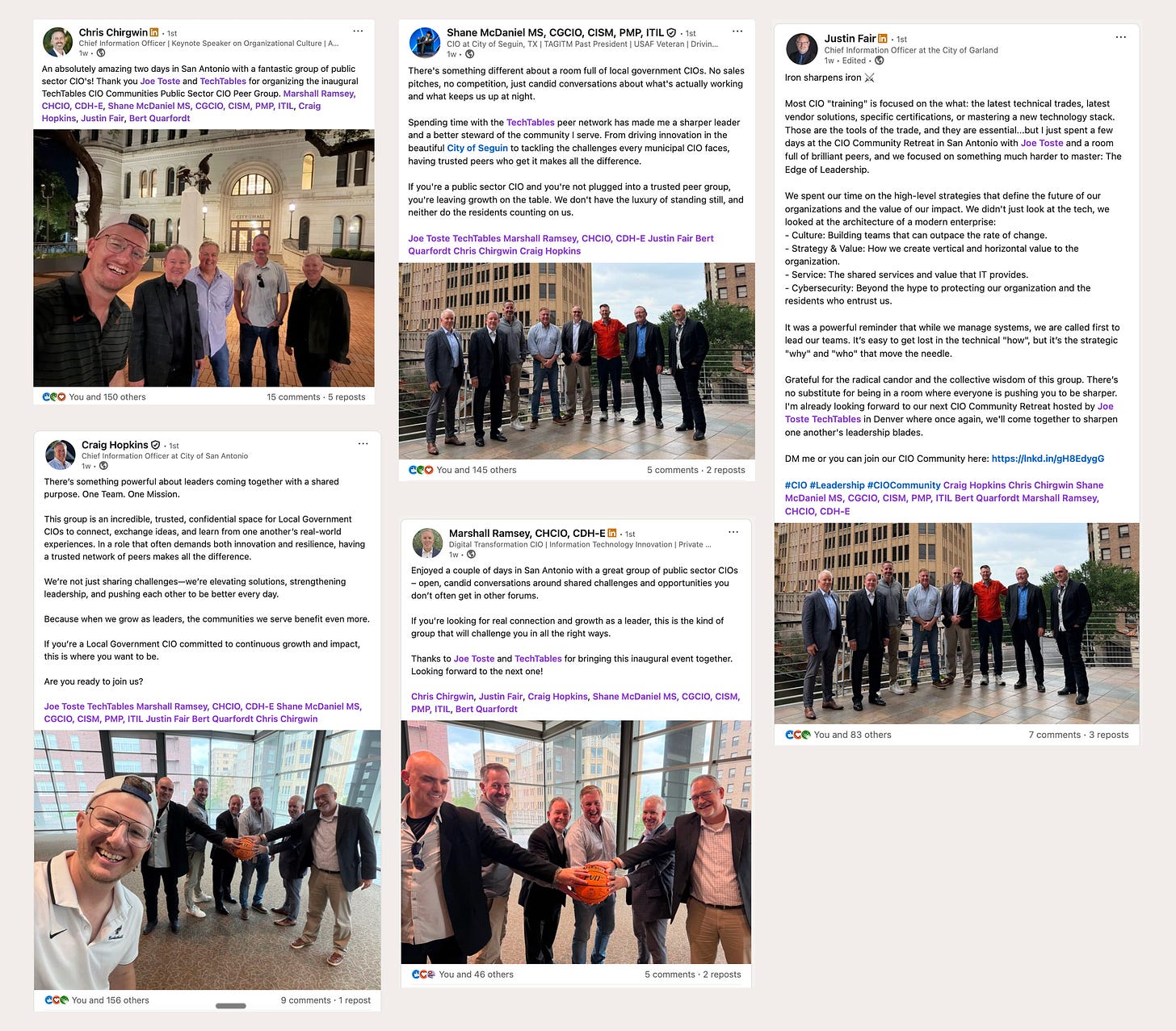
2. 🤝 Are you a local government CIO who wants to become a better leader?
Check out our high-trust, vendor-free peer group built for local government CIOs tackling real challenges, honest conversations, and an authentic desire to become a better leader — our next retreat is November 2026!
Learn more → https://techtables.com/communities-local-government
🤝 The Better Together Series (Virtual & On-Site)
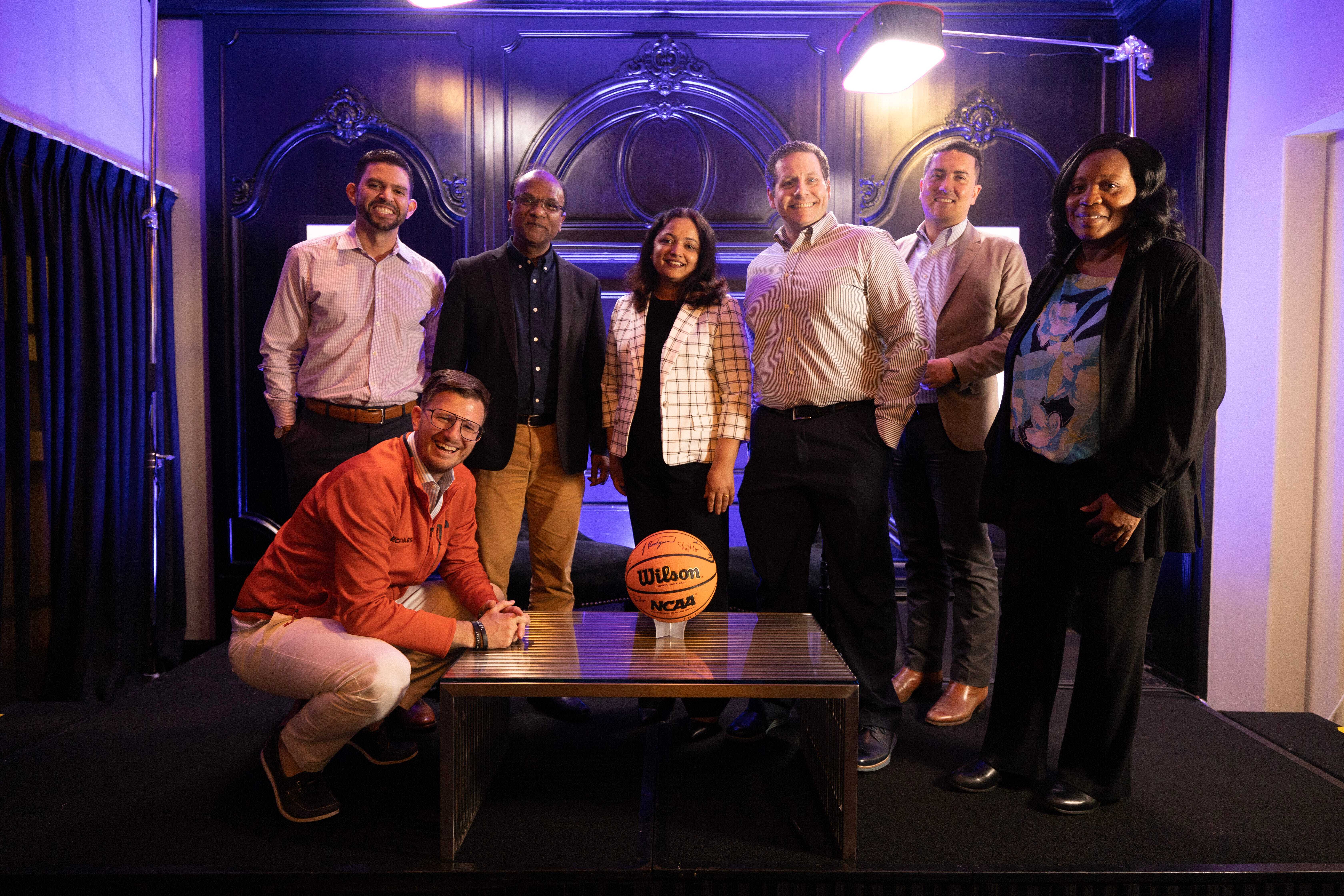
The narrative-driven series bringing together industry partners and public sector CXOs. Discover the compelling stories that unfold when we stop working in silos and start building together.
»»» Email joe@techtables.com to learn more.
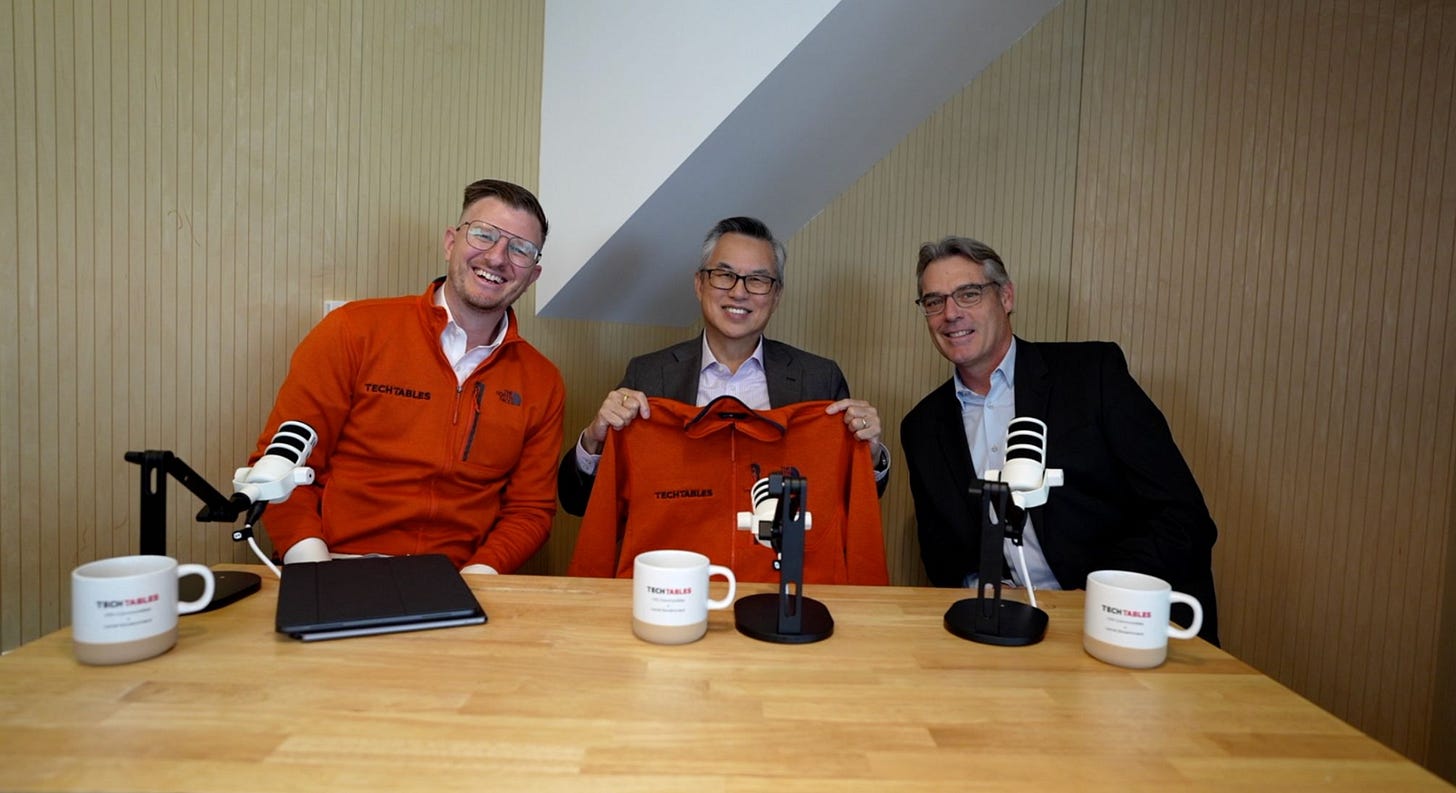
TechTables Better Together On-Site with Peter Loo, CIO, LA County & Hannes Scheidegger, Chief Global Delivery Officer at Info-Tech Research Group
Platinum Newsletter Sponsor:

Join TechTables & Info-Tech Research Group at Info-Tech LIVE 2026 - New Orleans (February 3 - 4, 2026) and/or Info-Tech LIVE 2026 - Las Vegas (June 9 - 11, 2026)!
Learn more about upcoming Info-Tech events here: https://www.infotech.com/events
Gold Newsletter Sponsor:

SentinelOne—Learn how SentinelOne empowers this state to stay secure.
Verizon Frontline—The advanced network that keeps first responders connected when it matters most.
Carahsoft—The Trusted Public Sector IT Solutions Provider™, supports government agencies and education/healthcare markets. Contact your Carahsoft rep today to access special discount pricing exclusively through the TechTables + Carahsoft partnership!
Transcript
[00:00] Welcome
Joe: Welcome to The Public Sector Show by TechTables. Super excited to have you both here today. Saby, you've been on the podcast — you are now a returning guest.
Saby: Oh my God, I must have done something well the first time if you invited me again to be on this.
Joe: I think it was the $5 gift card.
Saby: Guess what? Right here for you, man. Right here for you.
Joe: What a pro. What a pro. He thinks I'm giving that back. I'm actually going to put this in my wallet right now. So real quick for Wayne — give Wayne some context. Yeah, you're also a public speaker, that's right. Okay, tell the audience and Wayne a little context around that.
Saby: Yeah, I started my speaking engagement about 10 years ago, became a professional speaker about 3 years ago. That's fun. I love it. By them a full-time role — I'm a Chief Information Officer and a Chief Information Security Officer, that's my full-time gig. And then I get to travel around the globe and speak and do podcasts with amazing folks like Joe here and get to meet you, so it's always fun. Such an amazing side gig. I love it. And I don't know which of those is considered the side gig.
Joe: Wayne, quick intro for the audience.
Wayne: My name is Wayne Bridges. I am a Senior Solutions Engineer with Omnissa. Omnissa used to be the End-User Computing division of VMware. We existed that way from 2004 to 2020, and then we were acquired by Broadcom. They spun off the End-User Computing division, so we're an independent company nowadays. I cover State, Local Government, and Education accounts in the central US — part of a 10-man team covering all of SLED in the US.
But that's helping leaders navigate digital transformation, correct? Break it down for us — what sparked the idea, what is it, and share a story about how this has helped Clackamas Community College.
[03:04] The CARES Framework Origins
Saby: This all started in 2018. I was working for the City of Portland and my boss was the Chief Technology Officer at the City of Portland. One day he comes to me and says, "Saby, have you ever jumped from a plane?" I was like, "No." "Are you interested?" I was like, "No." "Guess what — I'm assigning you to this project." And that project was implementing the City of Portland's permit system, going on 10 years, failed multiple times. So that project I said yes to, and once we delivered it successfully, I said this is a great opportunity to help other folks understand what it takes to deliver these transformations, especially in public sector.
So that's where I started this framework. Because SCARE is when leaders are put in that role, they get scared. And sometimes they want to deliver things by creating a culture of fear, by controlling folks, and by micromanaging. And I am telling folks you have to shift that mindset from SCARE to CARES.
CARES is an acronym which stands for Communication, Adapt, Relationships, Empowerment, and Staying Calm. Any kind of complex transformation, the biggest piece is people. 84% of these digital transformations fail. 92% of these fail because of people issues. 52% fail because of communication. So what you need to put focus on is people and communication rather than just on technology.
So organizational change management is a huge piece of that. C — Communication. A stands for Adapt. We know in public sector a lot of things can come at you. How are you going to adapt? Yesterday it was Cloud, today it's AI, tomorrow it's going to be some world-ending COVID or something else. How as leaders are you going to adapt and still be able to deliver on those transformations?
R — Relationships. Relationships is a key piece for anything. How effective you are in building relationships — whether that's with your vendor partners, whether that's your stakeholders, your sponsors, your team — that's a key piece for any transformation.
E stands for Empower. If you're not empowering your team to execute on those transformations, you're going to fail.
And then my favorite one is Staying Calm. Many times as leaders, when they get into that chaos or in these complex transformations, they get scared. And when they are scared, they're going to show that energy of chaos over the team, and their team is going to go into a spin. So no matter what happens as a leader, you need to stay calm and deliver those transformations.
Joe: Yeah, I love that. That is a fantastic acronym.
[05:00] Ransomware Response at Clackamas CC
Joe: So quick followup — there was a ransomware attack a while ago. Your team had, I think, like 72 hours to respond, targeting 10,000 students' worth of data. How did the CARES framework help you through that crisis?
Saby: Yes. When I initially started this CARES framework, I thought this is for transformation. But then very quickly I realized this could be used even for dealing with any complex challenges which you're having.
C stands for — again — Communicate. How good are you in communication? Because when that ransomware attack hits, you need to communicate with the media, you need to communicate with the students, you need to have internal communication. And what tools do you have in place to make sure that you're communicating? Out-of-band communication — don't just stay with your regular school email system. You need to create something outside, because you don't know if those attackers have control over your email system and they're watching.
A is Adapt. When everything goes down — your payroll system is going to be down, your financial aid is down, and people need to get paid — there are so many things which come at you. You need to adapt. How as a leader you can adapt to those challenges is going to make or break how you go through that complex challenge or transformation.
R — Relationships. Again, going back, you have to have strong relationships with the Department of Homeland Security, FBI, MS-ISAC, your state agencies, your county, your other higher ed people. Who is on your speed dial? Who are the folks? Because FBI is great, but who are the people who are going to be right there with you? Because you need boots on the ground. And how effective is your relationship with your cybersecurity insurance provider? Because those are the folks who have the resources and the team to come and help you.
E stands for Empowerment. Are you empowering your team to work on those things? Have you provided clear direction of prioritization? Work with the business to identify what is the priority for the college. Is the payroll system more important than financial aid? What needs to go up first?
And then Staying Calm — because when you go through this ransomware attack, it starts initially with a sprint where you and your team are spending about 12 to 14 hours sprinting, and then it becomes a marathon. And it still goes on. This happened in January and we're still working through those challenges. So that's the CARES framework for dealing with this ransomware attack.
[08:00] Texas A&M's Digital Experience Transformation
Joe: Love it. Wayne, so you're helping massive university systems like Texas A&M create these seamless digital experiences. At A&M, students went from juggling 15-plus logins to a single unified experience. Walk us through that transformation — what did day one look like versus where we are today?
Wayne: Yeah. So when you look at a large university system, there's a lot of different silos of tools and applications that they're using. And in the way that we handle that, you have to have a means of bringing all those tools together into some common broker. The way we do this is to look at — first off — what are you using, how are you accessing it, where are users logging in? And in many cases it's a matter of understanding where those different identity providers, those different directories, those different multi-factor tools might be living within the system, and bringing those together in a way that makes sense. A policy-driven means of allowing users access to the resources that they need, by consolidating all of those tools — and not necessarily eliminating them. There may be a business need for a particular business unit and the school to need that particular identity provider. We see that a lot in higher ed. But being able to consolidate those and to set rules for the end users, for the customer to be able to consume the resources that they need in the way that makes sense — looking for security first and foremost, but also an end-user experience that's going to be conducive to the way that students want to work, which is typically: I want my resource now.
Saby: I would like to add to that. Because I recently had a conversation with another individual — a director of IT for a bigger university — and he was talking about how there are like 128 different departments and each team has their own tool system. I was like, what are we talking about? Hundreds of tools. So the work that you're doing is amazing.
Joe: Just want to — the quick followup I had for you, Wayne, was: we've got all these tools, all these logins, but the actual platform — how are you trying to balance that consumer-grade experience that the students are looking for with the enterprise security that everyone's looking for? Which honestly is kind of a dumb question because with the decentralized piece of the university, it's almost an impossible situation. But I'm going to ask you anyway.
Wayne: It's wild west. You're absolutely right. What we use is a two-sided tool. Think of it as a policy engine on the back end that says: if I'm accessing this resource from this network, then I'm going to do it in this way. I'm going to use this authentication mechanism to get to that resource. If I'm getting to it from a different network, then perhaps I'm going to authenticate differently. Think of it as internal versus external connections. I want MFA on all of my external connections. I want my internal connections to go as quickly as possible to that resource.
So when we look at it that way, that handles the security piece. Building those policies — the end-user piece of this is really great because it allows us to build a consolidated catalog of resources for the students, for the faculty, so that they can get to those resources in a unified — I don't want to say single pane of glass because I think that term's overused — but that's essentially what we're providing. And that may be access to native applications for whatever device they happen to be using, virtual resources that they're accessing, or the prolific SaaS apps that are out there nowadays.
[12:06] Purple Cow Leadership Framework
Joe: That's great. Saby — the Purple Cow. You knew it was coming. Purple Cow leadership concepts. I love it. So for those who don't know, walk us through what makes a Purple Cow leader in higher ed, and share a time when this was a major win at the college.
Saby: All in higher ed, we're going to have challenges — budget challenges, students not coming into the college. But still, how can you continue to provide innovative services? At the same time, take a pause and look at the team and say: what's important, what is the priority for us? Don't run after the coolest tool out there.
Let's talk about Purple Cow first. Purple Cow stands for a leadership model — a framework to help individuals stand out.
P stands for having a Positive mindset. We get about 80,000 thoughts throughout the day. About 75 to 80% of those thoughts are negative. So what you as a leader are doing is shifting those thoughts — not stopping those thoughts, but shifting that mindset to be more positive. Because if you're bringing a positive culture within your organization, your team is going to feel more connected, more productive, rather than just creating that negative culture. And we have seen that a little bit more post-COVID — a lot of teams are now talking about burnout, having mental health issues. So that positive mindset is even more important right now.
U stands for Unchain yourself. What are your self-limiting beliefs which are stopping you from achieving anything?
R stands for Relationships. Going back to when I talk about relationships — I say: do you have Gratitude, Empathy, and Trust? Those are the three pillars which help to build any relationship. Are you grateful to your team for the work which they are doing? All of us are fighting our own battles, especially post-COVID. You need to take more care of your team, be thankful, recognize and respect the work which they are doing, so that you can build that effective relationship.
Empathy is having that conversation with your team member: what can I do to make you successful? Taking that action will help you to build that relationship.
T stands for Trust. And if there is no trust, there is no relationship.
L stands for Leadership. When I talk about leadership, I say: shared leadership. How can you start asking that question to your team — hey, what do you like to work on? Maybe your systems engineer is not interested in systems work anymore because it's stressing him or her out. How can you start helping that individual? Maybe they like scripting more, maybe they like automation more. How can you work with that individual to say: what do you like to do, and how can I make you successful? So that's very important.
E stands for Energy. What kind of energy are you bringing into the team? Is it positive energy or negative energy? How are you showing up to work every day? How are you looking at those challenges — to run away, or are you looking at those challenges as opportunities and saying: yes, we can do it, let's figure out a way?
Joe: I love that. So Wayne, this made me think — with you and your team, who's a Purple Cow? How is Omnissa helping individuals stand out? You don't need to break it down by the acronym, just — who's being a Purple Cow there?
Wayne: I just ran right here, man. Yeah, I'm not the Purple Cow. I think much of our leadership is — we're out getting in front of people. We're a new brand, not a new company by any means, but definitely a new brand. And I think in a lot of cases, the company has empowered all of us really to tell the company's story, to get out there and to be in front of people, and to help us to rebrand Omnissa as the company it is today.
Joe: And now you're inside the Carahsoft booth. Just as a note — one of our primary colors is purple. Just a high five for that, man. Love it.
[16:09] Digital Branding in Higher Education
Joe: Wayne, so we talked about Texas A&M — I think you mentioned LSU on the podcast pre-show call. Walk us through how these flagship universities are approaching their digital experiences differently. And we're going to have LSU on tomorrow, by the way. What unique challenges did each of those universities face and how are you helping them navigate?
Wayne: Obviously both of them are large university systems. They're decentralized, so there's a lot of tool sprawl. We see adoption of our own products even in a continuum — there are some who are using one piece of our portfolio, some who are using another. I don't want to get into the product stuff right now, but really the way that we get them onto this journey of digital transformation and start to help them rationalize those apps and give those users the resources they need is really by onboarding them. We use this central tool — I mentioned the portal before. Being able to give those users that portal is a big piece. It speaks to customer experience. I think that is the key — you have to have that winning customer experience. You have to bring those customers in, your end users, your students, your faculty, so that they're seeing this as the means by which they consume those resources.
Then on the back end there are lots of moving parts. Maybe it's digital desktops or virtual desktops that they're bringing in, and we integrate that into this portal so that when users consume those resources they're going to the same place. The interesting note of this is that because these are distributed organizations, oftentimes there's different branding across different schools. That can be a challenge many times for organizations. But we have the built-in resources there to allow for that branding, so that I get my colors for my particular school, I'm seeing my logo, I'm getting to my homepage when I click on a link within the portal. That familiarity for the students — along with authenticating in the same way that they always have, just through this centralized marketplace — becomes a win for those organizations.
In other cases it's a matter of compliance and security. They want to lock down devices, and at the same time we're able to manage those devices. The portal application that lives on the device also acts as the agent, so I have another win there in that not only is it providing policy for me, it's providing that security on the device side.
Joe: The brand identity is such an underrated piece. 100%. Because for a lot of folks they think brand is the nice color — or it's purple. It's actually how Saby makes you feel when he gives a talk. When you come on the podcast, it's the whole experience before, it's the experience after. You end up on TechTables.com, you're in the promo video. The entire experience. It's Tim looking fresh over there right now. It's the entire experience. But seriously, even within a school and any platform, if you've just got a bunch of different disjointed experience and design and there's no brand guideline, it just fumbles the whole thing.
And we actually — not you so much — but at Seattle City Hall had a great podcast with the entire basically product and design team at the City of Seattle IT, and just how they think about product and shipping to users. And they have an entire portfolio of City of Seattle logos that are a little bit different — the mayor's got one, Seattle IT has one, each department has their own — and that kind of rolls up into the larger brand, which is so good.
I actually have the podcast named The Public Sector Show by TechTables for a reason. It used to be called the TechTables Podcast. But I may not always host this podcast — I may host several other podcasts, or other people will co-host with me. So maybe Saby — because he's so good — maybe he'll co-host with me. And so maybe there's a CISO podcast by TechTables. There's this whole kind of brand identity.
Saby: But even for colleges and universities, it's so important. It is, especially the newer generation — they have that eye for brand. If you're disjointed, they're not going to feel connected to your organization. So putting that focus in there is such an important piece. And recently I got an opportunity to get to know an organization that puts so much effort into brand that even before they hire, they have a design anthropologist. Think about that. I was like, wow, that is next level. Giving so much focus on — totally right — and providing that focus on brand awareness. It's great for recruiting, it's great for hiring, both recruiting students and faculty. But even now it's so important to have that critical eye for detail.
Joe: Anyway, thank you for sharing that, Wayne. That was super great.
[21:01] AI Initiatives in Higher Ed IT
Joe: Saby, looking at the rapid pace of change in higher ed — and you've got a front row seat, you're right there — AI, automation, cybersecurity, design, product, that guy — how are you preparing Clackamas Community College for what's next, and what are you most excited about in the future?
Saby: Yeah, I'm very excited about the opportunities which AI is going to provide us. It is totally changing the way we look at work and how we respond to work. But at the same time, it's scary to see how threat actors are going to use that to damage a particular organization. There is so much going on within any community college or any higher ed institution. But what are you doing — what are those small steps you are taking right now to help you take that leap in the future?
So we're doing small proof of concepts with an AI-based chatbot tool. Somebody has an issue — hopefully there's a self-serve where they are able to resolve that issue by themselves. But let's say if they're not able to resolve that issue, they submit a ticket and it goes to a support tech. And even before the support tech sees it, the AI has that information, looks at all the data — what's going on with that particular individual and that particular machine — and has already provided a recommended solution. It gives your tech: this is what I recommend. So all your tech is doing is reviewing what AI has done — all the legwork which was supposed to be done by them — saving so much time so that they can focus on higher-value things. That is what excites me right now.
We are also using AI for cybersecurity. Anytime somebody submits — we all get phishing emails, thousands, all the time. So every time we get a phishing email, we ask our folks: hey, forward this, or we have a submit phish button. Every time, all those emails would go to a tech person who was looking at each and every email to figure out whether that's a phish or whether that's real. That was taking so much of their time.
So we now use AI — we grab that email, run it through an AI-based tool. The AI will analyze that particular threat, provide a step-by-step process, and then also draft an email back to the user saying: hey, this is what I found — in easy-to-read English, no technical jargon — so that they can understand it and here are a few things you should not be doing. So that's taking so much of the productive time away from my support tech and freeing them up to do other productive work.
I'm very excited about automation, AI, and other things. But at the same time I also want to emphasize: take care of the team. There's so much going on right now, and there's so much coming in. What is your priority? Put that focus — work with the business to understand what is the priority. Maybe for some, a chatbot may not be the priority because student-facing technology is in some kind of a hole that's much more focused. So work with them, identify those things, so that we can make it beneficial for our end users, who are basically students.
Joe: Love that. That's fantastic.
[25:00] Closing Thoughts
Joe: Wayne, any closing thoughts?
Wayne: I'm very excited to hear what you're doing up there. It's pretty exciting stuff and it's great to meet you, Saby. I'm a big fan now. I wasn't before — I didn't know you before. I apologize.
Saby: Thank you, man. Okay, just for that — is there a $5 gift card?
Wayne: Just for that, man.
Saby: You're a fan now.
Wayne: I'm your biggest fan. Anybody who's a fan gets a Starbucks gift card. That's how we do it.
Joe: That's how we do it. Thank you for having me, Joe. This has been a highlight for the show so far. I'm looking forward to seeing how bad this came out. I am not a public speaker. Definitely excited to see the show and to tell all my friends to either look or avoid based on what I see.
Joe: This is your very first podcast on video?
Wayne: Yeah, very first.
Joe: That's awesome, man. You did amazing. So you're almost done — you're not quite out yet, but we're almost there. Wayne, who else should come on the show? Who else should be telling their story? Who comes to mind?
Wayne: I think some of these big university systems who just need the exposure of what they're doing, because they're the ones truly doing the transformation out there. They're the ones taking all of these parts and looking to make something out of them and looking to tell a cohesive story in their branding and their user experience. I think that's the right answer, and I can refer you a ton of those if you'd like.
[26:35] Shoutout: Andrea Bollinger, Vice Provost and CIO, Oregon State University
Joe: Saby, who else should come on the pod?
Saby: Okay, I'm going to tell you — I'm a big fan of Andrea Bollinger and I want her here. And the reason for that is she's the CIO for Oregon State University. There are two reasons for that. One — you're wearing the orange color, which is the color for Oregon, the Beavers. Go Beavers.
Joe: I'm not a Beaver.
Saby: Oh man. That's okay, I know — but you connect right there with the brand. That's number one. Number two — she's doing an amazing job. Recently I'm part of the SIM Portland chapter, so I'm the president of the SIM Portland chapter. We give awards like Oregon CIO of the Year and Oregon CISO of the Year. This year Andrea Bollinger won the Oregon CIO of the Year award.
Joe: I love it. She is our rock star and I want her to be here. So we've got to get her on the podcast. I'm here till tomorrow, till whatever — 5:00 p.m., something like that. Yeah, I know. This was awesome. I appreciate you both coming on The Public Sector Show by TechTables.
Saby: Thank you.
Wayne: Thanks for having us.
Joe: Yeah, absolutely. Always have an amazing time
/5S7A6587.jpg)