·
35 minute read
·
35 minute read
📬 The TechTables Newsletter
TechTables connects public sector technology leaders — CIOs, CISOs, and CTOs — through darn good conversations and peer-driven community. The best place to start is the newsletter.
Subscribe now.👇
Episode Summary
Boston's CIO thinks "modernization" is what you say when you've stopped investing. Clark County thinks AI should handle your entire move to a new city. Dell thinks you can't do any of it without clean data. Three takes. One conversation about what government services actually look like when they work.
Featuring
Santi Garces is Chief Information Officer at the City of Boston - leading a team that spans user researchers, designers, economists, and policy analysts, and currently building open-source MCP infrastructure to connect AI tools with city services at scale.
Bob Leek is Chief Information Officer at Clark County, Nevada - overseeing technology for the 11th largest county in the country, home to Las Vegas, with a strategy centered on helping large diverse communities thrive through people, process, and technology solutions such as AI governance, and drone-assisted emergency response.
Carrie Smith is Chief Technology and Innovation Strategist at Dell Technologies - covering the East and tracking modernization trends across state and local government nationwide, with a focus on helping cities start with the right problem instead of the right product.
Timestamps
(2:00) Boston's AI-powered website search - 400% improvement in positive feedback, built in-house(7:00) Clark County's AI framework - AI as a "how," not a "what," built around four constituent personas
(12:00) Dell's field view - why clean data has to come before any AI solution
(17:00) Santi's beef with "modernization" - why small, continuous investment beats the big bang approach
(20:00) Philadelphia's illegal dumping problem - how a vendor conversation became a drones-as-first-responders pitch
(25:00) Clark County drones - 30 to 60 second emergency response combined with ShotSpotter
(31:00) Boston's MCP server - building open source infrastructure so AI tools can talk to city services reliably
(35:00) The pace problem - Bob on why the universe shifting every 17 days is the CIO's real challenge
(39:00) Leadership and resilience - Carrie on stage three breast cancer, Bob on internal promotions, Santi on growing up in Colombia
Whenever you’re ready, there are 3 ways you can connect with TechTables:
1. 📬 The TechTables Newsletter
Thanks for reading TechTables! Get early access to new episodes, insights, upcoming events, and more — straight to your inbox.
Join now: https://www.techtables.com/
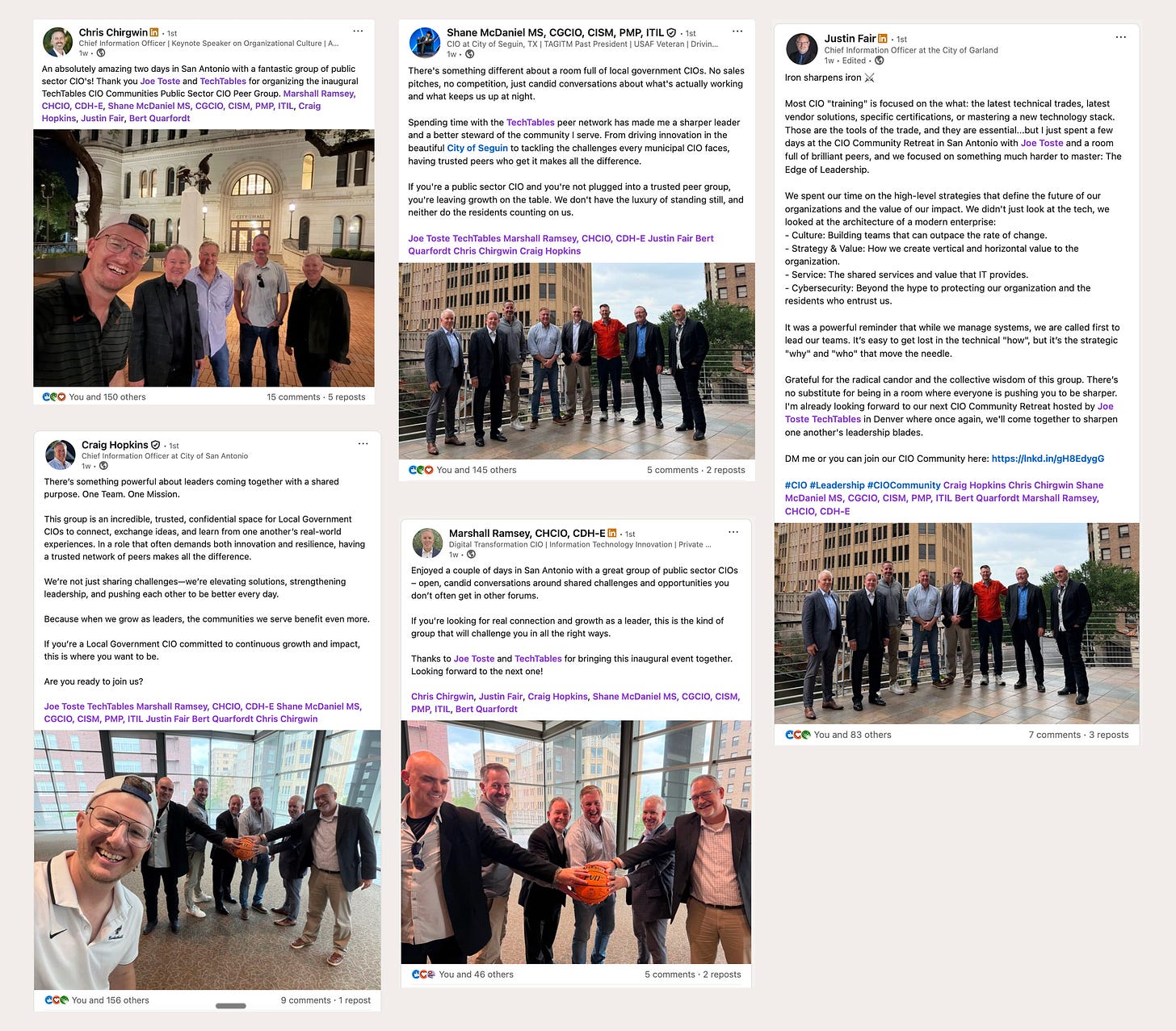
2. 🤝 Are you a local government CIO who wants to become a better leader?
Check out our high-trust, vendor-free peer group built for local government CIOs tackling real challenges, honest conversations, and an authentic desire to become a better leader — our next retreat is November 2026!
Learn more → https://techtables.com/communities-local-government
3. 🤝 The Better Together Series (Virtual & On-Site)
The narrative-driven series bringing together industry partners and public sector CXOs. Discover the compelling stories that unfold when we stop working in silos and start building together.
»»» Email joe@techtables.com to learn more.
TechTables Better Together On-Site with Peter Loo, CIO, LA County & Hannes Scheidegger, Chief Global Delivery Officer at Info-Tech Research Group
Platinum Newsletter Sponsor:

Join TechTables & Info-Tech Research Group at Info-Tech LIVE 2026 - New Orleans (February 3 - 4, 2026) and/or Info-Tech LIVE 2026 - Las Vegas (June 9 - 11, 2026)!
Learn more about upcoming Info-Tech events here: https://www.infotech.com/events
Gold Newsletter Sponsor:

SentinelOne—Learn how SentinelOne empowers this state to stay secure.
Verizon Frontline—The advanced network that keeps first responders connected when it matters most.
Carahsoft—The Trusted Public Sector IT Solutions Provider™, supports government agencies and education/healthcare markets. Contact your Carahsoft rep today to access special discount pricing exclusively through the TechTables + Carahsoft partnership!
Transcript
Joe Toste: [00:00:00] Welcome to the Public Sector Show by TechTables. Super excited to have everybody on. Bob Leek, returning guest. Super excited to have you back on to for those who didn't catch our first episode, Bob, why don't you give us the short intro.
Bob Leek: Great to be here, Joe and glad to be on with a great panel again. I am the CIO for Clark County Nevada. We have a small town that most of you may be familiar with called Las Vegas. That's inside the county borders here. And I just celebrated my five year anniversary. Here which as we know in the public sector is the difference between having retirement money and not having retirement money.
So I'm really happy to be here. Really proud and happy of all the work that we're doing here in Southern Nevada.
Joe Toste: Santi.
Santi Garces: Hi, I'm Santi Garces. I'm the Chief Information Officer for the City of Boston in well, Boston, Massachusetts. Home of the American Revolution of which we're celebrating the 250 year anniversary.
Boston's a city of about 20,000 employees. So we do public safety schools, [00:01:00] libraries public health functions and really proud to work with Mayor Wu and the great team here.
Joe Toste: Carrie.
Carrie Smith: Carrie Smith. Great to be here. Thank you for having me. I'm the Chief Technology and Innovation strategist at Dell Technologies.
So I cover the Northeast, which is Maine, down to Maryland right now. And the really important and awesome part of being a chief strategist at Dell is I get to oversee and find trends that are happening in all of state and local government throughout the country. And then we're able to really take that holistic.
Approach and look at the business and plan for the three to five years, which is extremely hard to do in state and local government. So really excited to be on the podcast and love to hear what's going on for both Boston and Nevada.
Joe Toste: Yeah, super excited to have this conversation.
So Santi, it's been almost two years since we last talked. We did have an intro call, which is awesome. So I pulled up my notes. But the world has changed so much in the last two years. From generative AI to, robotics, just the pace of innovation, Chat GPT, this [00:02:00] thing became mainstream as we last talked.
It's crazy. Catch us up on the 30,000 foot overview of the city of Boston.
Santi Garces: Yeah. I think we're in exciting times where we know that the demand and the need for services, particularly at the local level, is higher than ever. With the pressures on affordability on the ability of accessing government services are higher than ever before.
And I think that people are concerned and usually, like when things are tough, people turn. To their cities and to their mayors to get support. Demand- higher than ever. And on the flip side, what we've been trying to do is build, figure out how, so that we leverage all of these kind of innovations that have stacked over the past 20 years or more and be able to deliver government services that try to catch up to that need.
We've been building a team that is much more diverse in skillset. So we have people that are user [00:03:00] researchers and designers and economists, people that are evaluating public policy and also leaning into the fact that we have tools like obviously all the, cloud services, low-code, no-code solutions.
And then lately AI, which allows us to do some really amazing things. Like for instance two weeks ago we went live with AI search in boston.gov, which. Improve positive feedback by almost 400% compared to the traditional search. And it cost us roughly the same amount. And it was something that we had first built.
We had built the integration in-house, put it in one page, learned a lot of lessons, took it to the top 50 pages, and then we finally made the decision to go to production. But we see that across the board where we're moving forward and then finding new ways of. Doing our work and hopefully delivering a better experience for Bostonians.
Joe Toste: Just a short follow up that I was thinking about. 'cause I had this conversation, Bob and I know with Richard McHattie at in Maricopa County. Where do you [00:04:00] think your vision for the website is gonna be in the next five or 10 years? 'Cause right now, a lot of times, and I like where Boston is going with this, you go to a government website, you have to click around and do a bunch of stuff.
It seems like you're already starting to move away from that. What is your, longer term vision for how Bostonians consume services?
Santi Garces: So the funny thing is that there's a big overlap in things that we were already doing and the things that we know that we need to do. For instance, if you, so the obvious trend is that increasingly a larger number of volume to our website is coming from AI tools.
Doing searches on our tools and potentially trying to interact and initiating transactions or trying to do transactions. The thing that we see there is the same gaps of quality that impacted constituents, like not having accurate content, not having complete content
not having content that is not accessible. So if you have a visual impairment chat, GPT is [00:05:00] basically like a screen reader. So if you don't pass a WAC hack compliance test, your website is probably not very good for robots to go and scan either. We see a world in which so much of the fundamentals of so like we've one of the things that was, it is funny.
Directly tied with AI, but we ended up passing the first archival policy for boston.gov because we. But it initiated with the AI search because we were finding out that we had all these content that was getting retrieved that was out of date. And we had to put a little bit of human software in and improving our management practices.
But by virtue of doing that, we've also created much more, storage space to be able to do AI translation for all the content in boston.gov and caching it, which is less expensive and more reliable. So anyways, I think like the general trend is yes, there's going to be more traffic from computers, but there's a lot of fundamental things that we still need to do and things, and some people are not gonna have AI to go and interact with our website.
I think [00:06:00] that we can go and build websites. And government, digital government services that are excellent for both computers and people. And then later I can tell you a little bit about what we're doing with MCP servers. We've also been very deliberate about starting to build this next layer of interface that allows AI tools to be able to interact with government services in ways that are reliable, secure, scalable.
And that's I can tell you a little bit more about that as well.
Joe Toste: Yeah, thank you for that overview. That's really, I am both a consumer of services and I also own a small business, so I also consume business services in the state of California at least and the federal government.
So I'm constantly keeping my eye on how I get to consume services across local government, state and federal. We are gonna jump into the MCP. I did catch that. So we're, we'll dive into that in a second, but I did wanna jump to Bob. Bob, so you came on episode #214, shameless plug.
We will link to that in the show notes. And last time you had talked about I think it was, correct me if I'm wrong, you had 20 AI pilot projects going on. I liked how you were, I brought this up how you were framing AI as [00:07:00] a how and not a what. Catch us up in the last six months or so.
Where are we with Clark County?
Bob Leek: We continue to work through both pilot efforts proofs of value. Then we do have a couple of things that we're working on that are really gonna be based in AI driven capabilities. And much like what Santi was saying and that's where my phrase came from that AI is a "how" and not a "what" for us.
We're not "doing" AI. We deliver hundreds of different services to the public. We wanna apply AI as a technology to that, but also rethink the tradition of how we've organized how the public interacts with us. And I've talked about the key four personas that we're centering our design and architecture around with our own employees, first and foremost creating a great place to work having our employees be as productive, effective pulling friction outta the process.
Applying AI to the work that we do. But with visitors, with the over 50 million people that [00:08:00] come through Clark County annually really rethinking what that interaction's gonna be for them together with Convention of Visitors Bureau the large resorts. All of the things that can distract people while they're here visiting.
And then the two main constituent groups that we provide support for being the residents, people that live here and being business owners. And so the pilot efforts that we have been working through are trying to put in place the foundational components of that. Obviously working with our data making sure that as these engines come to life, that they're appropriately and transparently using the data that we have that we're using AI in, in ethical and productive ways through our AI policies.
I think we're at the same place and that I find a lot of my peers around the country. And we do a lot of sharing with each other. I've been in a couple of different forums and we all talk through what it is that we're all working on and we're all tackling this, I think, in very appropriate ways.
And [00:09:00] trying to share lessons learned whether that might be some tools that we've tried. That haven't panned out, or some use cases that we did that we found were more difficult than we thought they were. A little bit, I, I guess the term might be pre-mortems. So before, before you have issues talking with each other about the work that we're doing.
And we've also implemented an AI governance group. It's through our county manager's office. Because using AI as a how it's really important that we don't just take on whatever's right in front of us that we need some governance and prioritization of that. This work is not free.
It costs both in terms of people, resources partners and then tools. And so we want to be very thoughtful about how we're pursuing the path related to bringing these technology and new and emerging technology capabilities to life. Probably one of the things I'm most excited is there's really three.
One is translation services. There's a lot of languages that are spoken here in Clark County and AI [00:10:00] driven translation services. I know it's not gonna be in all of our phones. I had predicted that by the end of 2025 I know that you can get those, the earbuds from the various organizations the beats and and the consumer grade products.
But embedding it in your phone and everybody walking around with a universal translator I think it's imminent. But at our countertops and with our board meetings. We wanna make sure that we're meeting people's needs related to that. And so that's a big pilot that we've had going on, that we're turning into more operationalization.
And then much like what Santi was talking about, rethinking the website we know that a website and and then a mobile optimized version of that is always gonna be an important initial contact point. And I'm thinking about, you Joe, as a small business owner, if you were to ask your AI engine.
I wanna start a small business in Clark County. How do I do that? That's what the AI is gonna try and do for you. And if we haven't tuned our services on our side of the world to make that AI agent work [00:11:00] with our AI agents, right? That that through some interaction, some prompting and some bidirectional data sharing.
There's nothing that says we couldn't help you start a business in a matter of a couple of hours rather than. Whatever that experience might be for small business owners today we know that's what the future looks like, and we're centering all of that around what we're calling life events.
So what is a, what is a life event? I just moved to Clark County, help me become a resident. An agent should help you with that. I wanna start a small business. That's another great example. I wanna expand my business. That's another example of a life event. And so when we rethink the interactions from transactions to more cross organizational life events I think we're gonna unleash the power of local government in a way that people expect and frankly deserve.
Joe Toste: Yeah. Thank you. And. If you ever start a small business this is a great, before COVID, I had to go walk into. I had to go walk into and wait in a line process [00:12:00] my documents and and then during COVID, I was even emailing them, you need to get online payments up, right? No one can pay you money.
You are not receiving any income. The city is not receiving any money. So I think things are changing. I do actually. I'm friends with the, we don't have the city of Santa Barbara does not have a CIO. It's just too small. The county does, but the city is just too small. We have an IT director, so shout out to Justin Cure.
He's a buddy of mine. I always tell him I was giving him a hassle. Hey man, I don't know when trash is. Trash day's coming. And so I remember that getting on the website. He launched a new website. And but shout out to him.
So Carrie, not a CIO at a city or a county or local government but you're walking into all of them, very much like me.
I just cruise around the country interviewing senior technology leaders in public sector. From that seat, what are you seeing right now in 2026?
Carrie Smith: Modernization, I think is, and that's multifaceted, right? But I think it's, and I loved both Santi and Bob both touched on this.
We've been having so many conversations with their peers across the country and. We will [00:13:00] go in from, right? From a vendor perspective, we're going in and saying, look at what our technology can do. Look at what our solutions are going to solve for you. But in this role as a strategist, we're given the opportunity to take a step back and say, I see some of their eyes just, bugging out.
Whoa. We're not even close to being ready for that yet, right? Because, because our data's not ready. And so then it's a totally different conversation. And esp I love how Bob said that. And he said it on our on our advisory board as well with and it was tremendous.
It's not a, it's not a what, it's a how are we going to do this, right? What services is it going to enable and help that's going to have citizen impact? And I think that's what we're really trying to get and hit home from a Dell perspective with our, refocus and verticalization. State and Local government, Higher Ed and K-12.
It's different across the board, but it's all, it all has to start with clean data and if I give these tools, right? These AI tools, bad data or [00:14:00] old or stale or not up to date. What is that solution really going to provide to me?
And then that time that it takes for not only her team the vendor, all of that could be months worth of investing in a solution that the solution could be tremendous. But if what is being inputted into that solution isn't, or it's not accurate and not up to date, then we're not going to really have the.
Ultimate out outcome that the city or the state is looking for. So I think that's been a great learning lesson from my side and something that I hope that the partner from a vendor community perspective can really take a step back and say, wait a second. And also, furthermore, with that, we were having another conversation with a very large K-12 school district.
On the East coast and they said, this is great and we want it, but the 30 guys that are going to be working on this don't have any training or any idea of what this is, right? So [00:15:00] now how do we get that layer? So I think that's, that also comes with modernization. These tools are new. We can't just assume that everyone that's going to consume it from an IT perspective understands how to work it.
So I think there's, it's multifaceted and I think there's different layers to it, but modernization from that and from the data I think has been, a massive impact on how we are bringing these solutions to market and making sure that it's a holistic play. We're starting from the get go. Let's start with your data.
How do we prepare your data for a solution like this? That, I hate to use that term reverse timeline, but we have to start from the foundation level, or it won't be a success. And then the user perspective is going to, that impact is going to go down as well, right? And we always want happy customers and we want the solutions to work, but I think oftentimes we take that step too soon and we really need to be in the trenches with the cities and the local governments to be able to say, here's what's going to make this a [00:16:00] positive.
Impact on your organization and the constituents within your county or city. So that I think is a huge part.
Joe Toste: So Carrie, I am going to save you right now. I'm gonna save you. That was great. I'm gonna save you though 'cause I read a post on LinkedIn by Santi, how much he does not like the word modernization.
Carrie Smith: Oh, no,
Joe Toste: I, yeah, I was I thought about stopping you at the beginning, but I was like, you know what, I'm just gonna let her go. Maybe she'll change his mind. Santi, do you wanna tell us about that, but give us a little context and flavor around that?
Santi Garces: Yeah, I think. Look, and obviously in LinkedIn is where my provocative thoughts that I, that, that come to my brain at 11:00 PM at night get manifested.
So I look, I think my issue is. We have several large modernization projects, so it's the title of, and we, the mayor just passed a big modern technology modernization executive order in October. So for whatever it's worth, we can't help but to use the term. But for me it gets a little bit to this challenge of so much of what we say needs [00:17:00] to be modernized.
It needs to be modernized because we haven't been investing in the right resources to be able to keep it up. Like we either have gone to architectures that are monolithic and are difficult to change, or we just didn't put the resources to upgrade and to replace a system. And we know that again, we end up accruing massive amounts of technical debt and the, these holder technologies become more expensive.
But somehow, like we feel that. It is the appeal of these dealt this large step function in an investment that is oh, this is gonna be saving us. But the problem is like when you get used to those like big modernization initiatives, you probably don't wanna spend money right after that. So like you go back to a cycle where that thing that was new, like everything that we're replacing that is like all that needs to be replaced was the thing that was mo modern some time ago.
So it's I think that it is, for me, it is more about it is better to spend a little bit of money all of the time and doing it in a way in which you're always trying [00:18:00] to keep up, rather than waiting to the point that you need to do these like super expensive projects where the scopes blow up.
Like you just end up like trying, because at that point you're not just replacing the technology, you're, you've starved the organization from the things that it needed for so long that they're just trying to go after everything. And that makes those projects more expensive, it usually makes it more risky, less likely to succeed.
So that's my beef with modernization. It's not that it is bad, it's just I think that it becomes a little bit of a cop out for people to not do the thing that we know that is a little bit more boring, but the right thing, which is like invest a little bit all the time, fixing small things instead of just like overpromising this like large scale renovations because, there's so many opportunities to do things well and again, I think that's where there's so many technology patterns now that allow us to modularize, to break things into smaller components that allow us to get a bigger bank for the buck, for much less of the cost. So that's my not no.[00:19:00]
Beef with what Carrie just said.
Carrie Smith: I love it. My point, right? It's like it has to start with the foundation and I think having the, the AI conversations, it's, they've, it's coming to light how behind organizations are so exactly Santi's point, right? It's ooh, we probably should have updated that system like, five years ago, and now we have to do not only that system, but three others to even be able to do a POC for this AI concept. So yes, I 100% agree. But I think this time has really shed some light on that and hopefully it will get more too. You should always have the smaller projects and be keeping up with the modern trends because Santi said, at one point, whatever they have was the modern and the flashy and the new thing out there.
But if that was five years ago, obviously things have changed.
Joe Toste: Carrie, when we met you had talked about the city of Philadelphia. Can you just keep going and tell us a little bit more? About the city of Philly, the illegal dumping, the happening at 2:00 [00:20:00] AM kind of everything that we were just talking about.
I, I hate to use that word now. I'm thinking, what other word am I gonna use besides modernization now? It's just calling to me right now, but yeah, I'll you take it from there,
Carrie Smith: yeah, absolutely. That was a really interesting meeting, right? There was a lot going on. We have a lot of upcoming events.
That for cities and Santi will know this better than anyone with the World Cup coming. A lot of the conversations that we're having is like, how are we preparing, how are we getting ready? And these are the trends . And again, from a vendor and a sales perspective, that's a great conversation, but I just.
Felt like there was an underlying thing that we weren't getting to when we were having this meeting. So I said, let's take a step back- what's your biggest problem right now? Not that you think Dell can solve, what is your biggest problem? Just talk like we're talk, like we're a technology consultant and the response was illegal dumping.
We don't know what to do with it. All of the cameras that we have, right? The few that we have deployed, it's 2:00 AM there's mud and [00:21:00] dirt all over the license plate. We're not getting a good read. And at the end of the day, this is causing fires. And now we're having EMS issues, right? With, the fire department getting involved and arson and everything else.
And it was, it just was becoming such a large issue that it brought. So many opportunities to the table to be able to start talking again about some other cities and what they're doing. And we actually were able to tailor that whole conversation into a drones as first responders, what are they doing around there? Why would you start that? What other cities are doing that? There was another very large fire department that had 26 water rescues via drones in 2025. That's a pretty significant number. So just trying to use the technology to help. He had no idea that's where we were gonna go with the conversation.
But I think branching out and really focusing on what the problem is, and this was a point on the whole, AI and foundation and figuring [00:22:00] out, instead of trying to find a use case to sell to or to fit, here are all the use cases for AI. There's a billion right? Instead of that approach, we've really been trying to take what are your underlying problems that either you just can't solve or you're just not getting traction, or it's something consistent, you don't know where to go.
Let's start there. Instead of trying to fit into, these are the use cases, pick one that you think is the most valuable to you, right? All of them are going to be valuable, so we're really trying to swing the conversation to what is a problem. We might be able to help you solve by using AI and or, another, like a drone as first responder, right?
That was a really tremendous and I think groundbreaking moment for us to be able to hear that and have that type of conversation with them and really understand how we can take they. They're lacking in so many different areas from a technology perspective with that problem with illegal dumping.
But then we have to really, take it back and [00:23:00] say, what do you have in place and what is out there that might not be something that Dell can sell you from a solution perspective. But we also have many partnerships, right? And that's why. Having such a broad conversation, not only are we trying to solve for that problem, but I said if we solve for the illegal dumping and we institute some solutions for that, what other future events may we also be proactively solving for at the same time?
So not just trying to solve one issue or one use case, right? Really understanding holistically how we can get these and it's going to impact the future state of these cities is, I think, important because again we tailor all back, right? It was modern at one point and it's not going to be in two years from now.
Joe Toste: Thank you Carrie. That was great. Before I forget, I wanted to link, I'm gonna link a series in the show notes. It was just reminding me of what I was prepping for this episode. I was looking at the city of Boston. I know that Santi's also been hiring. Like the Chief Product Officer, folks like that reminds me a lot of the city of Seattle.
[00:24:00] And their structure with my outgoing friend Rob Lloyd who actually hired me for their Seattle Learning Conference last year, but I think there's a lot of similarities between Boston and and Seattle right there.
Bob, I did wanna jump to you. We talked about the language translation at length in our first episode. I thought that was actually really great. I actually had a number of folks reach out to me that did not know that.
I think it was, outside of English, I think Tagalog was like the number one language in incredible. But I did wanna jump to the digital twins, the drones. I was watching several YouTube videos last night. I know a lot of it was more like Las Vegas P.D., but I'd love to hear where the county, how the county is.
Just thinking about that right now.
Bob Leek: It's interesting being on the inside and knowing all these complex structures around local jurisdictions. We partner very closely when it comes to law enforcement fire and fire prevention emergency services. They're all county services and sometimes we, we flag them and brand them with the local cities because we know that people make connections with their local with their local [00:25:00] government. Metro is the law enforcement agency. Las Vegas Police Department is one of the brands within that, along with the Sheriff's office and so forth.
And I know you had shared with me that you had seen that here we have deployed drones in small little landing pads spread geographically throughout the region. Because the idea is to get eyes on a scene within 30 to 60 seconds, right? It still takes some time for a law enforcement vehicle to make their way despite, the, essentially the massive thoroughfares that exist everywhere and average speed limit close to 50 miles an hour around most of the region.
But if we can combine some of these technologies like Shot Spotter, right? That's something we've deployed years ago along with a drone that when a shot is detected and a drone launches autonomously and ends up on a scene in 30 to 60 seconds. We are fulfilling our mission. And we're very careful to say that's not surveillance, that's emergency response.
And combining [00:26:00] all these technologies together and doing them exactly in the line of what Carrie was talking about, where we tend to we do talk about problems, we also talk about opportunities. What's the greatest opportunity that we have to respond to an emergency situation in a timely way? That's a mission we already have. So this isn't, we're doing AI to do a mission that we haven't had before. We're applying AI and applying new technologies. And I was very careful to not use the word modernization in that last sentence, but to apply all these new technologies. So that we can fulfill our missions.
I have talked many times when people ask me what's the ROI on a particular technology investment? And sometimes my response is there's not really an ROI, there's an ROM, right? The return on the mission. So what is the mission that we're trying to perform? How do we measure the success of that?
And this I think is where Carrie was going as well, is for everything that we do, there is some metric associated with that. We don't just do government [00:27:00] services because that's there, there's no intended benefit. Whatever that benefit happens to be. So we would call those business outcomes. So when we start with a business outcome and we look at an opportunity to improve those outcomes, how can we apply technology to that?
And the advent of AI is making that really much more accelerated and much more creative than we've been able to do in the past. And so the things that I'm really excited about when it comes to all of that is really around. I think I've now been in local government for 12 years between Multnomah County which has Portland, Oregon inside of its borders and now here at Clark County.
And I've watched the availability of technology come to light for local government in a way that now those of us that are in local government, it's just throw it at us, let's go. Find out what those operational issues and opportunities are and then apply technology to that. And so we flip the script with most of our partners, and Dell is one of our big partners as well.
Where instead of me listening to a presentation [00:28:00] about all the capabilities that an organization has, I come to the meeting with our technology strategy, our seven strategic imperatives, that the county manager and the elected officials here in southern Nevada have come together around our three pillar strategy around public services department capabilities and having a great place to work, and the roadmaps associated with all of that.
And so what I say is, this is what we're doing. How can you help us? And it flips the script with all of our partner conversations into so much more. Of a enabling type of a model where in order to achieve those business outcomes, whatever that improvement is, it could be lower cost, it could be less friction, it could be more productivity, it could be more effective services.
Whatever those business measures are. That's what the conversation that we're having with all of our partners. And because things are moving so fast, let's say a partner can't help us this quarter I'll meet with them in 90 days. And evolution and progress would've would've [00:29:00] occurred. And now maybe there's something for those partners to help us with.
So it's really flipped the script on its head. Instead of having to listen through a lot of capability presentations from the partner, it's, here's what we are trying to solve. How can you help us? Great. Let's invest in whatever that assistance may need to be. And I think the last thing that I am rounding out around this is.
Rather than also have to replace our transaction systems because we spent tens of millions of dollars on transaction systems we are fully capable of processing any transaction digitally within Clark County. We don't have to replace all of those if we take an opportunity to build this kind of portal methodology.
And through modern data practices, through APIs that are available in most solutions through an architecture that's scalable and cloud-based we can keep all those transaction systems and create this great branded experience for people interacting with us and have those handoffs happen [00:30:00] behind the scenes.
Not just for our own services, but what's really exciting is we can do that downstream to the cities. Upstream to the state, and I know I know you name dropped Richard McHattie and the folks in Arizona, they're doing some incredible work in Arizona for, the millions of people that live in Arizona to create this great experience for their interaction.
We're gonna, we're following along and we're learning lessons from their deployments and the work that they've done. And I've always really admired what Boston has done for years and years around open data resident and citizen access to that data, their service models, where they publish what their metrics are.
We can all learn from each other and I think that's the beauty of being in government is we're not competing with each other. In fact, if we're competing for anything, we're competing for recognition and winning prizes about the great work that we're doing.
Joe Toste: I love that. I love that.
Santi. I wanted to give you some time to dive into the recent MCP.
Santi Garces: I think that this is one where again, [00:31:00] to be innovative I don't think that you need to go and throw out, like start from scratch. I think like figuring out how, so that we make things that we already have more usable is a great place to start. So that was a little bit of the provocation around September of last year, we've been working on building some internal AI tools, so basically building like web exposures for LLMs.
And one of the things that we realized as we had conducted a survey of our employees around how they use AI and what they thought would be useful analyzing data is really high up in the list and. We started to try to figure out has it that we solved that problem, has it that we can make it more reliable, more secure, and easier for people to use AI tools to analyze data.
And we realized that there's a big disconnect. So we have all this data, we have all this data in the open data portal. We spend tons of money to pull the data up like all these automated ETLs, but open data is one of those services that is like underutilized. [00:32:00] And we started and again to some extent, this is also the part that is interesting.
I feel like sometimes we feel like government is behind, but, things like MCP- So MCP stands for Model Context Protocol. And it is a thing that was invented by Anthropic, the people that made Claude last year. And even over the past year, it's gone over some really serious iterations that has made it actually much easier for you to deploy and to connect to these things.
But anyways, so we're trying to figure out how, so that we connect people with this great resource. And we started to try out building these MCP servers as the interface, the intermediary, that enabled people to access this resource that already exists with these new tools. And we're super excited.
It's we've been doing a lot of research and development on the tool we have, we have some prototypes that are, they're working and we've done some refinement. And then our goal is to release this new MCP. A project for as open, as an open data as an open source project in the [00:33:00] next few weeks.
And we've been able to build it in a way that accommodates all three of the major open data providers. So CKAN, Socrata, and RGS Hub, Open Data Solution. And we think that this is just the beginning. We think that this is, the right pattern for us to be able to have governance and to have more control around, like how these AI tools interact with the city.
Basically at the heart, what an MCP server does it, it specifies. What does the language, like LLMs are tools of language. They just they're talking like in English or whatever language you want. So it starts defining what is the language pattern, like what, what would trigger a particular tool?
What is the type of information, like what are the arguments that would get extracted from the tool? And then it actually has the prescriptive API call. So it's actually, again, I think for me, a lot of times it's it's not about rethinking how is it that we would like. With a clean slate, how would we do government?
We already know what we do in government. A lot of times it's like, how is it [00:34:00] that we make it more convenient? How is it that we make it more reliable? How is it that we make it faster? And we definitely need to get ahead because again, there are these like changes in patterns, how people are interacting with government.
And I feel that if we're not inventing what the future looks like, we'll be left behind , and we have a unique opportunity where not everybody's at the same starting line. The private sector, the public sector and these are things that are, anyone can go and figure out.
That's why we build our MCP server. We figure every, any, if anyone can build one for us, we might as well go and try to build ours first.
Joe Toste: That's great. I hopefully I can test that out in the coming weeks. I am very geeky and love me some Claude We'll leave that for another discussion. I was kind, curious, I know we're coming down to our time.
Bob, I was curious, what's one issue or trend that you're dealing with right now, that you suspect other CIOs across the country are also facing?
Bob Leek: Oh, wow. To boil down what I deal with on a day-to-day basis to one. Just one ju just one. Just one. Just one. [00:35:00] Yeah. I think a macro trend would be finding that balance between pace and effectiveness.
I think we have to be really disciplined in what it is that we're taking on. And and I do think that technology is moving very rapidly. I had a peer of mine reach out. I'm gonna, I'm gonna make it precise about 17 days ago and said, with the latest release of Claude that the entire universe has now shifted.
And I thought to myself, wow. So on this day, in 2026, so 17 days ago, the entire universe shifted. Should I be worried about that? And then, what is my role and responsibility related to trying to figure out, so where did the universe shift to and what should I be doing when we have, we have millions of dollars worth of work that we're, that we have underway and one could go curl up in the corner in a fetal position and think, oh my gosh, in, in my role with a very large county, right?
Clark County's the 11th largest county in the [00:36:00] country. If the universe shifted, what is that role and responsibility, and then how do we keep up and what does keeping up, mean and look like? And so I think that one trend is that the pace has gotten just so accelerated, but we have to remember that at the end of the day we're delivering services to the public. This morning our treasurer's desk opened and people are paying, their property taxes, which are all coming due by the end of the month. And we love it when people come in earlier in the month to take care of that versus the long lines that we see, at the end of every quarter. But every person I see in line, I'm thinking to myself, why are they even here? Why aren't they doing this online? Have we made the online transaction a worse experience than coming in person? And so the pace of change coupled with the availability of technology where we're still thinking through how do we provide services on a day-to-day basis? That intersection is the macro trend that [00:37:00] since you forced me to answer it with one that's what came to mind for me.
Joe Toste: I love it. Santi, I got the same question for you. What's one issue or trend you're dealing with right now that you suspect other CIOs across the country are also dealing with?
Santi Garces: I think at the highest level is like rethinking what the CIO's role is. I think
Bob Leek: yeah,
Santi Garces: to some extent I'd imagine that when CIOs first started coming around and like ERPs were the thing, like with the being a CIO felt really innovative and felt, like we're gonna go and transform the way that the city works.
And then I think that over time that you probably feel the CIO is more of a defensive role where you're like, it is so hard, it barely, we can barely keep our telephony up and running and the payroll systems crashing. And I think that it is easy to fall, to be overwhelmed, but I think to some extent, there's so many of these of having chief data officers, chief digital officers, and to some extent I think it's because CIOs never like.
For different reasons, a lot of times for good reasons. We [00:38:00] just felt a little bit of despair and we felt that our job was to protect the city from change instead of enabling it. And I think that is a piece that I feel like there's ways in which you can do it without too much money while being responsible of the risk.
But I think that going back and realizing that you have a really exciting and unique role within the organization, that you're in a unique position to enable a lot of people changing the way that they do their job in a way that is really positive.
Joe Toste: That's really great. So you talked about, change, not requiring a whole lot of money.
One of my favorite quotes it has to do with leadership. I talk about leadership quite a bit on the podcast. Not so much on this podcast, but we'll round it out with that. I also coach high school basketball. These are actually signed by CIOs, not by new professional athletes. And actually Richard McHattie signed one of these balls when I came to Arizona.
So when the leader gets better, everyone gets better. I say this kind of quote quite, quite a bit, but I love that when the leader gets better, everyone gets better. That doesn't require any money at all, right? And so as we round this out, Carrie, I'd love to round [00:39:00] with you something personal that you shared.
And my wife was like, can you even share that publicly? As I was like as I was going through the podcast questions, my wife works behind the scenes. She helps me out and I run ideas by her. But so you were diagnosed with stage three breast cancer. And then two months after returning from maternity leave came back.
You won President's Club that year. I was curious around, what did you learn? What leadership lessons did you learn around, it could be performance, resilience what, how did that experience help shape your leadership?
Carrie Smith: Two big things. One is everything is temporary, the good, the bad, and everything in between.
So I actually use that phrase quite often in some motivational speeches that I do. And I teach my kids that too. I. We're in sales, right? So we wanna win the deals we want, right? But everything is temporary. So if some, if we don't come out on the winning end of, an opportunity we've worked 2, 3, 5 years on, there'll be another opportunity, right?
With that same [00:40:00] customer or another customer. So from a career perspective. The second huge thing that I do both professionally and personally is control only what you can control. And that was a significant shift for me. I would work constantly but I love it. I loved it then.
And when I called my VP and my director at the time, I said. This is what's going on. I plan on continuing to do my role as long as I can. And if, and when I can't, I will tell you that I wanted my career was the only thing I could control in that moment when my entire life was out of control. It brought me a sense of peace.
Feeling like, okay, this is something I'm going to go through. And then at the end of it, I'm gonna learn so much about myself and other people and what I can really do. And I have a three-year-old and a six month old, and I have to fight to be here for them, but I also want to show them that. This is life.
It's ugly, right? But that [00:41:00] phase was temporary. I will forever fight. My fight is not even close to being over, right? But I get the chance to continue my fight. I'm still here, I'm still present. I get to be at their graduations and I get to come to work every day and do something I love and talk to people that I learn from.
Every minute of every day. And so I think, when I used to rush back to answer work emails at nine o'clock some days, do I still do that? Yes, I do. It's just in me, right? But I've also taken a step back and said it can wait if I'm overtired or if I just got, one of my shots the day before blood work and I'm not feeling well.
Allowing yourself to control what you can control. I can get to that tomorrow, right? I don't need to do this right now. And the feeling of defeat is temporary because tomorrow's a new day. And we're all still here. And we also have the opportunities to turn any situation around to a positive.
Joe Toste: I love that.
Thank you for sharing your story, Carrie. It means a lot. My mother passed away from [00:42:00] stage four colon rectal cancer, so I know that very personally, I think as a lot of folks do. In the public sector might not happen on camera, but when I text and have breakfasts and coffees with people people do have real lives.
It's a shocker, right? You're not just a CIO. People have real lives.
Santi, you grew up in Columbia, right? Watching I was reading this on the bio. Tell me if I got this right, but the government nearly collapsed which probably shaped how you actually think about how government can deploy services in the US today.
How did that how did growing up in that environment shape the CIO that you are today?
Santi Garces: Yeah, I think, look, I grew up in Columbia in the nineties when there's a lot of violence and the majority of the country was not controlled by the government. There's mass kidnappings, people getting killed in in bombs and terrorist attacks, and to some extent, the part that I'd say unfortunate is that I feel that my adult life, the world feels as uncertain and as scary as it was when I [00:43:00] was a kid. And but I think that it taught me a couple of lessons. The first one I think is, what we, for me is let's call it government, but is like this shared experience, the shared space that we have is a thing that is worth investing in, that we could live in societies where people are not afraid, where people are less, just trying to fend for themselves and where you are just, and I think that, but that takes a lot of intentionality and the easy thing is to go and try to build a world that only works for you. And I saw that things started to get better when people said, enough is enough and we need to go on and build a better world.
I think that it also, being an immigrant taught me to know what it feels like to be on the outside of the system. And also and I feel very lucky and proud to be an American citizen now, but I think that understanding that that path and the journey is really difficult and scary but yeah, and I think a little bit to what Carrie said is like you learn how to control the things that you can [00:44:00] control and how to keep focus on the things that are important. But I think that piece is , this idea that we could collectively build something that's better than what is happening right now.
Joe Toste: Thank you for sharing that.
Bob, round us out. I know we're at time. Something in our last podcast episode you had mentioned was the 33 leadership roles were filled through internal promotions. I don't know if I got a chance to ask you your leadership journey and why you thought that was the best outcome for Clark County.
Bob Leek: I think every one of us, we all started somewhere. I too am an immigrant. I'm from the Netherlands. I was four years old when we moved to the United States. So I've, my formative years have all been here in the United States and.
And I think each of us has our journey, right? Our lived experience. I grew up in the mountains of North Carolina, Andy Griffith's hometown. So I literally grew up in Mayberry. For those that know the Andy Griffiths show and what that life was like, it was like that. And to get an opportunity to, to go to college and then start my adult life in [00:45:00] Atlanta Georgia, where I met my wife, and this journey that I've been on.
Each of us has this journey. And I think as I was thinking about this when you sent me the question, yeah. Half of my leadership roles here have been filled through internal promotions. A fourth of them have been in leadership roles and they're still successfully navigating, their own responsibilities and the work that they need to do.
And a fourth of them are external hires that we've added since I've been here in the last five years. And so when you round all of that out. What we're gonna deploy this year are individualized development plans, IDPs for every employee in the organization and the role. And what I wanna share with folks and both Santi and Carrie mentioned this too, it's all done with intent.
It's not accidental. And so we have a clear sense of what we believe we, the residents and business owners and visitors to Clark County, what they should experience. And I loved how Santi put it, a society that doesn't suck. Yeah. That's perfect. I love that. That's real.
People can connect with [00:46:00] that. And so the work that we're doing with every employee is what is your path? What do you want to do? The obligation that we have is to say where we're going. So we need more prompt engineering resources. We need more business systems analysts. We need better project management.
We also need to deploy modern technologies. We need to think about our architectures and our tech stack, and we need to retire our technology debt. And, so all of that exists and all of that is real. And so by painting, I call it a compelling vision of the future. My role as the CIO is to paint a compelling vision of the future, show the pathways that need to be followed, and then connect that to people's wants and desires in terms of what they want to do.
And I have, and I tell to this all the time, I have people that are just like, I'm retiring in three years, just, help me get to retirement. Okay. That's a plan. What are you gonna do to help us when you retire? We need knowledge transfer. We need you to mentor the younger staff that we [00:47:00] have. The new entrants.
You were someone as naive as they are today. 30 years ago when you started your career. So that's your pay it forward. And for those that wanna go on a leadership path, we have a path for that. If those wanna become a technical expert, we wanna have a path for that. So the reason we were successful in filling half of our roles with internal promotions is because we created these intent.
Pathways and then we help people navigate those pathways. And so that's the pay it forward piece for me to to my peers that are in leadership roles. My model doesn't work without great leaders and great people, otherwise, it's just work. And we don't run that kind of a shop here. We are running a place to make society not suck.
I'm gonna use that going forward. I really appreciate that from Santi.
Joe Toste: I love that. With that, thank you for coming on the Public Sector Show by TechTables.