---
title: "#214: Clark County: $370M Budget + 4M Daily Cyberattacks + AI Agents on Org Chart (& Running 20 AI Pilots)"
description: Clark County CIO Bob Leek on defending Las Vegas from 4M daily cyberattacks, putting AI agents on the org chart, and why most CIOs are doing AI wrong.
image: https://techtables.com/hubfs/Screenshot%202025-08-13%20at%2010.24.47%20PM.png
---
[Skip to content](https://techtables.com/podcast/214-clark-county-370m-budget-4m-daily-cyberattacks-ai-agents-on-org-chart-running-20-ai-pilots#main-content)
[All posts](https://techtables.com/podcast/all)
August 14, 2025
# #214: Clark County: $370M Budget + 4M Daily Cyberattacks + AI Agents on Org Chart (& Running 20 AI Pilots)
 Joe Toste · 38 minute read
[mailto:email@email.com](mailto:email@email.com)
### 📬 **The TechTables Newsletter**
TechTables connects public sector technology leaders — CIOs, CISOs, and CTOs — through darn good conversations and peer-driven community. The best place to start is the newsletter.
**Subscribe now.👇**
### **Episode Summary**
From building software at Egghead to defending Las Vegas against 4 million cyberattacks a day, this CIO is putting AI agents on his org chart as actual employees-and thinks most CIOs are doing AI completely wrong.
As CIO for Clark County, Nevada, Bob Leek oversees technology for 2.3 million residents and 50 million annual tourists. With a $370 million budget, 20 AI pilots running simultaneously, and a 50% internal promotion rate, he's not just keeping the lights on. He's rewriting what govtech can do.
His take: AI isn't artificial intelligence. It's augmented intelligence. And the CIOs who understand that difference are the ones moving from tactical firefighting to strategic leadership.
### **Featuring**
[Bob Leek](https://www.linkedin.com/in/bobcleek/), CIO, Clark County, Nevada
### **Timestamps**
[00:32](https://www.youtube.com/watch?v=7x4aEBZeRCE&t=32s) - From Egghead to Public Sector: Bob's Journey
[06:00](https://www.youtube.com/watch?v=7x4aEBZeRCE&t=360s) - How to Align AI with Business Outcomes
[12:00](https://www.youtube.com/watch?v=7x4aEBZeRCE&t=720s) - Real-Time Language Translation Revolution
[18:00](https://www.youtube.com/watch?v=7x4aEBZeRCE&t=1080s) - Putting AI Agents on Your Org Chart as Employees
[24:00](https://www.youtube.com/watch?v=7x4aEBZeRCE&t=1440s) - Citizen-Centered Technology Design
[28:00](https://www.youtube.com/watch?v=7x4aEBZeRCE&t=1680s) - Four Persona Framework for Public Services
[34:00](https://www.youtube.com/watch?v=7x4aEBZeRCE&t=2040s) - State-County Collaboration on Identity Management
[38:00](https://www.youtube.com/watch?v=7x4aEBZeRCE&t=2280s) - Cybersecurity: Best of Fit vs Best of Breed
[42:00](https://www.youtube.com/watch?v=7x4aEBZeRCE&t=2520s) - 50% Internal Promotion Strategy
[46:00](https://www.youtube.com/watch?v=7x4aEBZeRCE&t=2760s) - Moving from Tactical to Strategic CIO Role
Whenever you’re ready, there are 3 ways you can connect with TechTables:
#### **1. 📬 The TechTables Newsletter**
Thanks for reading TechTables! Get early access to new episodes, insights, upcoming events, and more — straight to your inbox.
Join now: [https://www.techtables.com/](https://www.techtables.com/)
2\. 🤝 Are you a local government CIO who wants to become a better leader?
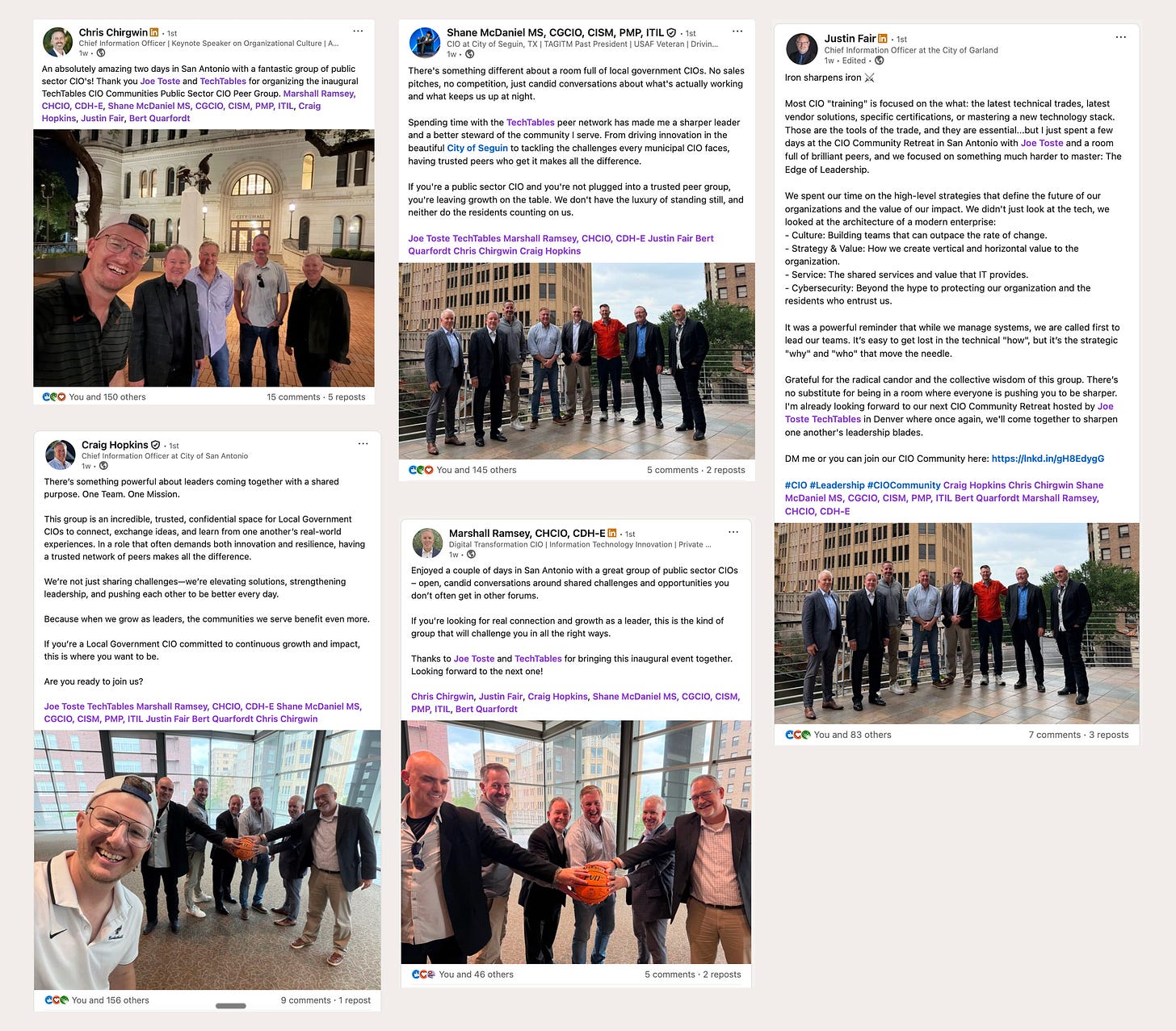
Check out our high-trust, vendor-free peer group built for local government CIOs tackling real challenges, honest conversations, and an authentic desire to become a better leader — our next retreat is November 2026!
Learn more → [https://techtables.com/communities-local-government](https://techtables.com/communities-local-government)
### 3. 🤝 The Better Together Series (Virtual & On-Site)
The narrative-driven series bringing together industry partners and public sector CXOs. Discover the compelling stories that unfold when we stop working in silos and start building together.
»»» Email [joe@techtables.com](mailto:joe@techtables.com) to learn more.
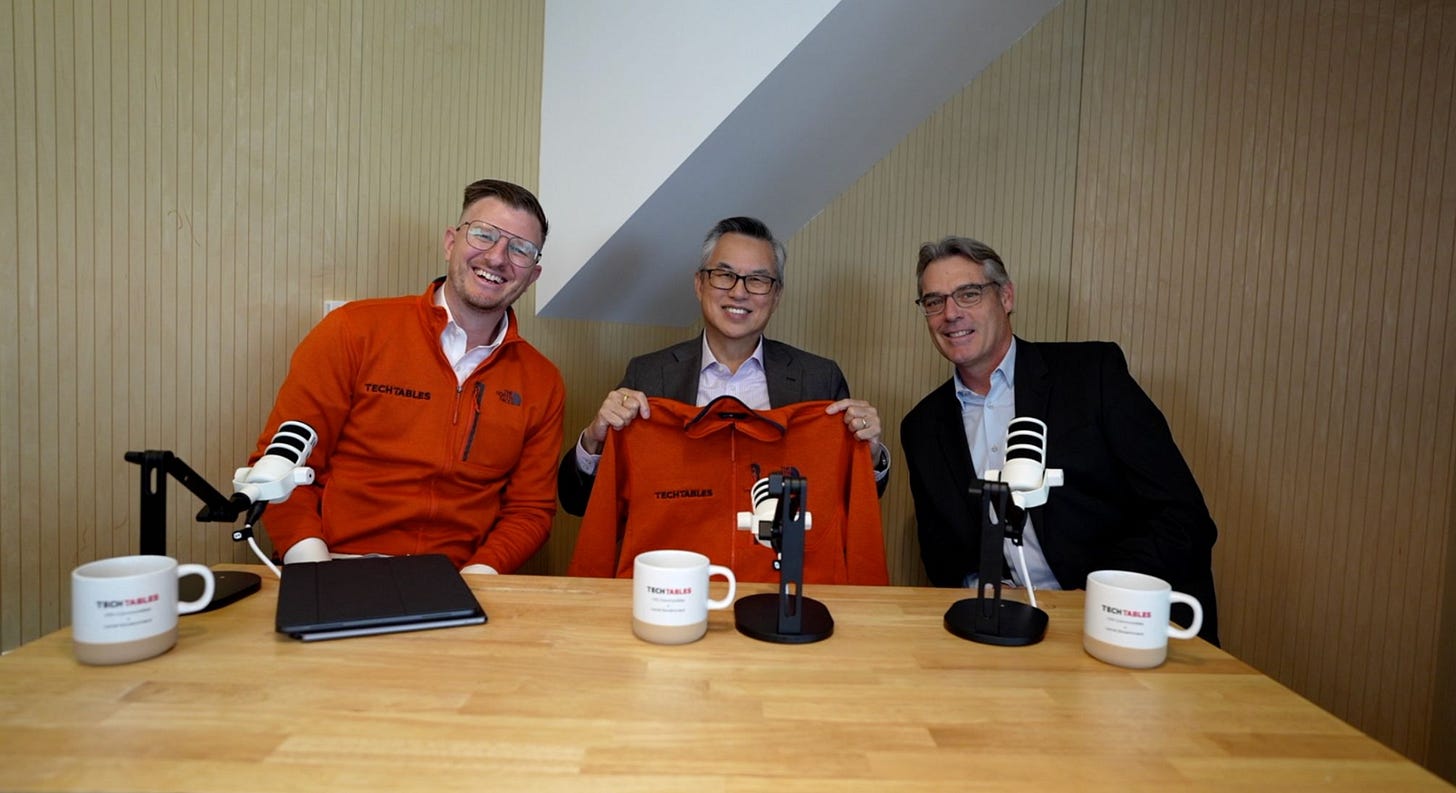
> TechTables Better Together On-Site with Peter Loo, CIO, LA County & Hannes Scheidegger, Chief Global Delivery Officer at Info-Tech Research Group
### Platinum Newsletter Sponsor:

Join TechTables & Info-Tech Research Group at [**Info-Tech LIVE 2026 - New Orleans**](https://preview.convertkit-mail2.com/click/dpheh0hzhm/aHR0cHM6Ly93d3cuaW5mb3RlY2guY29tL2V2ZW50cy9uZXctb3JsZWFucy1saXZl) (February 3 - 4, 2026) and/or [**Info-Tech LIVE 2026 - Las Vegas**](https://preview.convertkit-mail2.com/click/dpheh0hzhm/aHR0cHM6Ly93d3cuaW5mb3RlY2guY29tL2V2ZW50cy9sYXMtdmVnYXMtbGl2ZQ==) (June 9 - 11, 2026)!
Learn more about upcoming Info-Tech events here: [**https://www.infotech.com/events**](https://preview.convertkit-mail2.com/click/dpheh0hzhm/aHR0cHM6Ly93d3cuaW5mb3RlY2guY29tL2V2ZW50cw==)
### Gold Newsletter Sponsor:
****
> **[SentinelOne](https://assets.sentinelone.com/ghe/sentinelone-empowers)**—Learn how SentinelOne empowers this state to stay secure.
>
> **[Verizon Frontline](https://www.verizon.com/business/solutions/public-sector/public-safety/)**[—](https://www.verizon.com/business/solutions/public-sector/public-safety/)The advanced network that keeps first responders connected when it matters most.
>
> **[Carahsoft](https://www.carahsoft.com/)**—The Trusted Public Sector IT Solutions Provider™, supports government agencies and education/healthcare markets. Contact your Carahsoft rep today to access special discount pricing exclusively through the TechTables + Carahsoft partnership!
Transcript
Joe Toste: Welcome to the Public Sector Show by TechTables. Super excited. We have Bob Leek, the CIO for Clark County, Nevada on today. Welcome to the show, Bob.
Bob Leek: Thanks, Joe. Really happy to be here.
Joe Toste: I'm super excited to have you. And I emphasize the Nevada piece because I met someone who was the CIO of Clark County that was not in Nevada, it was in like in Oregon or Washington.
And they told me that was the most common \[00:01:00\] when they talk to vendors, it is the most common mistake. They're like wrong Clark County. So there are two of you out there just, you probably knew that, but
Bob Leek: yeah, there's a, actually there's a total of 12 Clark counties and I got a solicitation yesterday from someone that said, we can help your Clark County in Ohio do better.
And I thought didn't do a lot of research on that one.
Joe Toste: Oh wow. That's pretty funny. Learn something new every day. Clark County in Ohio. Love it. There you go. We've had the chance, this has been a long time coming. And just for the audience just to back the truck up a little bit, we had Nadia Hansen come on, maybe what was it, like a hot, three months after you got hired or something like that, or, that's right.
Bob Leek: Yeah. That was a little over four years ago. Yep.
Joe Toste: And so super excited to have both Bob here and have an update on Clark County, how Clark County's doing. And for those who weren't at Infotech Live, we got to connect again. You just, you gave a great little teaser during the kickoff kind of keynote.
But I'm excited that we have you for the next hour. For those who don't know you, Bob, around the nation, just 'cause we cover \[00:02:00\] higher ed and some of the different verticals in public sector, could you just give us just a quick intro on yourself?
Bob Leek: Yeah I appreciate that, Joe. So I serve as the Chief Information Officer here at Clark County.
I've been here four and a half years. I moved here from Portland, Oregon. I'd spent 20 years in Portland and had been the CIO there for Multnomah County. Also worked for Kaiser Permanente for 10 years in human healthcare. And that's important because I worked for Banfield, the pet hospital, which is PET Healthcare for a handful of years before that.
And and this is usually my test question for audiences, I can gauge people's age by also sharing that. I worked for Egghead back in the late nineties and early two thousands. We were probably the first. real@scale.com online retailer as we transitioned from the days of brick and mortar stores into the.com world.
And got my training and education in how fast the world works. Working for a.com back at that time and have been in technology for most of my career. Been in leadership roles for most of that \[00:03:00\] time and really do appreciate now being in the public sector and being here. In in Clark County, we have a little town in our borders.
Las Vegas. People tend to know us by that. But people in Paris, France don't say, oh, we're gonna go watch the Formula One race in Clark County. They're coming to Las Vegas and right outside of my window, I can see the strip from where I am and really enjoy and love being in this area now.
Joe Toste: That's fantastic. Okay, so you said egg. How do you go from, what's the short story from like egghead to public sector? So you're in private sector, how do you, how, where does that jump happen?
Bob Leek: Yeah, I worked at Egghead during a time of transition. This was the beginning of the.com world.
And egghead was trying to do two things at the same time. We both know the organizations that are successful. So we were trying to be an online marketplace to sell other people's products through our brand and name recognition, because we had a name recognition that was equivalent to like Coca-Cola, McDonald's, and so forth.
Everyone knew egghead in the technology world and the successful organization that figured all that \[00:04:00\] out. We now know as Amazon. But we also had a very strong auction presence. And we were able to buy products and then put them up for auction. And we know the organization that was really successful at doing that.
We know it as eBay and so egged was trying to do both egg do what Amazon does and what eBay does at the same time. And it was a brilliant three or four years worth of work that we did. Went through some venture capital money and ended up just not being able to cross the finish line with that transition which gave me an opportunity to pursue other other paths with other organizations.
Left Egghead went to Banfield, the pet hospital and then to Kaiser Permanente and. Kaiser's largest department was the health department. This is in Portland, Oregon. And and so I had an underpinning in health technology with electronic medical record systems and the solutions that Kaiser uses to deliver healthcare to the public.
And an opening happen with Multnomah County. And the largest \[00:05:00\] department in Multnomah County was the health department. And so that's the group that really allowed me to leverage my background in history to get a position as the deputy CIO in Multnomah County. And then through succession planning, was able to step into the CIO role after that and expand my role to include facilities and strategic planning and the fleet there at Multnomah County.
And this career journey that many of us find ourselves on, luck is the intersection of opportunity and preparedness. And so I feel really lucky that I've had this career journey and now it's ended up with me here in this area doing this role for Clark County.
Joe Toste: I always love hearing the stories of how people get into public sector, mainly because when I meet people for the first time, they always ask me, Joe, how the heck did you end up in public sector? It's like the number one question I always get. So I'll leave that. You could go to TechTables dot com and when you subscribe on the email list, the landing page on the next one, I just recorded a video of it because so many people ask me, so I just reported it which gets quite a number of views.
Speaking of \[00:06:00\] Las Vegas, I actually, I was telling you off camera before we started recording, my wife has not been, I have not seen her or my daughter in the last, I don't know, it's been maybe a little over a week now. Because they initially went to the Backstreet Boys at the Sphere. Yeah. With my sister-in-law and her daughter.
And then now the girls are on some road trip in Arizona right now. Hopefully they'll come back to us soon. 'cause the boys are missing the girls. Yeah. But I love what you said about, no one refers to it as Clark County. They just refer to us as Las Vegas.
Bob Leek: Yeah, that's fine.
We, we accept that.
Joe Toste: Yeah. Yeah. So we've got a number of just really great topics that we're gonna dive into. When we met for our intro call, you just covered, I don't wanna say your whole portfolio, but it was a pretty strong, it was a pretty strong showing of your portfolio. Let's dive in first to what I just call AI implementation and strategy.
As you break this down so Clark County's so your budget is 300 or maybe about 370 million. And you mentioned about having 20 AI pilots currently running. How are you ensuring that these pilots \[00:07:00\] align with the actual business outcomes rather than, this was just in the Wall Street Journal, maybe yesterday morning.
Walmart had recently announced that they'd built too, maybe too many AI agents. Things are starting to get crazy confusing and now they're moving to simplify. Did just talk about actually aligning to the outcomes
Bob Leek: I think, un until a couple of years ago, it's not that AI hasn't existed and that we all haven't experienced it, right?
Any Google search is an AI engine that Google developed. And and the opportunity that happened with Open AI and the release of chat, GPT has just started us down this path. And now there's hundreds, if not thousands of different ways to look at ai. So for us, AI is a how and not a what.
We're not doing ai. We do hundreds of services that we provide to the public. And what we wanna do is apply AI for better outcomes. And that means that we have to evaluate and understand what are all the outcomes that we have around our public services and \[00:08:00\] measure those. Issuing a business license, you can't get a business license from anyone other than a county government.
In our case. We work with the cities that are inside of the borders to make sure that if you're crossing jurisdictional boundaries that your business license is accurate and complete and correct. And so how do we apply ai. So that we issue business licenses faster and more accurately. That's the principle that we take is AI is a how.
And so we talk with all of the departments and we go through what are the core success measures of the work that you do. And we collect all of that information, those metrics. And then we have a conversation that says, what could we do in applying technology and now in, in applying AI to make those outcomes better for your department.
So , your question was around how do we ensure that we're gonna achieve those outcomes? That's where we started is what are the outcomes? Now there are some cool AI things that are out there. We're gonna skip over doing chatbots. We really don't have any chatbots within our organization.
And it's \[00:09:00\] because it's, it was really hard to do chatbots. Pre ai, right? You had to think of all the questions that anyone would ask, all the permutations of those questions, and then all the answers that you would need and permutations of those answers, and put all that into some type of structured data capability with ai.
We're gonna skip that and we're gonna be working on, in our, working on a digital assistant for our website so that you can come to the website and ask in, in natural language what is it that you're looking to do. Not only that, but to do that in multilingual capabilities and potentially with some options related to what kind of digital assistant would you like to interact with?
So that you could change the persona and the look you want an antagonistic person to work with, or would you like a really helpful person to work with? And, I think the growth in these AI technologies is, it's just going so fast that an organization like Walmart, as you alluded to that made these investments in a lot of different, and the term is agentic solutions.
I think \[00:10:00\] we're taking a much more measured and cautious approach. And not cautious because we don't believe in the technology. But because we wanna make sure that we're good stewards of the public dollar, that the investments we make, that we predict that they're gonna be successful and beneficial, and that we don't just chase the technology.
And I talk to people that we're a close follower. We're not gonna be on the bleeding edge. I love it when other organizations, and you and I know a lot of people in our circle, right? Without name dropping folks, King County Maricopa County, all those leaders there. I love it when they go first because then we can learn from the lessons learned and apply these solutions in a way that's predictive of success.
And there will be places where we go first as well. And so by collaborating together, we're taking a look and seeing what all this AI stuff is, and then the AI leadership in local government and the public sector. Is really being led and championed by the Gov AI Coalition that Khalid started outta Santa Clara.
We're a member of that group. There's 700 of us \[00:11:00\] and I think it's growing now, maybe over a thousand people that are involved in that and really trying to work on setting standards and trying to figure out what is AI gonna mean in the public sector. And at the end of the day, for us, it's how do we improve what we do, what we already do?
And that serves as the kind of the core foundational approach for us.
Joe Toste: I really like that, especially the, like when we talk about agentic ai, there's the, right now you can see okay, there's some promising aspects of this, but promising aspects goes in the.
Somewhat someday. Fun bucket. And then there's the okay, here's where we are today. 'cause there's a difference between prototyping something even getting a website up, like a unlovable or rep lit right now where you can just spin up a website in natural language processing.
And it's awesome. It's a ton of fun. I was doing this with my daughter for an entrepreneurship homework assignment. And then there's, we're deploying this to millions of people, right? There's, the scale is different you can't necessarily go \[00:12:00\] at the lightning speed at scale because there's just so many issues.
Everyone's using the word agentic right now, but if you think about behind the scenes. What that means is it's gonna try and take an action on your behalf, but what does that mean, like for your entire county or city? And what happens if it takes a wrong action, right?
Like where's the governance involved in that? How do you think about that? And I think you can test in like a small scope, but I think rolling out super fast can become a nightmare if you don't really think through all of the implications of that when you've got such a large body of people and residents and tourists that are coming through, right?
Exactly. Yeah. Love what you said. And shout out to our friends in Maricopa County. I love, we just had Aaron again on the podcast and they're innovating and and they're doing a blast. And so yeah. Can just collaborate together, get those lessons learned. Wanted to dive a little bit deeper.
I think you had mentioned to me that there are 30 different languages spoken in Las Vegas. Talk a little bit more about the practical applications that you're seeing for this right \[00:13:00\] now.
Bob Leek: Yeah. And I've shared that one of the most exciting things I think that's happening with AI is language translation capabilities and language translation services.
And the state passed a law a couple years ago now, last legislative session that we had to do business in English, Spanish, and took Tagal Filipino and. We had to do that in certain areas with certain transactions and certain documents, like board agendas and those sorts of things.
And so we started to work on that. But we recognize that this area speaks a number of different languages. 30 is probably not a precise number, but it's representative of how diverse the population is here in southern Nevada. So we started to look at solutions around language translation services.
So we just launched our new website, Clark county nv.gov. We transitioned from a legacy system onto Adobe's Experience Manager. One button click will change the language on the website so that you can begin to read the website in a language that you're familiar with, which is great from a navigation \[00:14:00\] perspective, right?
It doesn't go all the way deep enough to say, okay, the application for a business license is now available in multiple languages, but that's the next step that we're gonna take, and so that we can meet our constituents and the people that need services from us where they wanna be met. So one of those is written.
All of our forms, our documents the interaction that we have digitally we want to be able to do that in the language that they would prefer to operate with. And then seamless transition back to, because we're a predominantly English speaking employer that we can translate it back into a language that we can use to process whatever those next steps are.
But the real promise, I think, is in real time language translation. I know, we're science fiction geeks and we have always appreciated that idea of the universal translator the ear piece that lets us hear in the language that we wanna hear and the other individual be able to do that as well.
And there are organizations that have developed that. I saw an address the other day. I know \[00:15:00\] that Beats is working on this and so forth. I think Jabra has some solutions that are out there already. And so we are gonna be piloting and working with some translation, realtime language translation services.
One of those is to put on a counter, two iPads sized. They're tablets. I don't mean to say that they're just iPads, they're tablets. They go back to back and we choose the language that we wanna speak in. And and what we'll display on the other side is the language that the person that's interacting with us wants to read and hear it in.
Real time language translation capabilities, right on a counter. Clark County School District is deploying these in their administrative offices because obviously they're dealing with parents. The teachers and the administrators want to talk to the parents about how great their kids are doing, or if their kids are in a little bit of trouble, be able to have that conversation to come up with some type of a plan related to their behavior or their support that they need.
We can do now do the same thing across our counters. So we're deploying those for \[00:16:00\] counter based interaction. And then one of our use cases is with the coroner. When the coroner goes out to these horrible situations where there's a car accident or something's happened, they need to interview witnesses and to be able to collect all that information.
And so we're gonna deploy a handheld version of that same capability to the coroner's team so that when they're out in the field, they can eliminate a barrier, which is that communication barrier, and gather richer information and richer content and context around whatever that event is that they're dealing with.
Then the third with the same solution. The third is what's called, it's a broadcast solution. So in our boardroom, our commissioners tend to operate in English, but you could sit in the audience and through an a non-app download. So just a connection to the internet, choose the language that you want to hear and listen to the dialogue that the board is participating in.
And I always envision the UN with everybody with their headphones on and people in the back translating everything. It's the \[00:17:00\] equivalent of that. And so for the meetings, whether that's the board meeting or the planning commission or other important public meetings that we have, the ability to connect with people with real time language translation services.
I, it is one of the most bullish things that I'm on with respect to applying AI and all of that is AI driven. And I think it really does eliminate a barrier and a constraint and operating with the people that we're trying to provide services to.
Joe Toste: There were a lot of gems that you published there.
And really, you said you were really bullish on this and I think if you haven't traveled out of the country before, you're doing yourself a little bit of a disservice. But when you travel to I've been to, Europe, to Philippines, Japan, Korea, south America you will probably not know every language.
And so first thing is you land at the airport and sometimes just directions to, where the train is or how to navigate. Great use case. Las Vegas obviously great use case just 'cause there's so many tourists coming through. And then what I really liked, I don't know if everyone caught what you said, but you took one.
Solution \[00:18:00\] and got it deployed to at least three other use cases. I think it's very smart. So you just didn't spend all this energy just on one isolated use case, but you got one to drive home, three other ones without, multiplying the work on your team is great. I'm sure you, obviously, I'm sure you've thought about that, but that's, yeah.
That's fantastic. Yeah.
Bob Leek: Yeah. And I'm happy to share, people can get in touch with me and we can talk about what we're doing. There's dozens of companies that are coming forward with this stuff now. And I think, again, tying in this use of AI to the services that we provide to make it better is what we're looking for.
And I remember, taking Spanish in school and a couple of other languages and the most important phrase when you're traveling is, where's the bathroom? And being able to now do that in 170 languages I think is pretty powerful. As you travel around.
Joe Toste: Yeah. Even, I'm just, I'm spitballing right now in real time, but I'm thinking, even taking all of the, county or even within the city taking all of the transcript data from city council \[00:19:00\] meetings or county meetings, and you can also translate that and Yeah.
So I wanna go where I wanted to go before we wrap up. The AI piece of it was the AI augmented workforce.
Love to hear just from you. I don't see AI. Replacing folks who are going to use it. And so I think there are a lot of great use cases today even without it being insanely intelligent for the workers to help just augment this. This could be writing better emails.
Communicating better. But I'd love to hear from you, where are you seeing this really augment your workforce?
Bob Leek: I think about this in kind of three buckets. So one is that there are roles that we perform that are never gonna be replaced by ai. They're gonna be enhanced, and two that I think of all the time is law enforcement and firefighting, right?
Those are services that we provide. And we're not gonna have AI agents doing that type of work. Now, maybe we can arm \[00:20:00\] firefighters to arrive at a site with more information than they otherwise would. This structure likely has paint and therefore that's a hazard. And so helping, again, augmenting the services we provide through AI enhancements.
I think that's one way to think about the workforce. The other, on the other extreme and I'm starting to toy with this a little bit, is what if on our org chart, we actually have a position for an AI employee, an AI worker, and an area that could work in would be, let's say we have a role around a customer service agent who primarily answers the phone and answers questions and that.
For whatever reason, we have some open positions. They tend to be a little tough to recruit and hire for. But what if we were to take that position and rethink it in terms of what if that position could be an AI agent? And right on the org chart that we make the AI agent a \[00:21:00\] part of the workforce.
So they're a teammate, they're someone that we work with, we find out what the workflows are. Where do you do your job? Where does that transition to one of our staff members? What does that look like? And I think that this is something I think that's emerging in the realm of thought that says, embrace AI and have it be part of the team so that it's not seen as a replacement.
It should be an augment. And so that's what we use the term ai. For us, it's not artificial intelligence, it's augmented intelligence. So we are working on augmented intelligent solutions, and it, let's say we have a dozen customer service rep positions that are open that we can't find people to fill.
Let's think about the possibility around applying an AI agent in that realm and making it part of the team. And then the middle component is the skills and the capabilities that everyone seems to need to have as we grow and more AI comes to bear. But this has been true for us \[00:22:00\] for a long time.
Digital skills or technology skills in the workforce has continued to grow. I know that we still have some employees who talk about, yeah, I don't use email 'cause I don't know how to use email. And for many of us, email is just a core part of what we do all day long. But the reality is that some of these technology skills are still seen as, they're desired, but they're incumbent upon people performing their role. And so with AI coming along, what does the skill need to be? And then how do we enhance or change the job descriptions to further acknowledge that technology literacy technology capability. Even at inter, at beginning levels, and maybe in some cases in intermediate levels are just an important part of this.
So we're starting to talk about and look at the hundreds of positions that we have and asking ourselves how is AI gonna impact those positions? And then what do we need to think about in terms of the skills needed for the people that we're hiring \[00:23:00\] so that they can use these capabilities. We're a Microsoft shop.
We're gonna roll out copilot and have that become a core part. And I know my peers in San Francisco just got a lot of kudos for having rolled it out to 30,000 City of San Francisco employees. We're following again, l lessons learned. Lots of training that's needed. A users group an affinity group the reference materials, all those sorts of things.
So let's do it right. But we're really excited about how we can leverage AI to, to do the work that we do in better ways.
Joe Toste: Yeah, there is. So a couple things I'm thinking about too, especially in the digital literacy piece is even the workforce today of how, when people submit their resumes, it used to be proficient in Microsoft office, right?
Proficient in this. Now it's gonna be for the upcoming generation, right? It's gonna be proficient in AI prompting, proficient in building a custom GPT on chat, GBT, right? Or something like that. Or, proficient. Claude projects. I don't know what it is, but, or co-pilot, right? Yeah. Yeah. \[00:24:00\] So it's very interesting because especially when you work with I work with kids, the high school kids and a high schooler at my house and having these conversations right now of, part of it, Annabel is thinking about, Hey, what does college look like?
And I'm thinking to myself, what does college look like when she leaves, right? This is now six years later into the future. And which is pretty fun to start thinking about what skills do you need and what makes college important and even for adults right now. And if I think right now the stat is there are six generations of people in the workforce all at one time.
And there's gonna be some folks who are retiring. I just had a podcast, with the CIO for the Washington State Cannabis and Liquor board great guy. George Williams, he was telling me that they had to hire just as a contractor, a gal who was maybe 70, 75 years old, just to keep this one thing alive till they could migrate.
And but she's I'm done after that. And the world is just moving where I think, the tech is moving, the people are moving. \[00:25:00\] But I did see that with San Francisco. I'd love to get the lessons learned on rolling out 30,000. Yeah. That sounds a, looks a little heavy. I love the headline number, but.
I think there's gonna be a lot of folks who need training on that front. And who knows, may, maybe Microsoft is deploying lots of actual human people to help train them up. I know we're
Bob Leek: taking advantage of them. Absolutely. Yeah.
Joe Toste: It's a lot easier when I do the podcast virtually for me to write a bunch of notes down because my brain is just constantly swirling very hard to do this in person.
But one of the reasons I love it is I just have an actual notebook next to me and I just love jotting down your thoughts. My last one on the org chart piece I was just catching a podcast this maybe a couple weeks ago, but it was with Mark Benioff. Who is the chairman and CEO of Salesforce.
I have no affiliation. But him and then another guy, Jason Lemkin from Saastr, and yeah, they were just talking about the future of what. What an AI employee looks and I think I, I love that you put this on here, like actually incorporating it onto the org chart. I think the great use case, customer service agent and this is one example, but I think making it \[00:26:00\] less scary for people.
Oh, this Ag agentic thing isn't gonna come take me out. Take my job. But hey, no we're just gonna be working. We're gonna be better together. We're gonna be working together.
Bob Leek: That's right. Yep. And it has to be done with intent. And you have to invite people into that. And you have to accept that people are on a different they're on a different curve, right?
Those that are really scared about losing their jobs because of ai, that's a different conversation than those that are excited about how do I get rid of the stuff I hate doing? Like authoring emails and make an agent that, does email responses, 70% of the time. Think about all the great time that I can then get back to do all the creative work and the strategic work that I really wish that I was doing.
And that's just a personal use case of mine. And I'm watching people that are taking these agents and capabilities and really. Getting that a whole set of work off their plates so that they can do that value added work. And that's the way that I describe what we're gonna do with AI is we want people to do the value added work \[00:27:00\] and the rote, mundane, repeatable stuff that, that some people have on their plates.
Let's figure out whether there's a better way to unleash your creativity in other things. So it's a very intentional approach. It's scary. It's, it has to be done with, with sensitivity and empathy and understanding. But it's also inevitable. We've gotta make our way through these conversations.
Joe Toste: I can go all day, but I love what you said about the value add. The value add piece, and I think sometimes we lose sight when we are really in the technology of, especially in public sector, there are so many different types of agencies from health and human services to, you name it, police fire, and not everyone is in the tech like 24 7.
And so stepping back, going, okay, this person's perspective is actually probably pretty valid with where they live. Let me enter into their world. Could be a case worker, right? Enter into their world to understand. And then, going back to what we talked about, focusing on that outcome, that business problem and then figuring out, hey what can we \[00:28:00\] maybe apply or not apply?
So citizen centered technology design.
So when we met, you had talked about, you focus on four personas visitors, employees, business owners, and residents. How has this shift changed the way you evaluate when you implement technology solutions from maybe your previous history? Working in healthcare, working at egghead? And did I get egghead right?
Did I get it? Yeah. I just copped to my age. I'd just love to know like those are your four personas here and kinda how you think about that when deploying technology projects.
Bob Leek: I am a big steward of simple frameworks and so I was thinking about the fact that we have 8,500 employees and 40 departments, and every department is uniquely designed to deliver its service.
But at the end of the day, for a county like ours, which has 2.3 million people and 90,000 businesses, and then around 50 million visitors that come through, and then our 8,500 employees, I just had this epiphany one \[00:29:00\] day where I was writing down and I was noodling around on some stuff, and I was like, so if we rethink our service models.
To deliver solutions to those four personas. And a lot of this is in design thinking. And I've had the benefit of having worked with some great organizations in the past around user-based design and those sorts of principled approaches. I thought, what if we start to center our work around this approach?
And we're not the first to think about this. There are leaders around the country and local jurisdictions who have built portals and they've really taken this model and said, we really wanna make it easier for people to consume the services that we provide. And so here. We're centering ourselves around these four personas.
Our employees, obviously we directly need to create a great place to work, make it easy to work here, access to the things that they need. We have a pretty robust remote work option for many roles so that people can work from a secondary work location, usually their house.
So the \[00:30:00\] employee persona, we're doing work around that and we're centering some technology solutions around that. And then the visitor persona is really with the Las Vegas Convention and Visitors Bureau, the airport, the city of Las Vegas, the resort key orders and so forth. So what can we do to create this great opportunity for people that when they come here, that they have a great experience?
What can we do with technology to make that better? In QR codes and easy access to discounts for like rideshare programs restaurants you think about search engine optimization. I want my restaurant to be at the top of the list. No, I want mine to be, what could all of that look like to create this great experience?
And so that work is happening, but the two that we are centered on are business owners and residents. And so business owners here interact with, four to eight different departments through the life of. Of owning a business and running a business here. And so what if we rethink and do user-centered design with business owners so that when they come to Clark County nv.gov, whether that's on a \[00:31:00\] mobile device or on our website through a laptop or some other larger device, tablet and so forth, that that we create this experience for them that makes it easy for them to do business with us.
One, two, that we add identity management to that. So we do want you to log into our website because when you do, we can present you with more information. Oh, based on the characteristics of your organization, did you realize that these economic development dollars were available or we're trying to target growth in a particular area of the region?
Have you thought about expanding your business into this area of the region? And so in the same way that we're inundated with the recommendation engine on Amazon, one of my favorite places to shop, why can't we do that in the public sector too and bring these programs that people are eligible for to the forefront?
And then when you think about that from a resident perspective, the 330,000 families that we support through family and social service programs the folks that we support through juvenile justice the business \[00:32:00\] license area or the permitting area in terms of expanding on your house or doing projects at your house.
What if we flip the paradigm and we become proactive in a lot of that? So that was the underpinning behind this thought that said let's identify these four personas and then the investments that we make should enhance the experience that those personas have and do customer journey mapping and invite business owners to participate with us.
When we design programs, we want the programs to actually be effective to the people that consume those programs. So let's invite them to be part of that design process. So a lot of this has just started with us. It's been a concept but we're really starting to see it take hold.
And it lets us rethink how we've organized and designed our own service models. So that instead of after you get a business license and you say, okay, now I need permits in order to open my space we can't help you with that in the business license department. Go call them. Let's rethink what that journey would look like for that business \[00:33:00\] owner, and let's make it really seamless for them to go down the hall or virtually, to the next department and take those next steps and do all that in a really thoughtful way, but in a proactive way.
So that's the idea that we had around the personas.
Joe Toste: I love that. I talk about this quite a bit on the podcast, but I am, I consume services in different versions of me of Joe Toste. So I'm a consumer of everyone else, like of the DMV, but I also consume business services too, as a business owner.
I'm curious, you can punt the question if you don't wanna answer it. Just very quickly, and you don't have to say anything about any vendor partners you're thinking about, but Sure. The identity management piece is super interesting because when you are a business owner, you file stuff at the state and other types of entities that you operate in. How are you and Tim collaborating together to try, even if you're not there yet, but as you guys are thinking about this, Nevada is not a massive state in the sense of like California, where there's 50 something million people, \[00:34:00\] but I think you guys have a pretty great relationship, which is somewhat rare between kind of the state, CIO and then the largest county in this state.
Could you maybe just talk about the identity management and even just the collaboration between the two of you?
Bob Leek: Yeah. No I appreciate you bringing Tim into this. I was trying to find an entry point for that. Tim Galluzi is the state CIO. He's doing some incredible work at the state level, and there's, three and a half to 4 million people across the state.
Two and a half million of them live here in Clark County. And so I think it's really important that the state and Clark County work together wherever we can because it's a predominance of the population, the economic engine and so forth. And that's no disrespect to the Reno, Carson City area and Washoe County and that area Northern Nevada.
But, the work that Tim and I are doing is that we have an agreement that there are certain topics. Identity management is one, cybersecurity is another, a statewide approach. And we've coined this term one Nevada, as an approach. And so when we are thinking about making investments, we touch base with each \[00:35:00\] other.
And identity management is one area where we believe and many states have already done this. Again, Arizona's a little bit ahead of us, Missouri rolled out a statewide identity that we need to make a very strategic investment in identity management. And, maybe five or eight years ago we would've said, okay, you're gonna log in.
And then all services, state, county, city tribal are all gonna be available on one massive website. States tried that and it really didn't work all that well. Now with modern APIs and the capability to do integration, that if we can get you to log in, no matter where you log in on the state system or one of the state agencies, D-M-V-D-O-T, et cetera, or at the county level or at the city level, and that we've shared this identity management and identity verification.
'cause that's really the piece. Logging in is one piece, but that you are who you are. That's the really important part. And if we can do that in a collaborative way and roll that out in a very \[00:36:00\] seamless way so that when you log in, that you, now we know who you are and we begin to tune the service models underneath that.
I think that's the next step in terms of being a resident of the state and having access to all of these services. In a proactive way that helps you navigate all those service structures. That's both the promise and the tactic that we're gonna take on. And there are some solutions that are out there.
We could start anywhere. Voter registration database, DMV database the business license database. There's there are other, publicly accessible databases along with the services that have come on along, like id.me, that the prevalence of that as a solution is also out there, but it's less about which solution provider we're gonna work with and more around how are we gonna ensure that as we take these next steps, that we're doing that with the resident at the center of that model, or the business owner at the center of that model.
Joe Toste: Yeah. It's a fascinating study work problem. \[00:37:00\] Also same thing, like I've gotta log in for the IRS. And pay taxes. And I'm kind, it's so weird now that I'm, I've been in public sector doing this for four years. All I'm thinking about is, what does the experience of this look like across the board?
And if you're a business owner, you don't actually pay taxes on a number. That's like a real number. You estimate what you think you should pay, which is crazy because you just go into this black hole and then communicate with the IRS.
They send you letters of we're charging you interest and you underpaid us by a hundred bucks. Something random like that. And constantly thinking about what is the experience from top to bottom. And obviously as a business owner I'm thinking about this, but.
I was thinking about I had a great conversation with this guy, Dan Teczar. For Texas.
He's working on a huge modernization project and so yeah just figuring out how are people tackling this? How from identity to you actually getting the persona right. And I love what you said about the recommendation engine piece. Yep. So it's so good. I wanna know as a business owner when there are tax breaks, things I \[00:38:00\] should be made aware of that it's just, impossible to find otherwise.
You nailed that. Wanna cover cybersecurity? You briefly mentioned about it, but the number that you gave was that Clark County fends off about 4 million cyber attacks. A day. And I wanted to just, the nuance a little bit that you brought up when we met was best of breed versus best of fit.
Could just talk about how you think about that with Clark County.
Bob Leek: Yeah. I think this term, best of breed has has been something that's been around for a long time and my experience has said that best of breed ends up being the most expensive set of options. And that instead we've taken a best of fit approach.
And so we, we really know who we are and what we're trying to do and what our footprint is. We have about 72,000 devices total across all the different types of devices that can exist within, end user devices all the way through the network servers and so forth. And that's who we are.
And we're not a, we're not a multinational company, we're all \[00:39:00\] regionally based. And when we talk to the solution providers, we wanna make sure that we are, we're saying here's who we are, and this is what success looks like to us. And some features and capabilities for, multi multi-location companies that are spread out all over the United States, yeah. That theoretically makes sense, but we're probably overpaying for those capabilities when all we need is something that works in southern Nevada or through our SaaS relationships that we have with SaaS solution providers. So this best of fit approach allows us to evaluate potentially more options.
Then narrow those options down to the one that's best for us. And in the realm of cybersecurity, there is a lot of consolidation that's happening, right? The one platform approach single pane of glass, we've heard that for 15 years now. I think those are all great and I really applaud what's happening in the solution provider community.
But for us, we're always gonna look and say, we need a privileged access management solution. Here's what success looks like for \[00:40:00\] us. Let's navigate that landscape. And if we have an existing provider that also has that, of course we're gonna look at that. But if the rightest privileged access management solution is a one-off product that integrates with that single pane of glass concept we're gonna look at that too.
And that's been our approach. And in cybersecurity as fast as things are moving. And the fact that our number one goal is to maintain uptime and availability of our systems it's it is the thing and probably always will. It's the thing that keeps me awake at night is are we ready?
And what have we done in business continuity planning, disaster preparedness, and then can we recover when something happens?
Joe Toste: That's really great. Going back to, we were talking about offline that on the intro call about the number of cybersecurity vendors that are just acquiring each other.
And I was laughing because I think today I saw that Palo, again, no skin in the game is acquiring cyber arc for, whatever, $20 billion. And so I was thinking about our podcast that was coming up and I was laughing that, oh, there's another one that's just gonna get swallowed up \[00:41:00\] in the ecosystem.
Bob Leek: Yeah. At least for us, that means we'll be able to consolidate from two solutions to one. So that's great.
Joe Toste: Yeah. Yeah. Yeah. Love it. Wanna touch on leadership and then one other, one other topic as we close out. So you mentioned to me that you had filled half of your 33 leadership roles through internal promotions over the last three years.
Yeah. We'd just love to hear, your leadership philosophy around internal promotions and what you're looking for as you're training up the next generation.
Bob Leek: Yeah. This is something that I'm really proud of and I think the legacy of this was set by prior leaders and here and then people that I've worked for.
And it goes like this. So we need to be really clear and understand what it is that we need in terms of the roles that, that we need to have based on where we're going. And those roles evolve as technology evolves, as our mission changes and evolves. That, the people that we have, the leadership roles that we have.
May not be the ones that we need into the future. So this is always done with a two B state that's constantly changing. So what is the two \[00:42:00\] B state? And then what are we doing about that? The second piece is, and this is something that I believe very strongly about, is that every, everyone should have an individualized development plan.
Now, that development plan could be, I wanna retire in five years. Okay, that's great. Then let's build a plan to help you retire in five years. And what that means is I'm probably not gonna send you to a conference. But what I really want you to focus on is succession planning and knowledge transfer, right?
That we wanna enhance your existing skills, but we're not gonna put you on a project with new things you know, in it, if that's what your development plan is. We also have people that wanna grow in their technology skills, their technical skills. They wanna become technology or technical experts.
We have people that want to grow into leadership or the management track, so to speak. We have folks that wanna go into project management and we think that's great. Or we have people in one area of technology that want to change into a different area. Maybe a system administrator wants to become a network person.
So we do this at the individualized level. And then \[00:43:00\] from that we can see some patterns emerge. And one of the patterns that we saw is that we had people that wanted 'EM to move into leadership roles. So we have a relatively flat organization. It's probably like a lot supervisors, managers, and then the executive team.
And as we laid out the two B state of our organization. What we found is that people said, I really think I could be a leader for that particular function or that particular area, and so we worked with them on the skills that are gonna be needed in order to be the best candidate for those roles.
Everything we do is competitively done. We're competitively recruited, and so we wanted our internal candidates to be the best possible candidate. Why? Because they already know us. They know who we are. They know our culture, our philosophy, our approach. They know their peers. One of the toughest things is to rise above the level of your peers into a leadership role.
We wanted to help people with that transition. And so as we did that over the last three years, the results are, is that we promoted in of those \[00:44:00\] roles, about half of them were internal promotions. Which is we're really happy and proud about because one, people wanted to do that. Two, we had the positions that were available and then we set everyone up for success in order to do that.
And so I am really proud of the work that we did because what it showed us is that we have a tremendous pool of talent inside the organization that we could bring up into leadership roles, which become influence roles. They become decision making roles. And because we're all operating off of this shared sense of where we're going, and our technology strategy is on our website, ClarkCountyNV.gov, you can search for Clark County technology strategy that tells everyone where we're going and to align every individual person into that overall strategy and then bring leadership to bear with that.
That's what we've been doing of these past few years.
Joe Toste: I love that preparing the next generation also against external candidates. I love that the individual. Development plan. Kind. Looks like a coach. Yeah. We have individual development plans. That's
Bob Leek: right.
Yeah. \[00:45:00\] Yeah. We need you to stop turning the ball over. Okay. We're gonna work with you on really doing bounce passes really well, right?
Joe Toste: Yep. Ball faking, not turning the ball over, handling the pressure. Ooh. That was a big one at practice this morning. Handling the pressure for the younger guys
So as we wrap this up wanted to get a little tactical just in the sense of, you've got a lot of great insights. There's some other CIOs that are listening right now who maybe they're getting pulled down right now, Bob.
They're trying to keep the lights on, so to speak. Based on everything that we've talked about what's one conversation that you might suggest that a CIO have with their county manager, the mayor, the county CEO, tomorrow, to start moving them from the tactical to the strategic.
Bob Leek: Yeah. Yeah. I think this is an evolution that's happening in all kinds of industries. And because I've had the benefit of being in different industries. I know there was a leader at Kaiser one day that said, Kaiser Permanente is a technology company that does healthcare. And I thought that was my, maybe a little bit of a stretch.
But the fact is that \[00:46:00\] technology is a pervasive part of everything that we do now. And so the conversation that I would start with, one is a, is self-reflection and it would go something like this. Do I, as the CIO, do I really know how success is measured in terms of the work that my jurisdiction does?
And if I don't. How would I find that out? I know here our county manager has done an effort to refresh the county's tech the county strategy the, what is Clark County about? And now we have seven strategic priorities. They're named. And it is, it was meant to focus our efforts around with our commissioners and the other elected officials.
What is it that we intend for the two and a half million people and the 50 million people that come through here? What is it we intend them to experience? And so as a CIO I need to be tuned into what does success look like for the organization that I work for? When I was at Egghead, it was margin how much money can we make and have satisfied customers.
When I was at Kaiser, it's how do we do preventive \[00:47:00\] healthcare? Because Kaiser's model is that you don't get sick because you take care of yourself, but if you do get sick, we're gonna take really good care of you. In the public sector, my experience has been how do we create a great place for people to live and work and thrive and enjoy the area that they're in?
So that's the first question as a CIO. Do I understand what success looks like for the jurisdiction that I'm in? And once I have that, the second is. Second piece of self-reflection, how do I align everything that I'm doing to those successful outcomes? And you're gonna find some things that you're doing that don't align to those outcomes.
And you should label those, maybe in a red, yellow, green, in a yellow. The red areas are things that you're doing that don't align; things that measure success for which you have no projects. And we had one of those, , one of our core things is to address homelessness.
And then we looked at our IT portfolio and we found that we had very little investment going on in technology related to \[00:48:00\] homelessness. So I label that as a red flag, right? And then we have the alignment things green. Hopefully there's more green than yellow and red, because that means your organization is aligned.
Now you can go to the county leadership in our case and say, here's everything we're working on. Here's how it aligns to what you've identified as success. County manager, board, et cetera, mayor whoever those leadership individuals are. And here are my suggestions for how we could be more successful as the technology leader.
Here are the investments I think we should be making as a technology leader. I wanna stop investing in the seventh different firewall tool. Let's live with the one we have and let's take that money. And apply it to a data scientist that can help us understand how to do interventions with juveniles so that they don't commit crimes when they're 14 years old.
That's the conversation for the CIO to have. And that means that you have to build relationships. You've gotta understand what your organization is and \[00:49:00\] how it works. You've gotta know the department leaders that you're working with. You need that proverbial seat at the table, but you can create that seat yourself by taking a business-based approach.
And I think that's the crux of that conversation is to move beyond the tech, the IT job. This is why I talk about that. I lead a technology organization. I don't lead an IT organization. It is what it has always been. Networks, servers, the IT stuff. Technology is what we leverage to improve the lives of people in our community.
And so that's that conversation. And if you're not having that I don't think it's too hard to start to do that. The role of the CIO has grown to a point where we tend to be one of the largest cost centers, right? Most of us are not revenue centers, and so we already have an obligation to spend that taxpayer dollar in the best way possible.
So let's ask, are we doing that and be a little vulnerable by doing that?
Joe Toste: That was a \[00:50:00\] great wrap up. Same thing in the kind of business sphere. Ecosystem, how I think about it at I, I start out the BHAG, which is the, big hairy, audacious goal. What's that?
What's that vision that you want? I use like Google's OKRs, and so it just puts it in a frame of Right. What's the objective, what are the key results, and. And it works very well in public sector too.
And then from there I look at, okay, what are, what projects am I working on and how do those align with the weekly goals? And then if there is misalignment, which it happens, right? If you're not constantly having a quarterly reviews or, having the, having that time to get away from the day to day but to sit down and actually think Hey, are we aligned on this plan or are we, are we veering off a little bit?
It's the same thing. It's, it's a really great process to get in and it sounds very easy. It's just too easy to say, Hey, we got too many projects we're working on right now. This the strategic work can wait. And then that actually is, I think, a huge mistake because then you end up getting dragged and doing all the technician \[00:51:00\] technical work and not the role of the CIO of actually driving.
Organization forward. So
Bob Leek: love we've said. Yeah and a great mentor of mine. I learned this this phrase, it's the CIO's sovereignty, right? There are things that we are accountable for the network, which end user device company that we align ourselves with the core, the guts of it.
But if that's more than 20% of what you're focused on, it's, you're probably too much of an IT leader and not enough of a business leader. And we're not at 80 20 yet. That's a, that's the direction that we're striving to go. And we measure that in terms of the investments that we make, the projects that are on our list and so forth.
But every time we add another 5% in work that we're doing on behalf of the departments, which is where it directly impacts the public and 5% less in our IT spend because we do stabilize and, just the fit for function solutions. That's the direction that we're going. So I don't ask for help with the CIO's sovereignty, that's me and my team.
The \[00:52:00\] 80% that we do on behalf of the departments, that's where we need to get the help.
Joe Toste: I love that. That was fantastic. Bob, thank you for coming on the show. I really appreciate the conversation today. It was fantastic. Awesome. Thank you so much.
Bob Leek: I loved it.
Share: [facebook-f icon](http://www.facebook.com/share.php?u=https://techtables.com/podcast/214-clark-county-370m-budget-4m-daily-cyberattacks-ai-agents-on-org-chart-running-20-ai-pilots) [linkedin-in icon](http://www.linkedin.com/shareArticle?mini=true&url=https://techtables.com/podcast/214-clark-county-370m-budget-4m-daily-cyberattacks-ai-agents-on-org-chart-running-20-ai-pilots) [twitter icon](https://twitter.com/intent/tweet?url=https://techtables.com/podcast/214-clark-county-370m-budget-4m-daily-cyberattacks-ai-agents-on-org-chart-running-20-ai-pilots) [envelope icon](mailto:?body=https://techtables.com/podcast/214-clark-county-370m-budget-4m-daily-cyberattacks-ai-agents-on-org-chart-running-20-ai-pilots)
## Recommended Next Episodes
[](https://techtables.com/podcast/105-how-great-leaders-inspire-action-with-mandy-crawford-state-cio-texas-kevin-gilbertson-state-cio-montana)
[State CIO](https://techtables.com/podcast/tag/state-cio)
#### [#105: How Great Leaders Inspire Action with Mandy Crawford (State CIO, Texas) & Kevin Gilbertson (State CIO, Montana)](https://techtables.com/podcast/105-how-great-leaders-inspire-action-with-mandy-crawford-state-cio-texas-kevin-gilbertson-state-cio-montana)
[](https://techtables.com/podcast/218-how-3-state-cios-cut-through-ai-hype-to-save-millions-with-bill-kehoe-tim-galluzi-alan-fuller)
[State CIO](https://techtables.com/podcast/tag/state-cio)
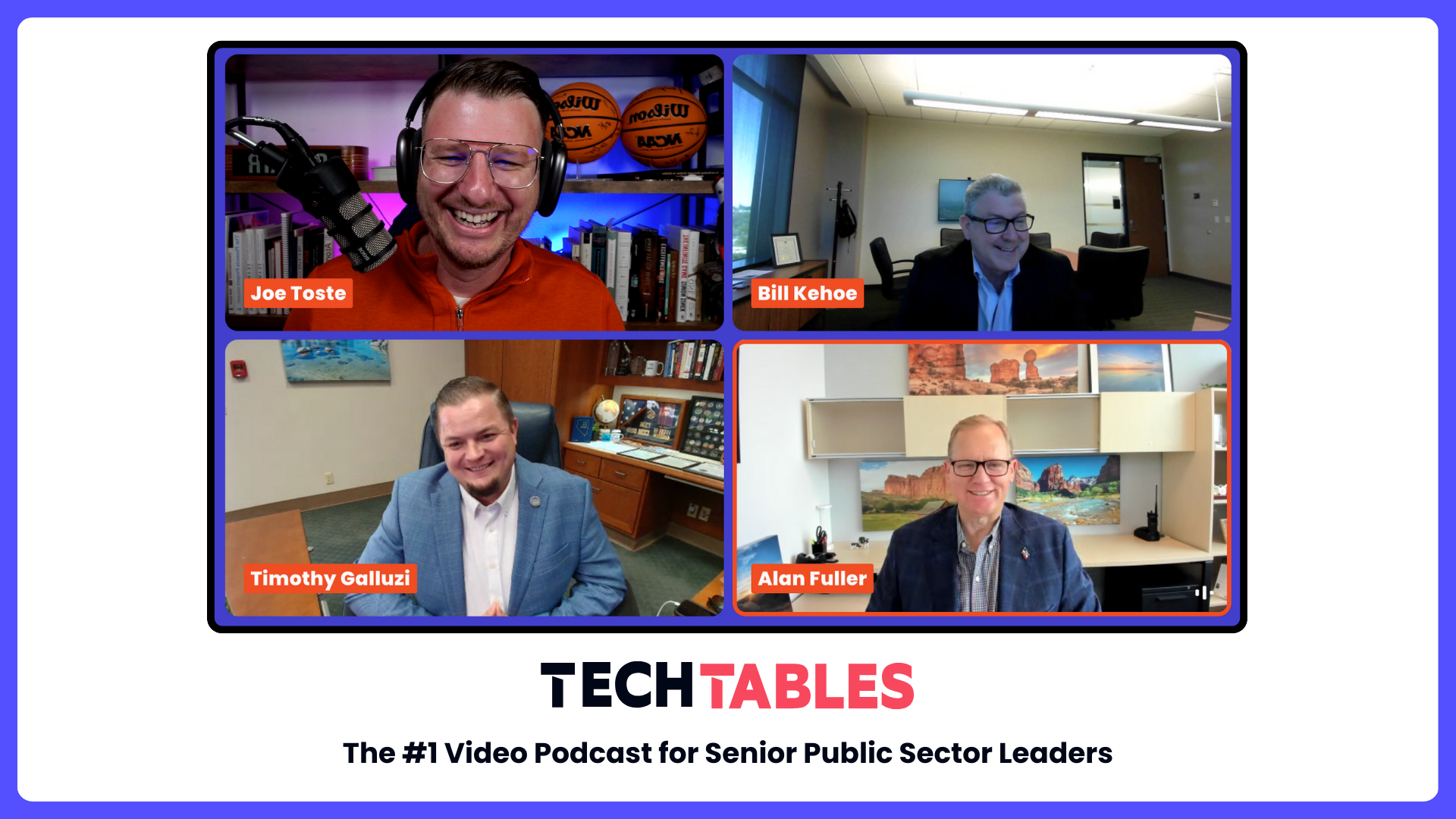
#### [#218: How 3 State CIOs Cut Through AI Hype to Save Millions with Bill Kehoe, Tim Galluzi, Alan Fuller](https://techtables.com/podcast/218-how-3-state-cios-cut-through-ai-hype-to-save-millions-with-bill-kehoe-tim-galluzi-alan-fuller)
[](https://techtables.com/podcast/220-from-admin-to-youngest-cio)
#### [#220: From Admin to Youngest CIO- How Curiosity & Collaboration Built Two Public Sector Leaders](https://techtables.com/podcast/220-from-admin-to-youngest-cio)
[](https://www.techtables.com/)
### The #1 Video Podcast for Senior Public Sector Leaders
Join 250K+ Public Sector Leaders—from State and Local Government to Higher Education—including CIOs, CISOs, City Managers, and Executive Directors—by subscribing to exclusive podcasts, live events, and invites to private meetups and more!
[linkedin-in icon](https://www.linkedin.com/in/jtoste/) [twitter icon](https://twitter.com/thejoetoste) [Follow us on Facebook](https://www.youtube.com/@techtables/) [Follow us on Facebook](mailto:joe@techtables.com)
```json
{
"@context" : "https://schema.org",
"@type" : "BlogPosting",
"author" : {
"@type" : "Person",
"name" : "Joe Toste",
"url" : "https://techtables.com/podcast/author/joe-toste"
},
"dateModified" : "2026-06-21T23:46:52.772Z",
"datePublished" : "2025-08-14T05:35:02.000Z",
"headline" : "#214: Clark County: $370M Budget + 4M Daily Cyberattacks + AI Agents on Org Chart (& Running 20 AI Pilots)",
"image" : [ "https://techtables.com/hubfs/Screenshot%202025-08-13%20at%2010.24.47%20PM.png" ],
"mainEntityOfPage" : {
"@id" : "https://techtables.com/podcast/214-clark-county-370m-budget-4m-daily-cyberattacks-ai-agents-on-org-chart-running-20-ai-pilots",
"@type" : "WebPage"
},
"publisher" : {
"@type" : "Organization",
"logo" : {
"@type" : "ImageObject",
"url" : "https://techtables.com/hubfs/TechTables%20Black%20&%20Red%20Logo%202023-1.svg"
},
"name" : "Levity Media LLC"
}
}
```