---
title: "#218: How 3 State CIOs Cut Through AI Hype to Save Millions with Bill Kehoe, Tim Galluzi, Alan Fuller"
description: "3 State CIOs reveal AI saving millions: Nevada's wildfire detection, Utah's 70% call deflection, Washington's COBOL revolution. Real results, not hype."
image: https://techtables.com/hubfs/EP%20218%20YouTube%20Cover.png
---
[Skip to content](https://techtables.com/podcast/218-how-3-state-cios-cut-through-ai-hype-to-save-millions-with-bill-kehoe-tim-galluzi-alan-fuller#main-content)
[All posts](https://techtables.com/podcast/all)
September 30, 2025
# #218: How 3 State CIOs Cut Through AI Hype to Save Millions with Bill Kehoe, Tim Galluzi, Alan Fuller
 Joe Toste · 32 minute read
[mailto:email@email.com](mailto:email@email.com)
### 📬 **The TechTables Newsletter**
TechTables connects public sector technology leaders — CIOs, CISOs, and CTOs — through darn good conversations and peer-driven community. The best place to start is the newsletter.
**Subscribe now.👇**
### **Episode Summary**
What if the future of government IT isn’t about the biggest budget—but the courage to ship fast, fail forward, and use AI that actually works?
Three state CIOs share how they’re turning bold ideas into measurable wins:
• Nevada detects wildfires faster and launches aircraft sooner with AI.
• Utah rolled out Gemini statewide—deflecting 70% of help-desk calls.
• Washington uses AI to translate legacy COBOL into plain English, cutting months of manual work.
You’ll also hear Tim Galluzi’s Marine Corps lesson that *“speed beats perfection,”* Alan Fuller’s vision for cryptographically verifiable credentials (yes, even beekeeping licenses), and Bill Kehoe’s “Coffee with Kehoe” approach that guided teams through a $16B deficit with transparency.
When CIOs put people before platforms, they build systems that truly serve citizens.
### **Featuring**
[**Bill Kehoe**](https://www.linkedin.com/in/william-kehoe-a37a0714b/), Chief Information Officer, State of Washington
[**Tim Galluzi**](https://www.linkedin.com/in/timgalluzi/), Chief Information Officer, State of Nevada
[**Alan Fuller**](https://www.linkedin.com/in/alan-fuller-101a41/), Chief Information Officer, State of Utah
### **Timestamps**
([01:00](https://www.youtube.com/watch?v=FoKjSscQ8zk&t=60s)) Coffee with Kehoe: Leading Teams Through $16B Deficit with Transparency
([03:31](https://www.youtube.com/watch?v=FoKjSscQ8zk&t=211s)) Marine Corps to State IT: "Speed Beats Perfection" Leadership Philosophy
([11:00](https://www.youtube.com/watch?v=FoKjSscQ8zk&t=660s)) Utah's Reality Check: From "Can't Run Zoom" to Strategic Innovation Partner
([15:00](https://www.youtube.com/watch?v=FoKjSscQ8zk&t=900s)) Data Foundation First: From Spreadsheet Chaos to Customer Experience Insights
([19:36](https://www.youtube.com/watch?v=FoKjSscQ8zk&t=1176s)) 3 States, 3 AI Wins: COBOL to English, 70% Deflection, $1M Saved
([30:30](https://www.youtube.com/watch?v=FoKjSscQ8zk&t=1830s)) Wildfire AI: Nevada Saving Lives with Early Detection
([36:00](https://www.youtube.com/watch?v=FoKjSscQ8zk&t=2160s)) "We Aren't the Alpha Big Dog": Learning from the Smallest Counties
([39:00](https://www.youtube.com/watch?v=FoKjSscQ8zk&t=2340s)) Digital Identity Revolution: Every Credential Cryptographically Verifiable
([42:00](https://www.youtube.com/watch?v=FoKjSscQ8zk&t=2520s)) One Portal, One Identity: Making Government Simple for Citizens
### 🔥 Want more from TechTables? Check out these 3 other binge-worthy episodes you can’t miss.
- [#209: Teena Piccione, J.R. Sloan, Mark Wittenberg, Jonathan Feldman & Joe Durante](https://techtables.com/podcast/209-teena-piccione-j.r.-sloan-mark-wittenberg-jonathan-feldman-joe-durante)
- [#173: Exclusive Interview with the 23rd Governor of Arizona, Doug Ducey](https://techtables.com/podcast/173-exclusive-interview-with-the-23rd-governor-of-arizona-doug-ducey)
- [#138: Breaking Burnout with Jim Weaver, CIO, North Carolina & Mandy Crawford, CIO, State of Texas](https://techtables.com/podcast/138-breaking-burnout-with-jim-weaver-cio-north-carolina-mandy-crawford-cio-state-of-texas)
Whenever you’re ready, there are 3 ways you can connect with TechTables:
#### **1. 📬 The TechTables Newsletter**
Thanks for reading TechTables! Get early access to new episodes, insights, upcoming events, and more — straight to your inbox.
Join now: [https://www.techtables.com/](https://www.techtables.com/)
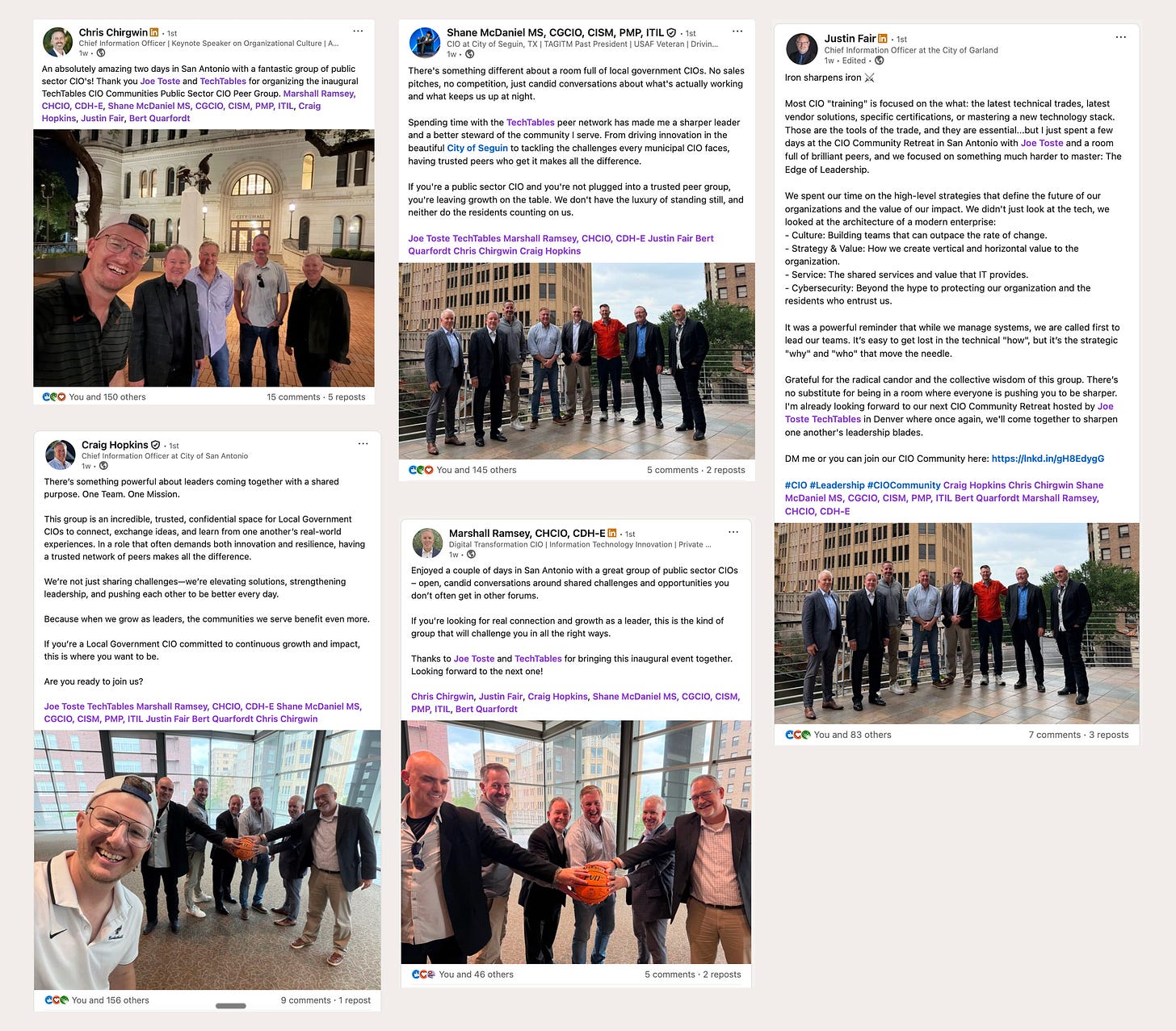
2\. 🤝 Are you a local government CIO who wants to become a better leader?
Check out our high-trust, vendor-free peer group built for local government CIOs tackling real challenges, honest conversations, and an authentic desire to become a better leader — our next retreat is November 2026!
Learn more → [https://techtables.com/communities-local-government](https://techtables.com/communities-local-government)
### 3. 🤝 The Better Together Series (Virtual & On-Site)
The narrative-driven series bringing together industry partners and public sector CXOs. Discover the compelling stories that unfold when we stop working in silos and start building together.
»»» Email [joe@techtables.com](mailto:joe@techtables.com) to learn more.
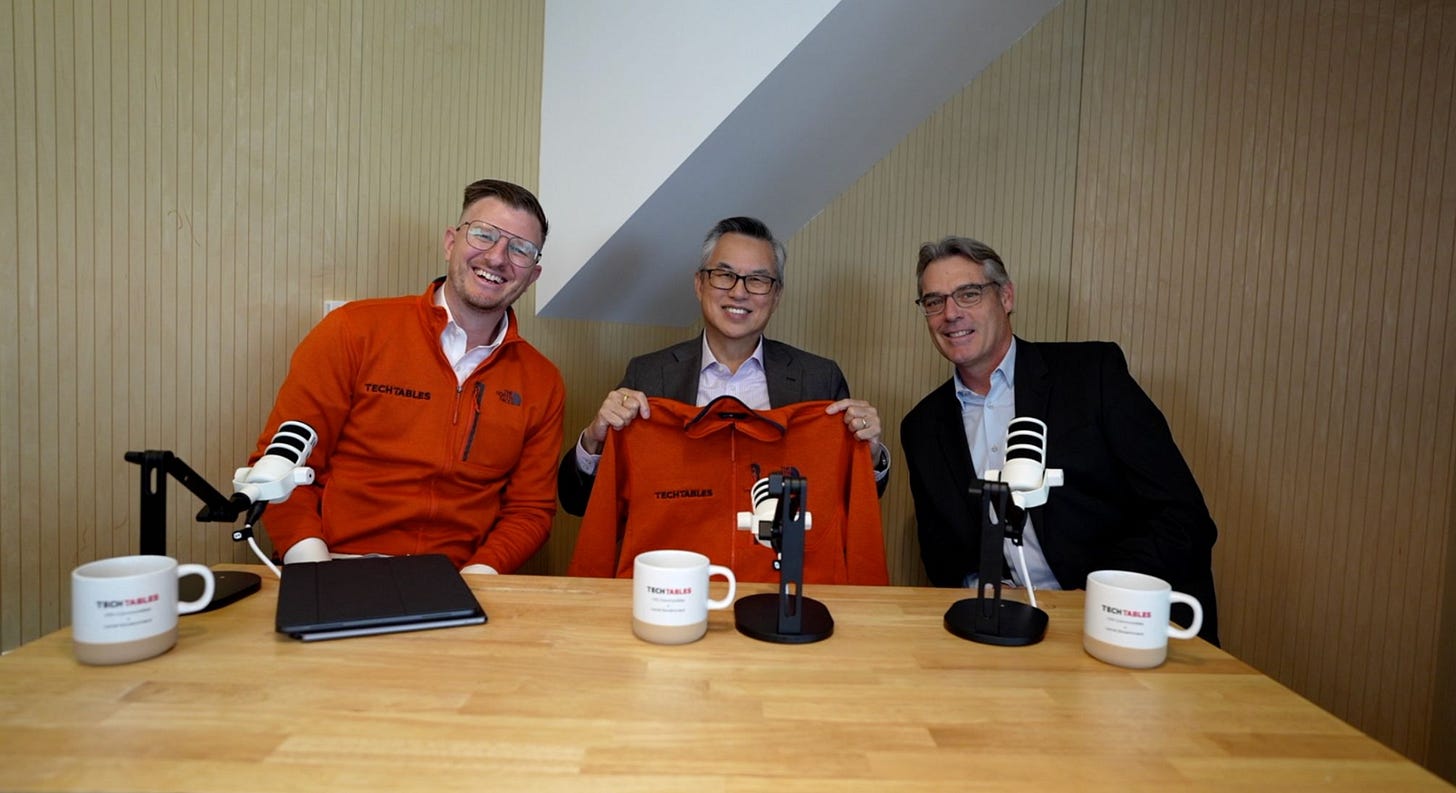
> TechTables Better Together On-Site with Peter Loo, CIO, LA County & Hannes Scheidegger, Chief Global Delivery Officer at Info-Tech Research Group
### Platinum Newsletter Sponsor:

Join TechTables & Info-Tech Research Group at [**Info-Tech LIVE 2026 - New Orleans**](https://preview.convertkit-mail2.com/click/dpheh0hzhm/aHR0cHM6Ly93d3cuaW5mb3RlY2guY29tL2V2ZW50cy9uZXctb3JsZWFucy1saXZl) (February 3 - 4, 2026) and/or [**Info-Tech LIVE 2026 - Las Vegas**](https://preview.convertkit-mail2.com/click/dpheh0hzhm/aHR0cHM6Ly93d3cuaW5mb3RlY2guY29tL2V2ZW50cy9sYXMtdmVnYXMtbGl2ZQ==) (June 9 - 11, 2026)!
Learn more about upcoming Info-Tech events here: [**https://www.infotech.com/events**](https://preview.convertkit-mail2.com/click/dpheh0hzhm/aHR0cHM6Ly93d3cuaW5mb3RlY2guY29tL2V2ZW50cw==)
### Gold Newsletter Sponsor:
****
> **[SentinelOne](https://assets.sentinelone.com/ghe/sentinelone-empowers)**—Learn how SentinelOne empowers this state to stay secure.
>
> **[Verizon Frontline](https://www.verizon.com/business/solutions/public-sector/public-safety/)**[—](https://www.verizon.com/business/solutions/public-sector/public-safety/)The advanced network that keeps first responders connected when it matters most.
>
> **[Carahsoft](https://www.carahsoft.com/)**—The Trusted Public Sector IT Solutions Provider™, supports government agencies and education/healthcare markets. Contact your Carahsoft rep today to access special discount pricing exclusively through the TechTables + Carahsoft partnership!
Transcript
Joe Toste: Welcome to The Public Sector Show by TechTables. Super excited to have three amazing state CIOs on today. We've got Bill Kehoe, the state CIO for WaTech, Alan Fuller, the state CIO. For Utah and Timothy Galluzzi, the state CIO for Nevada.
Gentlemen, welcome to the Public Sector Show by TechTables.
Bill Kehoe: Thanks, Joe. Thanks. Great to be here. I've heard this is the best podcast outside of Coffee \[00:01:00\] with Kehoe, which we'll talk about. At least it is. Now,
Joe Toste: Bill, we're gonna start. I really appreciate the kind words to, to my heart. Bill, you, let's kick off with you.
For those who don't know you. Tell us a little bit about WaTech yourself and coffee with Kehoe.
Bill Kehoe: Coffee with Kehoe. So WaTech isn't the state I represent. It's actually Washington state of Washington. And I've been the CIO here for four years and loving every minute of it. And I get to work with great colleagues like Tim and Allen through NASCIO and other events.
And there's a, just a strong state CIO community. In the country. So it's fantastic. Coffee with Kehoe started out as just a fun event. When your comms director comes up and says, Hey, I think you should do something something new, you always run. And I didn't this time and started out pretty small and it was definitely a growth opportunity 'cause I'm not one that likes to get in front of a camera, but I'm enjoying it a lot.
And it was a way to communicate with staff 'cause we're remote and with other agencies in the state. So it started pretty \[00:02:00\] small just for some key technology and leadership messages. But then I started getting like emails from industry. So instead of, wanting to meet with me, they'd say things, cute things like, Hey, I wanna have coffee with Kehoe.
Can we meet? So it, it turned into a funny thing. I'd go to NASCIO and other events and I just saw your Liz podcast, that was great. Which they never really liked it, but it was a good opener for to to have with industry. But I've expanded it. Now I have a co-host. Now We have a really cool set that we're working on and we have guests and it's a great opportunity to highlight my staff who, don't get highlighted a lot. It's like I had of HR directors on the last show, which was fascinating. So it's a good growth experience, and then it's a great way to get the message out about what we're doing in Washington. Enjoyed it.
Joe Toste: Yeah. I love that. State of Washington I've been so accustomed to saying the state of Washington.
Bill Kehoe: thought we had a new state. That's great.
Joe Toste: Yeah, 51st. 51st State.
Bill Kehoe: Yeah.
Joe Toste: Fun fact about Bill. One time I went to the state of \[00:03:00\] Washington. I was in Seattle. Bill rented a car, drove down to Olympia, went to Spar Bar with Ralph and a bunch of other agencies, and ran into Bill at WaTech. And he goes, Joe, what are you doing in Olympia?
Bill Kehoe: Exactly. Your
Joe Toste: reaction. Your reaction was priceless. It was great. I really liked it. Olympia was great. Thank you Bob. I really appreciate that. Mr. Tim, we're just gonna go around in circle as far as I am, just a little bit about yourself.
Tim Galluzi: I'm Tim Galluzzi. I'm Nevada's State CIO, executive Director of the Governor's Technology Office.
Marine Corps Vet Career Public Servant. My job is simple, make technology invisible to my agency partners, make my services feel invisible. Be their strategic partner but also make my teams feel seen to really be their cheerleader, be their voice be an advocate for technology across the state.
And I think that we're doing a real good job of doing just that. It's been a blast. I've been agency head now for. Been over four years. I was initially hired on as the division \[00:04:00\] administrator of VIN Enterprise IT Services division way back in February of 2021 back in the midst of the COVID-19 pandemic.
Back then I started a little thing called Coffee with the administrator that I did as a weekly touch base with all of my my division as just a a cooler conversation just to to keep in touch with everybody. Yeah it's a common theme, bill, and I definitely appreciate the scope and the what you've been able to do with yours, man.
That's awesome.
Joe Toste: Thank you, Tim. And I did actually listen to the last episode, Bill. It was really great. And I,
Tim Galluzi: oh no, we lost Joe. What happens when you lose,
Bill Kehoe: you're a host. I
Alan Fuller: guess that's a retake.
Bill Kehoe: We're still recording.
Tim Galluzi: We could really
Have,
We could really have a blast here without Joe, I could ask you two questions.
Joe Toste: That conversation was so good. I just disappeared. We were totally roasting you so hard.
Bill Kehoe: It
Joe Toste: happens more than you can
Bill Kehoe: get into ServiceNow Tech at Joe. Come on. Hopefully we can find a tech person that can help you. You gotta get
Joe Toste: that fiber connection to your house, man. I know.
I was gonna say, bill, that was a great episode because I was \[00:05:00\] thinking about Will Smith in Seattle, who's the Chief of Staff there. He is, got a big HR background and really appreciated. I don't know if the two of them, I think her name was Amy, is that right? I dunno if the two of them ever connected.
Bill Kehoe: Yeah.
Or that's your, or that's
Joe Toste: your co-host? Amy's your co-host.
Bill Kehoe: Yeah.
Joe Toste: Is it Jennifer? Who is the gal who was the hr?
Bill Kehoe: That's our HR director.
Kathleen over Mill. And she actually refused to come on and then did amazing.
So that, back to that, growth opportunity and highlighting, as Tim said, highlighting your staff. Alan,
Alan Fuller: thanks for having me on, Joe. It's great to be here. And so I've been the CIO for the state of Utah for about four and a half years, and this is my first foray into government service. Prior to coming to the state, I was with Oracle Corporation for 21 years, about a third of that time in product management.
And about two thirds of that time in internal IT roles. Did a lot of business intelligence, advanced analytics, what we now call data science, data warehousing. And it was a great experience, really enjoyed it. And then basically a miracle occurred and here I am. I \[00:06:00\] have not ventured into the podcasting realm yet, but I, man, maybe that's something I should be doing.
Joe Toste: Off camera. I think you had mentioned that when we had met that the GIS team was thinking about exploring something like this.
Alan Fuller: Yeah, that's right. We have one, one of my teams has they do the GI services. The team is called UGRC, and they do mapping for the whole state great service, great maps that they present, and they're thinking about doing a podcast.
Joe Toste: Highly recommend it. I think obviously y'all see the value, but I think as an internal, we're gonna talk about this at the end, but I think as an internal external communication tool, there is nothing better. Especially when you're distributed or remote it's just hard to get people on the same page and it's just a great, fantastic tool.
I personally opt for the video podcast because I think a lot of people love seeing it on YouTube, so I think that's always a win. Bill, let's let's dive back a little bit, just a little bit back into Coffee with Kehoe. You had a, maybe it was like a nine or 10 minute segment called Leadership in a Time of Change, and you had shared some insights on navigating.
Uncertainty, building \[00:07:00\] stronger, more connected teams. What I was curious, like what was the genesis? You talked a little bit about it of the podcast and I put this in quotes 'cause I heard, when I actually listened to the podcast, you said you opened up. And I love I love how you smile about this, but you're like taking the podcast by store millions of views.
I love the levity. Of that. You
Bill Kehoe: gotta have, you gotta have a vision. I think I had 69 last, we're growing. No, I, that was a really critical time for our state. We had a change in governor, which has always brings around a lot of uncertainty. We had a $16 billion deficit. Our governor asked each of our agencies to take a 6% cut.
So that was on top of all the other change. The federal government shifted and there was a lot of concern over how that was going to impact the state in terms of funding. And there was talk of furloughs. And so I really felt like I had to get on that particular podcast with a message to leaders saying, Hey, \[00:08:00\] this is our time to step up.
Let's not. Let's not go into hiding. Let's not do the fear thing and the paralysis thing. Let's actually step up. Let's really talk to our staff over communicate, be transparent, check in on them, because there's, so much uncertainty going on. And so I use that truly as a message for leaders.
It's we're gonna get through this. Here's how we're gonna do it. Your leadership is critical. Don't underestimate the importance of your leadership and we're gonna be here with you. And what I try to do is say, look, we're not gonna stop. We've got priorities. We're gonna move ahead.
Business is not as usual, but we know what we need to do. Let's do it if you have any concerns or questions, so at that particular time, I used the podcast forum. Just to send a message and to reassure my staff, but also to send a message to other leaders. It's this is a time when you know our staff need us, and let's be proactive.
Let's lean in, let's be innovative, and let's \[00:09:00\] not, hide in fear of what's happening in the future, and let's use this as an opportunity. So I took that as an opportunity.
Joe Toste: That podcast is still timely today. I was talking to an agency, one of the largest agencies in Los Angeles. I think they've gotta trim 200 million, but it's all around the country where everyone federal funding is getting dried up.
And this is, I think when leadership's gonna be even more critical. Tim, you have a little bit of leadership eight years in, in the military. Thank you for serving, sir. As a Marine, I don't use that lightly. My father served as a Marine. You made a comment in a previous podcast episode that I just loved.
I love it. Just brought a little bit energy to it, like you just said. Like you wanna be known like that you gave a crap and that you cared for people. I think I just love the energy. Yeah. It's a fist pump. I was curious what are one to two lessons that you learned from your military time that you apply as state CIO today?
Tim Galluzi: Yeah. I think what often gets lost and I'll start with this, what often gets lost is the first thing we must remember is that, we're leaders of organizations, of people first, and. Those people are in the business of it. The fundamental \[00:10:00\] leadership lessons that I learned while I was in the Marine Corps are transferrable.
And the people come first and the technology is second. So if you take care of your people everything else will work out. First lesson is I give my teams a clear North Star. And the autonomy to move I empower them. And then the speed beats perfection.
When the mission is clear if they have their direction they're going to move. And then people who feel safe will ship better systems. I invest in that psychological safety. And then if they make mistakes which that's bound to happen when people are moving fast.
You give time for that after action. And you know that after action is critically important. It gives time to do that lesson learned. Learn from those mistakes. And I never punish people for, honest mistakes because that's how you're gonna, that's how you're gonna stifle innovation.
My job is to remove that friction, remove the impediments, and that has \[00:11:00\] really created an environment where folks feel like they can win and that, that has fundamentally changed how this organization actually operates. So that's, it's been huge. It's been a game changer for us. I've seen a huge shift in, in the culture of this organization.
Joe Toste: Love that. And for those who do listen to the podcast, I always bring up basketball analogies all the time 'cause I coach high school basketball and when mistakes happen or when the ball gets turned over, I'm never actually mad at the kids when the turnover happens. But I am mad if you don't get back on defense.
Wow, why are you standing behind the back core just waiting. I love that. It's just next play, right? Yeah. And just having that mindset.
Tim Galluzi: There's always an opportunity to learn from it, right? It's but if you make the same mistake twice, then you know, that's an opportunity for a conversation.
Joe Toste: Yeah. Love it. Alan, in a previous interview you had mentioned that so Utah's centralized it about 20 years ago, and that you wanted to be a strategic innovation partner with each agency. But what really stuck out to me during that little short snippet was your story about sitting down \[00:12:00\] with an agency executive who said basically Hey Alan, that's all cool and good, but I can't even run a Zoom meeting 'cause of wifi issues.
Walking just through the leadership philosophy in Utah, I'm sure it could have been pretty easy just to ram issues down in a centralized environment, but you've taken a very collaborative approach. Like where did that come from?
Alan Fuller: We do have a very collaborative approach. We're set up and I, when I think about leadership, philosophy, fun, fundamentally we wanna be value add partners for our agencies and, help them accomplish their business objectives and their goals.
I think, sometimes in it we get in the mode of being plumbers that is reactively taking orders and getting stuff done. Some, sometimes. We get in the role of traffic cop, which is saying, no, don't do that. No, don't do that. And other times, we're the builders and I wanna, I want our organization to move more towards being builders, people who are proactively.
Lean leaning into strategically help agencies do stuff and hopefully we're organized in a, in such a way that helps us \[00:13:00\] do that. Now, I also recognize, you gotta keep the lights on and the truth is, nobody cares how smart your AI is if your network is down. So there's a certain amount of you gotta keep things working.
But I really hope that we can go in and be at the table be in the room where it happens. Hamilton, you gotta, you wanna be helping the business make the decisions about how they can improve things and do things a different way. Maybe a quick story to highlight. We have. I've had some conversations with agencies and their idea of modernization was we got a website and we put a PDF form out for somebody to download or, print, fill out in person, send, or actually take in so that someone else in the state can take it and manually process it into the system.
I'm like, guys, like the nineties called, they want their technology back. We can do things a lot better than that. And and it, it requires a change in process and as well as a change in technology, and we want to be that partner that helps 'em
Joe Toste: Love it. If you had to \[00:14:00\] ballpark it, what percentage would you say you spend your time on as far as keep the lights on versus maybe the strategic work?
Is it 80 20? 50 50?
Alan Fuller: For the whole organization or for me personally?
Joe Toste: For you personally, as state CIO.
Alan Fuller: Oh I'm probably more much more in my biggest roles are relationship building and communication and strategy. My team has to keep the lights on and we spend, I don't know, probably 60, 70% of our time doing that.
Joe Toste: Great. Awesome. Yeah, I love that. So Bill, you've called yourself the data, CIO. Which is actually pretty good because Alan, I think with the strong background and everything, all the, we're
Bill Kehoe: getting these books, but Tim and I dunno if we're gonna know, he's,
Tim Galluzi: Alan's definitely like the identity CIO, right?
Joe Toste: Yeah. We're gonna get, we're gonna get to that. Oh, we're gonna let Alan rip on that one because he told me a little bit earlier, throw you under the bus, Alan.
Alan Fuller: Nope. I'll own it. Hundred percent.
Joe Toste: And Bill, you had said that without a good data foundation, you get chaos in spreadsheets.
Bill Kehoe: And access database
Joe Toste: and access databases.
Exactly. \[00:15:00\] You've also said the goal isn't to collect data, but to actually use it to understand how the services are actually changing people's lives. Walk us through WaTech's approach to building Data Foundation and give us a specific example, how you've moved from just collecting data to insights that actually drive across the entire state.
Bill Kehoe: Yeah. When I got here, similar to I think many governments, it's very, data's very transactional and it, we collect a lot of data, operational data, transactional data, but we don't use it. And there was a tremendous, we didn't have a data strategy, we didn't really have any of these powerful cloud analytical platforms.
And we wanted to talk about AI and we wanted to talk about new systems. And I really raised the bar and said, look, we can't do anything like this without data. We have to have a foundation of data. We gotta know where our data is. We have to understand where our sensitive data is, protect it.
And so I, I really emphasized the importance of data and \[00:16:00\] then. We we created our IT enterprise strategic plan and we brought together our business and IT leader state. So we didn't do that in the vacuum. And it turns out that all of our agencies, business especially, we're interested in doing better with data.
It's wow, this is cool. I don't have to make this up. We have a goal now on our, it one of our four goals around data. And we've changed the goal name, but the first goal was great. It was, better data, better insights, better Washington or something like that. And from that we put together a data strategy that is now alive and well.
We put together a we purchased. Data analytics platform, we're starting to populate so we can bring data from around the state. And really, like you said the emphasis on that is we need insights. An example would be we're getting a lot more insights now on the customer experience. And that's really important because if we're not, if the customer experience is bad and we think it's great.
We're not serving our \[00:17:00\] residents, right? So we're doing a lot more on the customer experience side, whether that's websites services, applications, whatever it is around the experience. And then that allows us to make adjustments, and that's the whole purpose of our data strategy. A lot of it is as our services are being consumed.
Is it having the impact and the outcomes? And we just haven't done that very well in, in this, in government. And it's gonna transform how we use data. It's gonna actually drive us to making better decisions, more strategic decisions, and it's gonna drive us to serve our residents in a much better way.
I like to say, in the private industry. If you're not using data to get insights on your services, you out of business government. And if we don't do that we just serve our residents in a terrible way and it gets worse. So it's really important, but it's a hard sell as
Joe Toste: well. Yeah, I've heard from some.
They're now past state CIOs. They've never ran like an NPS \[00:18:00\] type of score before and they wish they had when they were in the office. I just always smiled at that 'cause yeah, if you're not collecting data to know hey, we, this is actually service actually valuable. Probably should go back out and do that.
And I'm a consumer, as an individual and a business owner. And so I'm actually very curious when I, when CIOs talk about modernization projects, it could be business licenses. This is right outta my alley now. I live in state, California, but I'm still curious I wanna know what you're doing because I consume those services.
Both at a, local level, a state level, and at a federal level at the same time whether it's paying taxes or whatever. Love it. And Bill, just to brag on you a little bit I've interviewed I think several of the other agencies in Washington. And they all speak very highly of you which is great.
So we recently had George Williams on at
Bill Kehoe: Oh yeah. Oh yeah. Yeah.
Joe Toste: Cannabis and Liquor? That was a great podcast by the way. That was fantastic. We've had Erica early on at the Treasury and Mary Craig accessibility. Yeah. Yeah, she's a big fan. So no, thank you. I really appreciate that. Just a quick follow up, I gotta ask, I \[00:19:00\] know I gotta say it, but as far as AI.
You've got the data strategy. Where are you in the AI journey right now?
Bill Kehoe: That's a great question that I get a lot.
A short story here. I was going through my confirmation on the hearing and one of the senators that told me, the state, CIO of Utah says that he wants to be the AI leader in the nation.
What do you have to say about that? I have no idea how, what man, when I see that Alan Fuller next time,
Alan Fuller: his neck.
Bill Kehoe: Oh. But anyway I don't think I answered that question very well. I think that's all I
I know that guy. I know that guy. I'll have to, so we've done a lot with task force policy.
Privacy and cyber regulation and building that foundation governance. And what I would like to see us do more is innovate. I think we can get cut out, caught up, and we should in, in making sure we have a really good foundation. And I think we've done that, but we need to start innovating around with AI and really starting \[00:20:00\] to see the impacts and the transformations that.
I think we've done some good things. We do have some examples of AI that's really transformed some of our services. Open data, GIS one of the uses of AI that I talk about a lot is that we developed an AI solution or our industry partner to extract. COBOL code into eligibility rules and plain language that could be loaded into a business rules section.
And you can imagine how much time that's saved. So we're doing a lot of modernization. That modernization usually includes, understanding what the current systems do. And if we can use AI in a way to extract that for us in a very short amount of time, it can save months. And the accuracy is much better.
So I think it's going to, help us with hr, help us contract procurement. We're building a resident portal. We're gonna have a AI chat bot there as well. But I think it's just the tip of the iceberg in terms of what AI \[00:21:00\] is gonna actually do for us.
Joe Toste: Thank you for sharing that. Alan, did you wanna comment on the senator, the state Senator? Did you wanna make a comment about me? I have no
Alan Fuller: idea how that got there. No idea whatsoever. We can talk about AI though.
We have the for our productivity suite, we're a Google shop and, google did a great thing for us where they bundled their AI into their productivity suite of electric charge to us, basically. And so it's funny 'cause we'd actually started down a path on a, pilot with them. We were paying for extra for the product. We were paying extra and it was gonna be, it looked like the AI suite was gonna be about two and a half times the cost of the productivity suite, the base productivity suite. And then, they came by and said, no, actually, we're just gonna bundle all of this.
And that's been really terrific. So we've rolled that Gemini product out to pretty much all of our employees. And we tr we like to be a little bit scientific about how we measure it. So we're looking at a rolling 28 day usage average. And what we're seeing is. Usage is just \[00:22:00\] skyrocketing.
And one of the things that I think is limiting us is the ability to train people and bring them up to speed on how they can use it. Naturally some people are jump in, with both feet and learn lots of things to do with it. But not only, interestingly, we also, not only were we seeing more people using it.
But we've broken it up and we say if somebody in the last 28 days, if they've used it one to three times, they're a low volume user. If it's four to 19, they're a medium volume user. And if they're 20, if they've used it 20 or more times in a 28 day period, we say they're a high volume user.
And then we're tracking these metrics of adoption as we go through. And, what we're seeing is not only are more people, you're using it, but. People are using it more. So we're shifting a higher percentage of people into the high level of use case. And the important thing about the Gemini for us is that it gives us a high quality AI tool that is secure and private.
Both the prompts and the responses stay within our enterprise. \[00:23:00\] So we're actually, we've actually put out a policy that says we don't want state employees going to public AI utilities, chat GPT, and there's a whole host of 'em out there. I don't, I won't name 'em all, but we don't want them going out to those because if they put anything in that's confidential or private, that is a data security breach for us and we want that data to stay within our.
Enterprise and in fact, we can even narrow it down so the data stays within a specific group or organization. That's pretty good. And this has led to some pretty interesting things. We've got I'll give you a couple use cases that have been really interesting. Our commerce department is working on a project to do in international, licensing. Ba basically, someone has gone through medical school in a foreign country and they're a doctor. They've moved to the United States. They wanna become a doctor in the United States. How do we credential them and how do we tell how good their credentials are from whatever foreign country they come from?
When you think about the number of different types of credentials and the number of different countries it's almost this nearly \[00:24:00\] infinite question of like how many, how good their credentials are. But what they found is that they've been able to use. Part of the Gemini Suite notebook LM to, to really quickly analyze the requirements for those credentials in other countries.
And there's both a language component of that and a summarization component of that. And they've been able to dramatically increase the volume of reviews they've been able to done. Been able to do and the speed with which they've been able to go through them. Now, we didn't start out rolling out Gemini thinking, okay, this is gonna be a great use case for commerce.
But what we found is we put the tool into people's hands and they are finding a lot of use cases. So that's been one of our one of our fun things to watch. And then. With regard to other types of generative AI projects I think we have about 50 project requests going on around the state, and probably 12 or 15 of those are chat bots for call center agents.
So we have, \[00:25:00\] we're doing one for tax. We're working on one, we're not live in production yet for our IT help desk, but. The idea is that, we can use a chat bot to help answer questions. For I it help desk example, it'll be as people come in and ask questions, Hey, I spilled orange juice on my laptop.
My, it appears to be fried. What do I do? Or I forgot my password, or my, I'm getting a blue screen. Or, something we can help them and. And, I don't believe everything vendors tell me. Okay. But what I'm hearing from vendors with it help desk chatbots using AI is that they're seeing about a 70% deflection rate deflection rate, meaning the chat bot is answering 70% of the questions before it gets to a human.
And, I don't know if we'll be able to achieve that. I hope we can, but even if we can get anywhere close to that, if we can get 40 or 50% deflection rate. That would be pretty significant for us in terms of a potential cost savings. I know people hear cost savings and they're like, oh, so you're gonna laugh half your people.
It's what? I really, we are so busy. I would love to move people to higher value \[00:26:00\] add positions and higher value add work. And when we look around the state we have nearly 10%. Nearly 10% of the state government employees are call center agents. We have call center, we have call centers tucked all over the place.
In packed in child health services or transportation department has communications. There's a bunch of stuff out there now. I. We have a bunch of other use cases. We're using it for development. One that was really interesting was in our transportation department is they had, they have maps and old maps, paper maps, and they were able to scan all the maps, but they were trying to create a database of right away on the right of way.
Signs were marked on the maps, but they needed them in a machine readable database format, and it would've taken. Thousands of man hours of grueling manual man hours to read those thousands of maps and then type into a database where they have, we're able to, we're able to use a product, scan those maps and train something to go through and create a database \[00:27:00\] for it.
And it, we figure it saved us over a million dollars and over 5,000 hours of work to do that. So we're seeing some efficiencies. Maybe one other quick example we're using a tool for cybersecurity with ai, and of course the bad guys are using ai, right? Phishing attacks are getting more sophisticated.
We're using it to we take all of our network traffic and dump it into a big old tool, terabytes of data, like 10 terabytes a day, and way too much to be human readable. But we have AI tools scanning through that, looking for malware snippets and identifying risks. And then popping out those risks to our.
Cybersecurity team, and that's been enormously helpful for us. So we're finding some pretty interesting ways to use ai and I'm very bullish on the technology.
Joe Toste: That is amazing. I just have a quick follow up. You probably initially put in governance and then you've deployed these tools and then there are probably use cases that you had mentioned that you didn't know.
Are you finding that you're going to, you're having to do like a V two or a V three on the governance front?
Alan Fuller: Yeah, we did. So we , \[00:28:00\] we put out our first AI policy two years ago and we just came out a couple months ago with an update to that and there were some things we needed to refresh for sure.
Look we're gonna make some mistakes and we're gonna have some AI projects fail. And there's a balance that has to be maintained between innovation and moving forward and allowing some failures. I like to call it let a thousand flowers bloom. We're not the only ones with good ideas how to use this technology.
Let's try to talk to all of our agency partners. Put tools in their hands and let them figure things out and or, I don't think we're making huge mistakes, but yeah, not all these projects are gonna be successful and I'm okay with that. In fact, I wanna fail fast if we're gonna fail and let's learn from it and then move on.
And I think by doing that we'll quickly identify where the real value is in the technology.
Hallucination bias, there's a number of issues, but what we're trying to do with call center agents is you've probably heard this term retrieval, augmented generation or \[00:29:00\] rag, and we take the, we can take a knowledge base of information like tax information or a our IT knowledge base.
And we can ground that knowledge base to a large language learning model and then we could do. We get much higher quality answers, much less hallucination, much more context sensitive context, rich, specific answers. And I also think, the, as the AI becomes more agent, so we try to run the questions first through an agent that is like an appropriate check agent, right?
So we don't want our chat bot to tell people like. Where to bury a body or where to buy drugs or this stuff. And that's the first thing. If we, when we come out with a public facing chata, that's the first thing people are want, gonna wanna do is break it and make it say something stupid so they can put that in the news, right?
But we wanna run it through an appropriate check and break up the pieces of response. So then you can have you can have multiple different AI agents responding to different types of topics. Anyway, that's what we're working on.
Joe Toste: It. Tim, you've got some big wins in \[00:30:00\] Nevada, especially on the AI and modernization front.
I've heard one, the Wildfire AI system, but I'm gonna let you, you might have 52, so I'm just gonna let you
Tim Galluzi: riff. Yeah, no I think we're in a very similar position as Alan, so ditto for a lot of what Alan's got going on. We are not a Google shop. We're more on the Microsoft side of the house similarly.
We have rolled out a copilot chat to the entirety of our enterprise. We've been rolling out copilot licenses to a lot of our power users to really start leveraging that product. But as far as AI implementations. Wildfire ai that, that's been a really cool pilot for us. It enables us to be able to get boots on the ground or aircraft in the air much faster than, than.
Humans and that's really just saving lives, right? Like that is technology being deployed to save lives and resources. And, that's a, that's an example of technology at work. So we're really \[00:31:00\] excited about that. That application there. Similarly we've got a lot of applications in call centers.
DMV is a really cool example 'cause that's internal use of call center AI chat bots and we're seeing some really good results there. Speeding up resolution time bringing insights to call center attendance much faster. And really this is really about empowerment, right?
It's really about getting information, resources insights to our team members more efficiently and faster and making their jobs easier so they can spend more time on what. Those higher value, those higher order tasks that make them unique, right? The things that we cannot automate that's what we want them to spend their time on.
Similarly to, I'm sure Alan and Bill. We spent a lot of our time at the very initial side of this setting up guardrails, setting up a foundation for our agencies to follow our statewide IT policy year and a \[00:32:00\] half, almost two years ago now. We've had that in place and really the onus, we put that down onto the departments.
They understand their business, they understand their consumers, they understand their data. And so we set a high level policy with the expectation that the departments would set their own refined internal departmental policy on how that they would leverage AI technologies understanding their data and their own unique business use cases as long as they fit within.
The minimum standards of the state. Obviously we want to ensure that the statewide environment was protected and statewide infrastructure was protected. And so I think that has enabled us to move fast. And to Alan's point to be able to fail fast too I'm a firm believer that there is not a monopoly on good ideas.
Good ideas come from all sources and so we've got a myriad of different pilots that we're. That we're looking at right now. One area of interest for me right \[00:33:00\] now is in the space of permitting. I think that, that is an area where a lot of us can see a a rapid ROI and the the commercial side of industry would love to see us, make some rapid improvement of, service delivery when it comes to interacting with state government is they wanna see their permits get done faster. And that is a area that is highly structured, highly regulated that there is a knowledge base that does exist that can be trained on.
And, I am looking for opportunities to, to augment. Those workflows here in the very near future. We are really excited about what the technology has done for us so far and the capability capabilities that I'm seeing in the near future. We just finished our legislative session.
I think what we've been able to walk the fine line of in Nevada is we've. We found a good \[00:34:00\] balance when it's come to our laws that made it through our legislature when it comes to re actually regulating and setting in statute how we're gonna deal with this new technology.
We looked at, some of the most egregious potential outcomes. We want to protect children, we wanna protect our elections. But we didn't want to really over-regulate or stifle, industry. And I think that we've, we found that right balance here in Nevada. We've done a good job there and we're seeing kind of the fruits of that labor.
We're seeing a lot of companies try to come here and experiment and innovate
Joe Toste: Just a quick follow up. 'cause recently had Bob leak on CIO for Clark County. He also speaks very highly of you. Great partner. Love to hear just a little bit. He's more local government boots on the ground.
You have a great relationship at the legislative level. Does he try and funnel any of that up to you? Does he try, talk about a little bit about that partnership.
Tim Galluzi: Absolutely. Nevada is obviously it's a great state. It's a great place to work and live. Our size gives us a very distinct advantage there.
There's not a lot of states \[00:35:00\] where we have the ability to get, the vast majority of state IT leaders around one table, including our large municipalities like Bob Leak and, representatives from Washoe County and others around one table and have real good strategic IT conversations and Nevada gives us that opportunity.
We've been having conversations about statewide it. Identity about statewide cybersecurity. And he's been a great partner. And we're gonna continue having those conversations because there is a lot of opportunity for those types of efforts. With cybersecurity, there is a distinct shift in.
In wanting to really have states look after themselves and protect themselves and look after our own constituents. And, there's going to be a little bit of belt tightening too. So we need to look for opportunities that how we can share resources amongst state and local governments and, look for opportunities to reduce duplication. And one of those, one of the ways \[00:36:00\] that we can do that is looking for opportunities such as statewide security operation center any opportunities similar to that? And those are the types of conversations that we're having.
Joe Toste: And just 'cause we were talking to Infotech Live and Bob was also there.
Background contact, we're gonna get to this, Alan. Not yet. Verified digital identity, I know is a topic for both Tim and Mr. Bob Leek. So we're gonna get to that in a second. But Bill, I wanted to jump to you real quick. You have this very rare perspective probably, I don't know if any other state, CIO has this, but you worked in local government and not just like in a small local government, you're the CIO for King County, LA County.
Before making the jump to state CIO in Washington state. I imagine that gives you an incredible amount of empathy on both sides of the aisle. Love to know, those, inner workings from local government, those insights that you would love to share with some state CIOs.
Bill Kehoe: Yeah, that's that is a perspective that I bring to state government. Very fortunate.
Say, you're closer to the customer, \[00:37:00\] brings you closer. And more of an appreciation for government services are to the people we serve. And I was able to bring that perspective back to the state. Sometimes we are a little, afar from our customers and we have to.
So there's that perspective. I also did not have always have a great relationship with the state. I think California, it was actually pretty good the collaboration, but we always long for that. If something was missing collaboration and you can't use state services. And I try to bring that back to Washington and, I started a local government collaboration where we meet with local government leaders on a basis, have talk about all.
And what I think and states need to remember, state CIOs need to remember is that we aren't the alpha big dog. We, our problems are just the same as the smallest counties, sometimes cities, and we all can share. And it doesn't matter how big of an organization we are we can learn \[00:38:00\] from local government and local government can learn for us.
So if we approach the relationship as a strategic partnership, not a one way, Hey, we're gonna tell you how to do things, what I found is that local government just ready to engage. To engage and in and with cyber and all the other things we're dealing today. Ai and I try to include local government in my recruitments.
I include them in our AI community of practice within our, we have local government representation in our governance. So it truly is a team sport when it comes to technology state, and we are state CIOs. Like Olympia or city. We are state CIOs and we have to recognize that part of our responsibility is to work
Joe Toste: with our love.
That, thank you for that plug. I know we're coming up on time, but I still wanna keep going. I gotta give, I gotta give Alan the I gotta give 'em a plug for the digital verifiable identity. Love to hear your perspective.
Alan, why don't you, why don't you kick us off?
Alan Fuller: I'll go super quick. Sorry I \[00:39:00\] know Bill and Tim are like, he never goes super quick.
When you have when someone goes today to a concert or a sporting event, high school basketball, even, a lot of times the tickets today are digital. They're on your phone. They're not a physical credential. I don't I have a hard time remembering the last time I got a physical boarding pass to get on an airplane.
And I think most people today board with a digital. Ordering pass. I still have paper. I, it's still an option, but we're moving to a world with digital credentials and it's happening and it needs to happen because of the convenience and the security and so on.
And so I, what I wanna get to is a place where we have a verifiable digital credential for every credential that the state issues, whether it's, phishing license and we have an app for a phishing license, but, professional licenses, beekeeper's license, whatever it is that there's a veri, there's a credential for it.
When I say verifiable digital credential, I don't, I'm not just talking about like a PDF of a credential, right? I'm \[00:40:00\] talking about a credential that's issued by the issuer with cryptographic codes that and then the credential is a digital credential that the holder of the credential can hold in a digital wallet.
Then there is a verifier that can verify the credential using public keys and public private keys to against the cryptographic codes to verify that credential is valid. That both the issue of the credential and the holder of the credential are valid, right? That's where we want get to. And when you start talking about credentials, the biggest credential, the most important credential is identity.
And digital identity. So we just last year this earlier this year, we worked with our legislature and we had some great leadership from some of our legislators and passed a bill, it was called Senate Bill two 60 State endorsed digital identity. And for the first time in Utah state law, it defined what do we mean by identity?
And it said, identity is owned by an individual. The state endorses an individual's \[00:41:00\] identity, and then we want to create, it also gave a bunch of other things about identity and digital identity and specific, but we want to create a digital identity that is a. What you'd call a decentralized identity, that the individual owns their own identity.
And we wanna get to the point where instead of logging in with a user ID and password, which goes into a database of a central party, that I can use my. Verifiable digital credential. State endorsed digital identity to be my login to the system, both in person or online. And I can use that credential.
Now we have a mobile driver's license. It's a great V one. We're glad we have it. We have. A bunch of people have it. Adoption has not been awesome. We're looking to improve that adoption. But going from in person to online credentialing is a big step. And governments are just starting into this stage of having, of giving an individual, a citizen, a \[00:42:00\] credential that they can use online to verify who they are or information about them.
And I just see tremendous value in this, in combating cyber crime, identity theft, fraud. I see it at, I see it making online transactions dramatically easier and safer for both commercial use cases as well as government services. And so that's why I feel so passionate about it and I try to talk about every chance I get.
Thanks for listening.
Bill Kehoe: He is the identity man. He is the man. So the identity, CI.
Joe Toste: The identity. CII love that. Tim, as we wrap up verifiable cyber, whatever you want, take it can take it and then we'll have Bill close us out.
Tim Galluzi: No, I am a hundred percent on board for digital identity for a Nevada id. I think it's all boiled down to one thing and that's simplicity.
And that's really what's government should be striving to provide to our constituency. We should not be putting the onus on the constituent to figure out our complicated \[00:43:00\] government bureaucracy. That owner should belong to us. But every single time we ask them to go to our government websites and figure out which division sits under which department, which bureau sits under which division, what form do I fill out?
That is us telling them that we don't care about their time, and that is not good customer service. That is not good constituent service. That's not good government service. And so I think we need to really take a good, hard look at how we're providing services to our constituents, and identity is a major pillar of that If we can solve the identity piece.
And create one identity and create a one stop shop, one government portal and then augment that with AgTech ai, with gen ai and create a more seamless transaction for that constituent that's real service. And that's really what I'm striving to do here at Nevada. \[00:44:00\]
Joe Toste: Love it. Thank you, sir.
Bill, Mr. Bill Kehoe.
Bill Kehoe: Yeah, I'll go Ditto to here. We're doing exactly what, yeah. Identity was all over the place.
Way to personalized experience.
We want be the
tin said the friction's on the back end. Make the experience easy so they can get the services they need some, or they need or critical services for their
Joe Toste: well. I really appreciate the conversation. I personally, maybe not all of them, but I personally could go for probably a couple more hours.
I just have so many questions and these obviously make for great. Round table discussions. And it just, it was such a fantastic conversation. I know we only had an hour, but I really appreciate you three gentlemen. Thank you for coming on The Public Sector Show by TechTables.
Share: [facebook-f icon](http://www.facebook.com/share.php?u=https://techtables.com/podcast/218-how-3-state-cios-cut-through-ai-hype-to-save-millions-with-bill-kehoe-tim-galluzi-alan-fuller) [linkedin-in icon](http://www.linkedin.com/shareArticle?mini=true&url=https://techtables.com/podcast/218-how-3-state-cios-cut-through-ai-hype-to-save-millions-with-bill-kehoe-tim-galluzi-alan-fuller) [twitter icon](https://twitter.com/intent/tweet?url=https://techtables.com/podcast/218-how-3-state-cios-cut-through-ai-hype-to-save-millions-with-bill-kehoe-tim-galluzi-alan-fuller) [envelope icon](mailto:?body=https://techtables.com/podcast/218-how-3-state-cios-cut-through-ai-hype-to-save-millions-with-bill-kehoe-tim-galluzi-alan-fuller)
## Recommended Next Episodes
[](https://techtables.com/podcast/220-from-admin-to-youngest-cio)
#### [#220: From Admin to Youngest CIO- How Curiosity & Collaboration Built Two Public Sector Leaders](https://techtables.com/podcast/220-from-admin-to-youngest-cio)
[](https://techtables.com/podcast/105-how-great-leaders-inspire-action-with-mandy-crawford-state-cio-texas-kevin-gilbertson-state-cio-montana)
[State CIO](https://techtables.com/podcast/tag/state-cio)
#### [#105: How Great Leaders Inspire Action with Mandy Crawford (State CIO, Texas) & Kevin Gilbertson (State CIO, Montana)](https://techtables.com/podcast/105-how-great-leaders-inspire-action-with-mandy-crawford-state-cio-texas-kevin-gilbertson-state-cio-montana)
[](https://techtables.com/podcast/214-clark-county-370m-budget-4m-daily-cyberattacks-ai-agents-on-org-chart-running-20-ai-pilots)
[The Collaboratory by TechTables](https://techtables.com/podcast/tag/the-collaboratory-by-techtables)
#### [#214: Clark County: $370M Budget + 4M Daily Cyberattacks + AI Agents on Org Chart (& Running 20 AI Pilots)](https://techtables.com/podcast/214-clark-county-370m-budget-4m-daily-cyberattacks-ai-agents-on-org-chart-running-20-ai-pilots)
[](https://www.techtables.com/)
### The #1 Video Podcast for Senior Public Sector Leaders
Join 250K+ Public Sector Leaders—from State and Local Government to Higher Education—including CIOs, CISOs, City Managers, and Executive Directors—by subscribing to exclusive podcasts, live events, and invites to private meetups and more!
[linkedin-in icon](https://www.linkedin.com/in/jtoste/) [twitter icon](https://twitter.com/thejoetoste) [Follow us on Facebook](https://www.youtube.com/@techtables/) [Follow us on Facebook](mailto:joe@techtables.com)
```json
{
"@context" : "https://schema.org",
"@type" : "BlogPosting",
"author" : {
"@type" : "Person",
"name" : "Joe Toste",
"url" : "https://techtables.com/podcast/author/joe-toste"
},
"dateModified" : "2026-06-19T00:57:15.878Z",
"datePublished" : "2025-09-30T05:23:41.000Z",
"headline" : "#218: How 3 State CIOs Cut Through AI Hype to Save Millions with Bill Kehoe, Tim Galluzi, Alan Fuller",
"image" : [ "https://techtables.com/hubfs/EP%20218%20YouTube%20Cover.png" ],
"mainEntityOfPage" : {
"@id" : "https://techtables.com/podcast/218-how-3-state-cios-cut-through-ai-hype-to-save-millions-with-bill-kehoe-tim-galluzi-alan-fuller",
"@type" : "WebPage"
},
"publisher" : {
"@type" : "Organization",
"logo" : {
"@type" : "ImageObject",
"url" : "https://techtables.com/hubfs/TechTables%20Black%20&%20Red%20Logo%202023-1.svg"
},
"name" : "Levity Media LLC"
}
}
```