·
35 minute read
·
35 minute read
📬 The TechTables Newsletter
TechTables connects public sector technology leaders — CIOs, CISOs, and CTOs — through darn good conversations and peer-driven community. The best place to start is the newsletter.
Subscribe now.👇
Episode Summary
Houston's prepping for the World Cup. Frisco's building for the future. And Dell's Derek Williams is making the case that public sector is the hardest game in town. Lisa Kent, Melissa Kraft, and Derek Williams talk honestly about what winning looks like in city government.
Featuring
Lisa Kent, CIO & Director, City of Houston
Melissa Kraft, CIO, City of Frisco
Derek Williams, Chief Technology and Innovation Strategist, Dell & former CIO, State of Louisiana
Timestamps
(10:15) Fusion teams in action — how Lisa's approach to embedding IT with business units delivers measurable wins
(12:00) Building systems that last — Derek's cost allocation model Louisiana still uses a decade later
(14:00) 40% efficiency gains with AI — Frisco's wins in 911 training and traffic processing
(18:00) The CIO role is transforming — all three guests discuss the shift from control to consultation and what it means for the next decade
(24:00) Why 95% of AI projects fail — and the three critical stumbling blocks Derek sees everywhere
(27:45) What NASA's 23-year-old moon landing engineer teaches us about trusting younger technologists
(38:45) What public sector teams deserve credit for — Derek's defense of the hardest working people few appreciate
(41:30) Small bets, big trust — Melissa shares her playbook for incremental innovation that wins department buy-in
Whenever you’re ready, there are 3 ways you can connect with TechTables:
1. 📬 The TechTables Newsletter
Thanks for reading TechTables! Get early access to new episodes, insights, upcoming events, and more — straight to your inbox.
Join now: https://www.techtables.com/
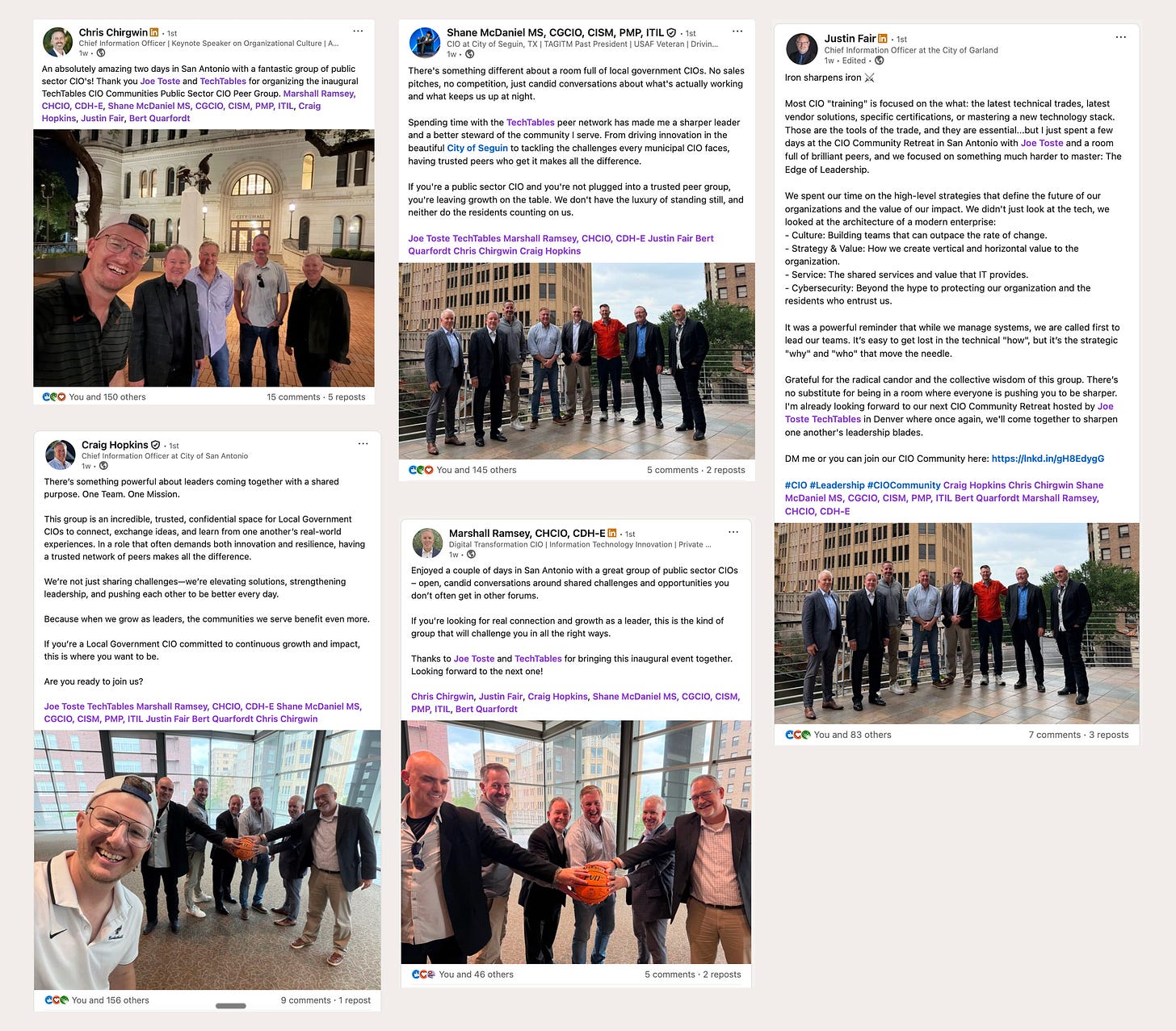
2. 🤝 Are you a local government CIO who wants to become a better leader?
Check out our high-trust, vendor-free peer group built for local government CIOs tackling real challenges, honest conversations, and an authentic desire to become a better leader — our next retreat is November 2026!
Learn more → https://techtables.com/communities-local-government
3. 🤝 The Better Together Series (Virtual & On-Site)
The narrative-driven series bringing together industry partners and public sector CXOs. Discover the compelling stories that unfold when we stop working in silos and start building together.
»»» Email joe@techtables.com to learn more.
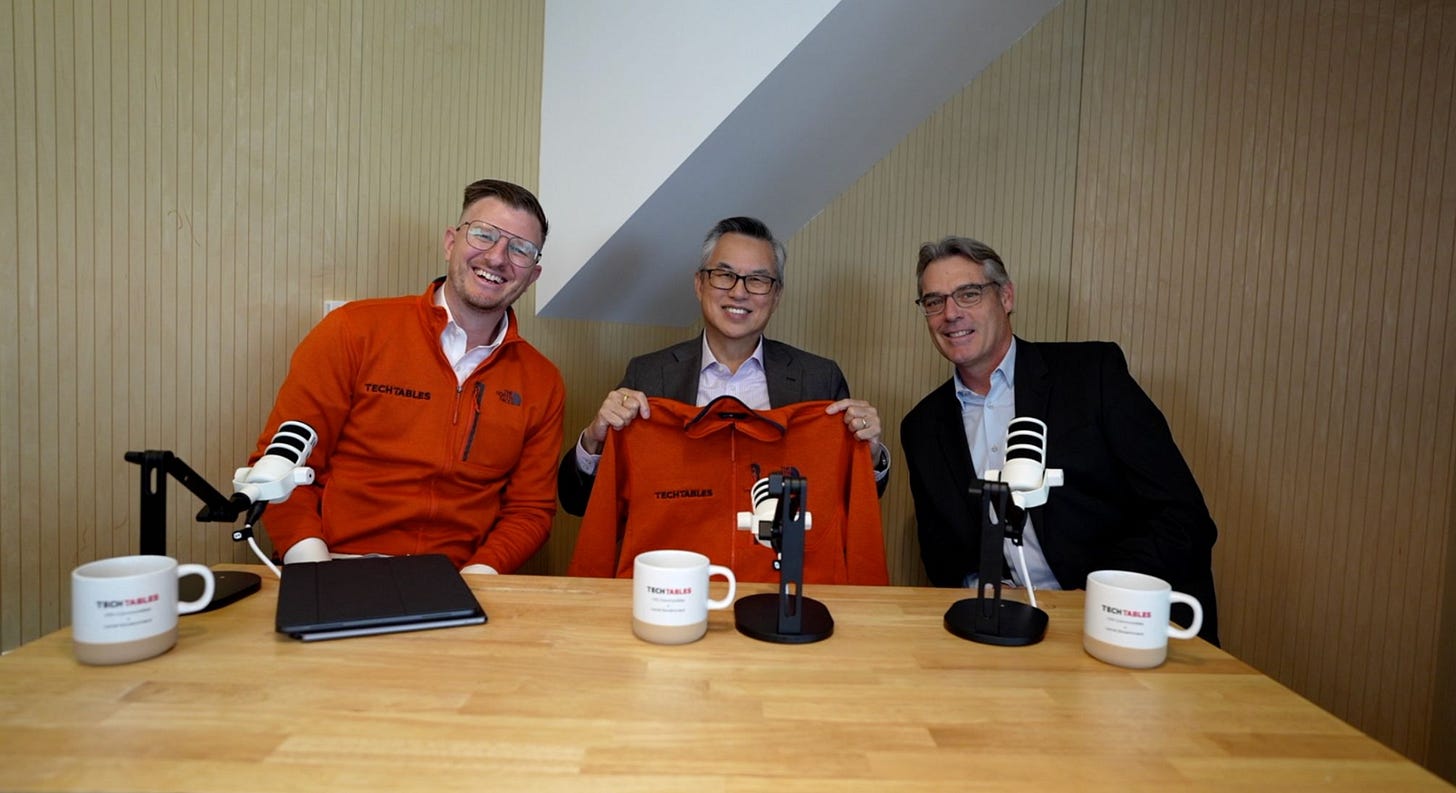
TechTables Better Together On-Site with Peter Loo, CIO, LA County & Hannes Scheidegger, Chief Global Delivery Officer at Info-Tech Research Group
Platinum Newsletter Sponsor:

Join TechTables & Info-Tech Research Group at Info-Tech LIVE 2026 - New Orleans (February 3 - 4, 2026) and/or Info-Tech LIVE 2026 - Las Vegas (June 9 - 11, 2026)!
Learn more about upcoming Info-Tech events here: https://www.infotech.com/events
Gold Newsletter Sponsor:

SentinelOne—Learn how SentinelOne empowers this state to stay secure.
Verizon Frontline—The advanced network that keeps first responders connected when it matters most.
Carahsoft—The Trusted Public Sector IT Solutions Provider™, supports government agencies and education/healthcare markets. Contact your Carahsoft rep today to access special discount pricing exclusively through the TechTables + Carahsoft partnership!
Transcript
Joe Toste: [00:00:00] super excited today to have Lisa Kent, CIO, and director for the City of Houston. Melissa Kraft, CIO for the City of Frisco, and Derek Williams, CTO and innovation strategist at Dell Technologies. Welcome to the Public Sector Show by TechTables.
Lisa Kent: Thanks for having us, Joe.
Joe Toste: Super excited to have everyone here.
Uh, Melissa, just, uh, for those you're brand new to the show, for those who who don't know you, um, give us a quick intro.
Melissa Kraft: Hi, I'm Melissa Kraft. I'm the Chief Information Officer for the City of Frisco. I've been there a little bit over two years, and prior to that I was the CIO for Dallas County. Been in local government, federal, private sector, 20 plus years.
So glad to be here today.
Derek: Love
Joe Toste: it. Derek?
Derek: Yes, Derek Williams. Thank you for having me. I'm with Dell. I'm a a chief strategist for state and local government. Uh, fairly new to Dell. I joined back in February of this year. Uh, prior to that, uh, spent about two decades on the public side with the state of Louisiana.
Uh, started as a programmer and [00:01:00] moved through a number of positions, uh, ultimately being lucky enough to culminate as the state CIO, um, and also been a partner in a private IT company for about 15 years. Um, and my original field of study, I was a computer scientist and my, my postgraduate work was as a researcher in AI and machine learning, but that was, uh, back before anybody cared about it.
So, uh, yeah, it served for me. Well, now
Joe Toste: the market is now hot just in time for you, Derek? Yes. Um, Lisa?
Lisa Kent: Yeah, Joe, thanks for having me back. I am Lisa Kent, CIO for City of Houston. I've been here approaching my tenure anniversary next summer. Prior to this role, I worked in the aviation healthcare and technology sectors, and I am a die hard Tennessee volunteer fan.
Go Falls.
Joe Toste: So, Lisa, I, I think you're in your office right now. We have, we have to do this. So the basketballs, those two are [00:02:00] watching on video. Uh, this is from the 2024. 2023 Houston Live podcast tour. We did go in 24, but we've got Ms. Lisa Kent. She actually has a matching ball in her office, which I do shout.
Do you wanna see it out? We cannot see it. Well, I can't see it. Maybe it is on camera. My window got a little short. But, uh, Bert, deputy CIO for infrastructure. Got you. A nice case, which is totally awesome. Yep. Let's bring this over here.
Lisa Kent: I'm gonna bring it out and show it to you. He framed it for me. I know.
Yeah.
Melissa Kraft: Cool. Alright.
Joe Toste: We fancy. Feel slightly over here. If I
Melissa Craft: may add, Lisa's also a legend for a lot of us women CIOs leading the way. So appreciate awesome. Thank you. I feel really honored to collaborate with you today too. So
Lisa Kent: I look forward to working with you more.
Joe Toste: Very excited. Uh, the podcast is done. We brought everyone together.
I'm just gonna turn this off and this'll be the shortest one. Uh, no. We'll kick off. We'll kick off with [00:03:00] Lisa. So you've been on the podcast twice, episode 1 47 and 2 0 5. Covered a wide range of topics from breaking down organizational silos to driving technology adoption across, I still believe it's 23 lines of business for Houston, uh, across emergency management, emergency infrastructure, natural disasters.
Uh, it's been almost about a year since you've been on. What's the biggest change or development in Houston it that listeners should be aware of?
Lisa Kent: Well, right now we're deep into World Cup preparation. So Houston, um, is super excited about getting to host some of those games here next summer. And one of the big projects, this has been a multi-year engagement, but we're finally getting into that last few miles to get done on our, um, network.
Redesign, I mean, Bert, you mentioned him earlier. Bert is our deputy CIO for infrastructure and he has [00:04:00] nicknamed this project from Frankenstein to Adonis. And uh, it's really getting rid of a lot of legacy. Um, nastiness and, and creating a real next gen network that is improving resilience and security capacity, all those things that we need for a thriving city to operate.
Um, we're still doing some of that organizational stuff. The City of Houston did an efficiency study and so. We did some pretty major consolidations of it. The the largest of which this year is the Houston Police Department, so migrating fully into the central IT work. It's a big, it's a big task. Um, and, and the other thing that I think is, is a lot more fun and Im, and impactful really to all of our business customers.
We've been experimenting with fusion teams. Where we're driving those technical IT personnel from our shop [00:05:00] onto these matrix teams where they're directly aligned with business SMEs and co-located out where the business environment is. And so we started with what we call public services. So think three one one, and all of those back office systems that tie into it like garbage pickup or anything that's reported about streets.
Traffic lights, potholes, things related to, um, heavy trash pickup or, um, illegal dumping, those kinds of systems. And we've had some really good success with helping move from that longer process of, you know, waterfall to real day-to-day agile ideating and observing, Hey, here are the barriers that the business is experiencing.
So, so we're expanding that. Um, this year we're working on building that for public safety as well as permitting, and then [00:06:00] hopefully in the near future for operational technology, um, and some other areas.
Joe Toste: A quick follow up question. I know I'm the host, so I get to ask these, but Melissa might have, might have a follow up on Derek too.
As you're going from, from, from team, from team to team, how, how are you getting the buy-in and collaboration to. Drive forward the, the new model
Lisa Kent: with the fusion teams.
Joe Toste: Yeah.
Lisa Kent: Um, you know, I think it's, it's about results. Um, so at first you, you have to, uh, entice the business with what's in it for them, right?
And, and there's lots of things where they, they have particular problems that when we can acknowledge that we understand that this is a barrier to their progress or accomplishing their goals, you know, they're listening, but they really listen and get interested when they begin to see it work. So that's why we started with one and um, big shout out to Summer Xiao.
She [00:07:00] was until just last Friday, she was the deputy CIO for enterprise applications. And summer, like you, Derek crossed over from that public sector, um, public service world. Into the private sector. Last Friday was officially her last day with us, so that was a big loss for our team, but super, super proud of her.
She's been on Joe's podcast multiple times. Um, but Summer was the, the one that helped us really drive that forward. And candidly, you know, what keeps it going is when the business sees that, hey, it works and it gets them what they need faster. And in many cases. Provides things to them that they didn't even know how to ask for yet, but we could see the challenge that they were dealing with and put things into place.
Joe Toste: Thank you for sharing that. Um, that is awesome. Yes, love. Summer. She's, she's amazing. She's actually, for those who don't watch the podcast on video, um, she is actually on [00:08:00] the cover of the podcast. So if you go to Apple and Spotify, she's on the Apple Podcast and I have not changed it. That was from the Commodore Perry Estates.
From our, from our podcast interview and, it is just such a great photo. I told Summer I might not ever change it, like not for like 10 years. It's so good. Um, yeah, it's just like a perfect shot in the library that we did it in and, um, anyways, I think that's awesome. Awesome.
Melissa Kraft: Mm-hmm. Yeah,
Joe Toste: yeah, yeah.
Yeah. It was great. And it's super random for those who we, we had Kerrica Laake on the CIO for the city of Austin. She got married at the Commodore Perry Estates,
Melissa Kraft: which is crazy.
Joe Toste: So she was like, Hey, I recognize that room. I was like, oh, yeah, yeah, no, we did the podcast there. She's like, I got married there.
I'm like, that's crazy. It was fabulous estate. Uh, yeah, it was really great. Uh, Melissa, uh, we'll just, we'll jump over to you. Um, so as you mentioned, CIO of City of Frisco, [00:09:00] uh, which has become known as. I think you mentioned like Sports City, USA. Yes. Um, hosting, hosting everything from the PGA, uh, not the World Cup.
Also, we're hosting
Melissa Kraft: bank, um, a couple of camps. Two camps, okay. Mm-hmm.
Joe Toste: Oh, so City of Frisco's still in it. Still on it? Yes. Yeah. Yeah. Still on it. You got a upcoming Universal Studios coming? Mm-hmm. Can you just walk? Can you just kind of walk us through where is the city of Frisco today? And then we'll go a little bit, uh, layer deeper.
Melissa Kraft: Awesome. I, I think one of our key focus areas is around really, uh, data and AI for all. I say for all because I, one of the first things I did was hire a data program manager over our data, right data first, so we can look at AI for the long term. So being able to focus on the people side and bring up some data literacy training, um, data analysis.[00:10:00]
Data processes. In addition to doing the tech side, um, as well, being able to inventory our data, catalog our data, understand the current state of data maturity. 'cause really in the effort to push those boundaries with ai, you need good data to do that. So being able to start to build that data foundation, not only on the technology side, but on the people side.
I think it's been really our focus over the last year, year and a half. Our city manager's office, even the, the, the mayor, you know, he's like, we wanna be the venture capital, capital of the Midwest. In order to do that, they want City of Frisco to be a test bed. In order to do that, you have to have a really strong foundation on the data side, on the resilience side and cybersecurity side.
So I think that's been in focus.
Joe Toste: I love that. Did you tell him you also need to be, um, big on the budget side too with a b. Budget money.
Melissa Kraft: Yes. And they, they have been supportive. I, I'll say I'm very fortunate in that regard. So, [00:11:00] um, we actually started a technology, uh, a, a small technology innovation fund to specifically pilot certain case uses.
So we started off really small with, you know, a couple of departments and learn, iterate to try to standardize our playbook. So, so it's been neat.
Joe Toste: What are some of your, what are some of your favorite use cases, like one or two that are just top of mind right now?
Melissa Kraft: Um, it, it really has to do with tra uh, traffic.
So, you know, sometimes, you know, we're rehauling or reconstructing our main street, a lot of it in preparation for World Cup. Um, so we also, fun fact, we also host a national soccer museum too as well. So we know that's gonna be an area where people would wanna visit and kind of venture out, um, as well. So that's, that's been, I, I would say one of our key focus areas.
Joe Toste: Thank you. I, you know, I was just thinking, I dunno, there might have to be a soccer ball up there just saying, I dunno, maybe
Melissa Kraft: you should come visit. I was actually there yesterday hosting a, a, a tech event, uh, for [00:12:00] CIOs. It's, it's revamping. Everything's get, getting revamped in preparation for that, in preparation for downtown.
Joe Toste: I love it. Um. Yeah. Now, now, now that all my friends live in Texas, not all my friends, a lot of friends I have live, live in, live in Texas and I live in Southern California. Um, so I think Texas is, I think audience size. I wanna say it's gotta be close to 30% of my overall audience resides in the state of Texas, which makes sense.
I think that gets California, Texas, Florida. I think actually maybe Arizona is probably number three. Mm-hmm. Up, up there. But, um, you know what, what
Melissa Kraft: you have, um, a lot of progression in a lot of those areas when it comes to technology.
Joe Toste: Yeah. Technology. And we all
Melissa Kraft: talk to each other. So
Joe Toste: Yeah. Texas folks are pretty, pretty friendly, so.
Mm-hmm. Um, I always like making, making it out there and going to all the different cities. Um, so Derek, you're also new to the podcast. Super excited to have you on. [00:13:00] Um, I did not pay Melissa at all to just. Throw you in Oop, in sports terms on the data and AI and AI side. But if you, but, but if you just wanna bring us, uh, just I think a little bit of a deep first, like a little bit of a deeper background on, uh, just the work that you did at the state of Louisiana, specifically around the cost allocation model that's still in use today, and then how that's leading into, um, how you think about modernization data.
And we'll take it from there.
Derek: So, um, I had an interesting career at the state. Uh, like I said, I started out as a programmer, uh, eventually worked into management and, uh, became an IT director over at the Department of Environmental Quality. Um, that was about 10 years ago now, and at the time, the decision was made to consolidate the executive branch into what's called the Office of Technology Services.
So, um, all it, all personnel, everything technology was required to flow through them is required to flow through them except for a few outliers. [00:14:00] Um. Elected official agencies and things like that. But, um, I, I was one of three that got tapped to kinda lead that effort. Um, and as part of that, yeah, we had to do a whole lot of work.
I oversaw all the infrastructure consolidation. We had two data centers that we owned and managed. Uh, we also moved to a hundred percent cost recovery. So anyone that that does that knows politically how fun that can be. Um, yeah. So I, I got to, um. Developed from scratch, kind of 'cause no one else knew, knew what to do.
And I had had a little bit of background with it, but, uh, I built a, a cost allocation model, uh, that they do still use today. It's about a thousand node cost pool model that's self waiting and does, does a lot of cool stuff. Luckily I have a, a background in programming, so I was able to write that and the billing system and a bunch of the reporting.
Um, so yeah, it's been, been an interesting piece, but it's turned out to, to be very valuable in the, now that I go around and get to talk to all these people that are doing this, so I can tell them all the things not to do usually. I love that. Uh,
Joe Toste: yeah. [00:15:00] Yeah. Go for it, Melissa. So
Melissa Kraft: I'll give you an example too.
I was more focused on a soccer ball and upcoming sports, right? So we, we live in it here in Frisco, but, you know, one thing that we leveraged was for our 9 1 1 operations center, we were able to use. An AI tool that helped them with training. So based on how they answered, the AI tool will then start to trigger certain responses and try to kind of hone in on the area where, um, they may get better exposure and experience in.
So we saw that. Gain operation efficiencies. It's not to say that we don't train our dispatchers, they still have the trainers, but it helps supplement them and also gives 'em the courage, you know, to kind of do a dry run before they start answering those calls. I think that was one of the AI tools for operation efficiencies.
And I, I think another one that's pretty neat. It's, uh, we call it a AI transcription service where, um, this is mainly for a traffic. This is where I was going at with before where. People would get calls in, [00:16:00] um, and it would go into a call flow or go in a voicemail. Obviously they couldn't attend it 24 7.
So we put, um, kind of AI on top of that to be able to pull those transcriptions, do automatic summarization and group it into themes and also automatically email and assign people with that too. So I guess it supplements. I know Lisa, you guys have a way more expansive 3 1 1 system that's rockstar. We're, we're mid-size so you know, we, we have, you know, our my Frisco app and it does some automatic workflow routing, but this really takes it to that next level.
So couple that with this, I think we were able to see, you know, decrease in processing time by over 40%. And a fun one, and I don't know if you're looking at this for real cup, Lisa, one of the things we're working with are parks. We already have our prototype, kind of develop the AI avatar, so we're already launching it in one of our parts to be able to use it as a guide, but also talk about [00:17:00] kind of historical artifacts.
You pull up your phone, you hit the QR code. It's conversational. It actually uses one of our. You know, assistant directors from the organization, she talks way better than I do. And you know, as part of that, you know, we're able to garner why are they visiting? What are they looking for? But also, um, you know, one of the things we were looking at being able to translate into multiple languages as well.
Yes. So with this tool, again, it's, it's a small pilot. With this tool, we're able to kind of use that framework and scale it out, you know, for the watch parties. And, 'cause we do know we're hosting at least two events and again, kind of the, the band camps too. So it's gonna be a large influx of people in addition to university studios opening up.
So being able to use some of those tools for, for better visibility, I, I think's really been key for us. I hope that makes sense. I felt like I had a five minute delayed reaction there. I dunno if you heard, but I had a, a dog in the background that was. Whining a little bit. So, but that, that was taken care of.
So
Lisa Kent: your, your, your voice [00:18:00] isolation must be working great. Awesome. Because I didn't hear you all. Sometimes she'll make guest
Melissa Kraft: appearances on my meetings and she'll, she'll, it's like she's talking to my staff too, so it's pretty funny.
Lisa Kent: Melissa, those were really cool. Uh, use case examples. It's funny, Microsoft was literally just talking to us about the avatar example.
Mm-hmm. Um, just a couple of days ago and, yeah. Asking Houston about whether or not we are pursuing that for some of the World Cup venues, which right now, candidly we're not. But I think it's a great idea for, for those outdoor venues and parks and even city streets where we have some of those kiosks that the avatar could be loaded on.
So those
Joe Toste: are,
Lisa Kent: those are excellent ideas.
Joe Toste: Yeah. So Melissa, just in the words of my friend Ryan Murray out in Arizona, I just wanna. Double, double click on on a few things you said. So multiple languages, really great. Recently interviewed Bob Leek, who's the CIO for Clark County in Nevada. Fun fact, there are 12 Clark counties [00:19:00] in the US So this is the Clark County in Nevada.
That's his number one use case is right now, He was telling me there's 28 different languages that get spoken in Las Vegas just with all the tourism and everything. Um, and I think Tagalog is like. Pretty high up there. So yeah, having the, the multiple language, um, translation is a big one.
And then the nine, then the training piece is a great, another great use case, whether that's like a custom GPT or, or something else. Uuper fun. Uh, Derek, love, love to bring you in. I know you're there in the, in the hotel. I know you're there. I love, love, love to bring, love to bring you in. You're hearing a lot of conversations right now, right?
So moved outta the state of Louisiana. Now at Dell, traveling around, you're hearing state agencies, local government, probably, you know, maybe even some higher education. [00:20:00] Just love to hear, you know, uh, around how are you? Coaching or leading or having those conversations with CIOs around, you know, what is possible, what does that art of the possible look like as everyone is just learning and navigating right now?
Derek: Man, you, you said the, the buzzword art of the possible. So, uh, yeah, there's a, a running joke about how much I hate the term art of the possible, by the way. People are hesitant to bring it up around me. Um, and I, I'm hopefully that the, the other CIOs on here are, are getting a chuckle about that because, you know, everyone beats you over the head with art of the possible.
But a lot of times in a CIO role, what that means is things that we can't actually deliver yet. Um. So, no, it, it has been a ton of fun, um, getting the bigger perspective, stepping out of just Louisiana and seeing that, you know. Almost all of the problems that we suffered, everyone else suffers from too. And there's a surprising, you know, lack of communication.
I think a lot of times between state CIOs, we go to NASCIO once or [00:21:00] twice a year. And uh, you know, that's, that's a lot of times kind of those in a few other events are the majority of times that we actually get to sit down and talk to each other. But, um, you know, AI and cyber are still the hot topics. Uh, AI is on everyone's mind.
Um, and a lot of people are sick of it, I think to some degree, but. It is interesting watching the transformative nature of it. And there's a weird shift happening right now that we're seeing everywhere and you know, a lot of people, I think especially on the business side, think about AI as kind of, um, a solution and, you know, people will tell me, I want ai, you just kind of to do what, right.
Um, but this weird kind of idea that it's an it owned thing, um, the role of the CIO is starting to change. Uh, and it's, it's a weird spot and I empathize with, with the sitting CIOs here because it's moving, you know, away from the old kind of mindsets where it is a pure support function and the role of it is to kind of control [00:22:00] technology and say, this is what you can and can't do, and this is how we're gonna lock it down.
Now these tools like ai, they have such a broad spectrum of what they can do. It is not like, here's email or, you know, a thing that does a specific task. A lot of these, these LLM bots and these rag chat bots and these agentic bots that they're, they're building, they can do so much. It's transitioning over into a bigger and bigger gray area where the CIOs.
Are getting more toward the business side, and there's a lot of overlap there. But also you have to move toward this idea of like building these secure sandboxes to let the business side play with the tools and develop what they need it to do. Uh, you can no longer just come in and say, this is it. This is how you have to use it.
And, um, there's a lot of push and pull going on out there. And it is not a, an easy, easy problem to solve.
Joe Toste: And for those who are listening on the podcast. Part of the possible. I did put that in quotes 'cause I did meet with Derek before and he had already mentioned that to me, which I thought [00:23:00] would be pretty funny.
For, for those who know who are longtime listeners, you know the, the name, the name of the bus. So the brand is TechTables, but the name of the bus, the actual business name is, is Levity Media, um, LLC. And so Levity for Lightness Fun. We tend to have that, uh, on the podcast. So I, I had to you, you just teed it up with the art of the Possible there.
Derek: I appreciate it.
Joe Toste: Uh, Lisa, there was a, uh, there was a pretty recent MIT study, um, that said that 95% of corporate AI projects fail. Um, I know that's different than public sector and I don't actually know what the sample size of that was, so just audience. I am aware. Bear with me. Don't, don't kill me.
But I am kind of curious to, I love to learn how the city of Houston is, you know, thinking about AI, the processes. I love what you had earlier about the fusion teams, the matrix teams. Um, and how are you helping to guide the [00:24:00] business leaders or even just partner with them for just to really find out what are those best use cases that actually solve a business problem for Houstonians?
Lisa Kent: That's a great question. So I'll, I'll play off a couple of things that both you and Derek have said. First of all, there is a Gartner, uh, report out. I don't know that it's 90%, but it's darn high, at least 75%, maybe more of those, um, AI initiatives fail, and much of it is because the, the user that initiated it said exactly what Derek said of, I want AI.
It didn't necessarily solve the problem that they were trying to solve or, um, not have enough thought put into it or the right people collaborating to help it be truly successful. So there's a lot of effort going into figuring out how do you vet those use [00:25:00] cases and pick the ones that have the greatest.
Opportunity for success. Um, the other thing, Derek, that you said that I totally relate to is that we can't have it in this mode of just, um, really more out of fear and risk management of just trying to control how this amazing technology is. Deployed and it's come so fast and so furious that many of our business units are out ahead of us and have begun using it now.
We were very early adopters in our cybersecurity program, Dr. Christopher Mitchell, who is our CISO, he's an amazing forward thinking rockstar of a CISO. And so we started using AI and many of those cyber tools, um, very early on. But we have been slower to deploy it in other parts of the business, trying to figure out what is that [00:26:00] governance process.
Um, so we, in my opinion, we actually are a little bit behind on that. And so some of our business partners, particularly in public works and like in the water management area and aviation. Are farther down that path of leveraging that out in the business. Um, much like what Melissa said, we did also dabble.
Early on in the 3 1 1 realm of trying to, um, discern in natural language what some of the, the customers were seeking and to peel them off into a bot. Um, it, it wasn't particularly successful that first go round, and I think that part of it was data and which is kind of the bane of most failed AI projects.
Um, but. Also we, um, the tools have evolved and have gotten better. And so that's one that we will be circling back and trying to decrease some of that [00:27:00] call volume, uh, for people who just aren't willing to use the mobile app, but they're going into the call queue. Um, but so we created an AI governance.
Version 1.0. And then just recently, in the last three months or so, we updated to a 2.0 and we're getting our arms around. What does that vetting process look like? Um, now. One of the people who couldn't be here today, um, du Menin, the CIO for Harris County, which is also part of the Greater Houston region.
They've done a really good job. They partnered with both, um, Gartner, as well as some other of the big manufacturers to create that, uh, vetting an intake process and that governance structure, but still not holding the business back, you know, letting. Some really wi winners, you know, get the money and the funding and the resources that they need [00:28:00] to take off.
So that's really where the City of Houston is looking to go so that we can enable our business partners to leverage it as quickly as possible.
Derek: You know, we, I, I get that exact question about the 95%. I, I heard it yesterday, uh, on a panel as a matter of fact, and it's. It comes up a lot, but just generally the, the stumbling points of AI and it's something that we've put a lot of time into at Dell and I've been so fortunate to go across the country talking to people and it is, it is funny, the exact things come up over and over and over and I'd say there are three categories and Lisa nailed the biggest one, which is data.
So many people fall down because data governance I think took a backseat for so long and so many organizations and all of a sudden now it's the most important thing. Like the data asset for state and local government is now one of their most important commodities. The idea of, hey, we have all this data in silos and suddenly there is a tool, um, a [00:29:00] technology that the more data you can give it from disparate sources, that is good data.
The better it will perform and the more insights you can give. Now there's kinda this mad scramble of like, how do you share the data? How do you ensure that the data is solid? Um, you know, everyone says, you know, you garbage in, garbage out. But it's much worse than that in ai. It's uh, if, if you don't give it good data, you get wrong answers very fast and a very high cost.
Um, but you know, I think a lot of people that have already consolidated, maybe have a head start on that because they have technical mechanisms to do data sharing. And they're probably used to doing data sharing agreements. Um, but that's been by far the major hangup. The other two we've seen are, um, people struggling with the initial build out of infrastructure and platform and having the personnel upskilled to run them.
Uh, I think the business side is so used to being like, Hey, I found this solution, and it saying, sure, I can go spin up a VM or a container and set up a web server and a database. [00:30:00] And that's been the standard for so long. That now they come along like, Hey, I need you to spin up ai. It's like, this is a different tech stack.
This is different infrastructure, this is different platforms. This is a different set of skills. We don't have that. And there is a major initial investment that has to go into that unless you just have a, a one-off, um, kind of hosted service. But the people that are doing one-off hosted services tend to end up regretting that because then, as I said.
Down the road, the way you make these things more impressive is to bring in more and more data. And so siloing out your AI is a terrible, terrible, long-term strategy. Mm-hmm. The last thing I would add on that is just the, the other thing that Lisa hit on as well is this idea that people just want ai. And you hear it over and over and over and I've had that conversation so many times when people ask me what's the best thing I should be doing in the AI?
And you have to tell them, like, just take AI off the table. It's a technology like any other, your top priority of challenges for the business are your top challenges [00:31:00] for the business. Go through those, work with it and see if I, AI might be a solution for one of them. It may be a good idea, it may not, but that doesn't change what your needs are.
You should never do a, you know, I call the AI fomo. Um, people are just like, I need AI for the sake of it. And it's just like the ROI conversation kind of goes out the window or people, uh, aren't up to speed enough to know how to really calculate ROI ON on AI projects. And so I used to go around as a CIO and I had about an hour, hour and a half presentation where I would just sit down with the C-suite of the agencies and walk them through.
High level, this is what AI is, this is where it's useful, this is where it's not so useful. Um, this is how you should approach it. These are the things you should watch out for. And, uh, you know, that, that helped quite a bit, I think. But, you know, just getting people used to AI at all levels, from the end users to procurement, to legal, all of that has to come together.
It's a, it's a, a big problem to solve. It's, it's such a big shift. Uh, I don't think people realize, uh, how [00:32:00] fundamental it it actually is.
Melissa : Well, and, and if I can key off that Derek, too, I think it's not just data, it's data permissions and how you have it configured. Going back to your foundation, I know one of the things in Frisco, we've been working on Zero Trust for years now, and part of that is, you know, ensuring the accessibility of of, of rights, user groups, all of that stuff's cleaned up because as soon as you start using ai, whether it's copilot hooked into your SharePoint, you're gonna quickly see what people have rights to, what they don't or what, what may.
Inadvertently get access. Right. If you don't have your, going back to the foundation too, I know one of the first things for City of Frisco's, it's let's do a AI responsible use. We don't wanna restrict people, but we still wanna have boundaries.
So we use automated mechanisms. You know, we, we did, uh, we used purview to do our. Data classification and some other tools since we're hybrid as well. Um, and [00:33:00] also with the responsible, if you wanna use it for public, if you wanna use Chat GPT, go ahead, but don't use it for private data. So going back to that educational piece, and this is where the data program manager really spent the time.
Training, not just it, but outside of it too, right? Because it feels like it, it should be co-ownership. It shouldn't be leading these efforts per se. We're just there to make sure no one lands in the paper, right? So at least that's my goal. So, so I think it, it's definitely iterative, um, at least from a, a Frisco City of Frisco perspective.
Because they want it. They want it now, they come back from a conference. But we do have a framework that we leveraged, our project steering committee process to leverage some of, is it important? You know, is it to meet a regulatory requirement? Is it for operational efficiencies or do you have the funding, you know, what's your intended outcome?
Who's all involved? Can it be scalable? Can more than one department [00:34:00] use it? So we have kind of these, these, intake mechanisms to kind of help with some of the filtering, but still, it's still, it's still a challenge. So especially if you see someone like utilities, like, Hey, I want this. And they're like, all right, let's give them the, the tech survey.
Let's look at it from a cyber perspective. It's an internet of things. Again, going back to that foundation, we have that network that's segmented, so they're using AI vision to do their pipe. Visibility, checking things, you know, I was like, that's really cool. It saves someone a lot of time. They have their outcomes on what their goals are, but it's hard to, and we're mid-size, so I can't even imagine.
Joe Toste: I love having the, the authentic, the authentic conversations.
[00:35:00] Um, and, and everyone's on their own journey, right? Uh, which, which I think, which is cool. So, um, whether you're a large enterprise or mid-size, um, it's, it's totally fine. Everyone, everyone, I'm sure most people love to, to learn, learn from others. Um. Derek, you, you, I mean, you said just you hammered it just right before, right before Melissa kind of teed her up.
Teed her up perfectly. But the, the, I want AI, right? And like, I think the lack of discovery kind of kills anything, right? Like, well, cool. So what does I want AI mean? Like, tell me more about like, your business. Like where, where is the bottleneck? Um, like what does that look like? In, in my space, the version of I want AI is, Hey Joe, I like from vendor partners.
They'll go, Hey Joe, I want a podcast. I'm like, dude, that's awesome. What does that mean to you? Right? Like, it's exact same thing. So it's like going through that like discovery of like figuring out what it [00:36:00] actually means. Where is the pain? Um. Just kind of just normally just like kind of going through that discovery almost, that like just being a consultant and just going through asking those questions.
Then you uncover like the, well actually that's not an AI problem, that's just a workflow. Routing automation. Like there's no AI on top of that. Like you just need to do this. Um, and oh, here's a spreadsheet. That's a very key point though.
Derek: Yeah, that is a really key point and I, I see this all the time from AI to general modernization projects where.
So many business side people and you know, I'm obviously very defensive of the IT side here. I'm just gonna keep throwing the business under the bus. Um, but a lot of times they think that modernization means it is going to come in and do a cloud migration or get new servers or write a new app. And you end up with like a bunch of, you know, 21st century platforms running 20th century business [00:37:00] processes.
And so many times we have to go yell at people like, hey. You need to redo the business process as well as well. Like that is part of modernization. In fact, it is the most important and often most difficult part of, of modernization. It is not just the IT side. I'm sure all the other CEOs on the call here have done that as well.
Where, you know, you go and it's kind of like, Hey, what does this app need to do? Well, you tell me you're it. That's what you all do, right? No, no, no, no. The technology there is there to enable the business. It is not the other way around. We're not here to tell you the business. Um, but that's what I was saying earlier, that it seems to be shifting and I think you used a very good word where it's like you, you come in and the CO is now almost a consultant role on telling people and doing some deciphering of what a lot of this is and how it works.
But it is, that's one of the things that I struggled with for 10 years. You know, in the, in the consolidated environment was just [00:38:00] getting the business on board to understand this isn't something that it comes in and just magically happens. It has to be a collaborative process. And, you know, Lisa laid a great framework, with the way they're running those agile sprints and bringing those teams in.
And that's exactly what we ended up doing, by the way, and where we found success in it.
Lisa Kent: Yeah, and I, I, I can't emphasize more what you just said about the business being willing. To modernize those business processes that candidly between data and bad business processes, those are really the two biggest things that cause big challenges in IT projects.
Getting that partnership with the business leaders where they're willing to think outside the box about how to modernize the process is a huge part of the, the success.
Derek: IT departments are awesome. Business needs to step it up. That's what we've learned.
Joe Toste [00:39:00] Love it. This is actually a really great transition and, and dovetails very well to, um, I think generically we hear this like, Hey, workforce of the future, but really like the role of the CIO, this is something kind of behind the scenes that I've been talking to a lot of folks about and the role I think is going through.
Pretty, pretty big change right now. Just with so much technology. It's already changed, but I think the next 10 years is gonna also, evolve again. And Lisa, I think you, you had mentioned you're coming almost on 10 years, the city of Houston, which is so impressive. Boggling.
Lisa Kent: Yeah.
Melissa Kraft: Unbelievable.
Lisa Kent: Thank you.
Melissa Kraft: Thank you.
Joe Toste: I mean, you've navigated. Hurricanes, COVID, and a hundred other things I have that aren't even on top of my head right now. Um, I was kind of curious like how has the actual job of a CIO CH evolved or changed over the last 10 [00:40:00] years and maybe what were some of the most surprising lessons that you've learned on the journey?
Lisa Kent: You know, some of it we've talked about that, it has to be that business enabler that can gain the business partners cooperation and partnership right to, to jointly be seeking how do we solve their problems. You, you just mentioned one of the biggest challenges and what has been surprising in the last, you know, two or three, four years, is that dramatic increase in the pace of mainstream technology evolution.
Um, it, it has been mind boggling. For everyone, including it people of how do we, how do we leverage this for good but not get clobbered by how it can be used in a bad way. And um, you know, I think one of the things that has surprised [00:41:00] me is that earlier on in my career was more willing to take chances.
And, uh, I had an interesting conversation with one of my sons recently. Um, both my boys are. Out of college. They're working men now. And um, one of the things that the Eldes was talking about, he works in logistics and he was frustrated that his CIO and IT team had not unleashed the workforce to use Microsoft Co-pilot, the premium version, right.
He was describing to me how he wanted to use it. Uh, this is, this is a young person in their mid twenties, um, but who has a lot of passion and excitement about how he could do his job better and faster and put in fewer weekend and weeknight hours by using some of these automation tools that are.
Mainstreamed out. And, [00:42:00] uh, as he was describing this frustration, I realized, oh my goodness. I, I resemble that remark, you know, that we were also in our IT organization, um, hesitant, even though Microsoft didn't actually turn on, um, copilot chat, which is the free version until June of this year in the, in the government environment.
But even when that did come open, you know, that was one of the things that we were still grappling with, okay, we gotta, you know, do one more finishing touch on the instruction to users about what not to put in there. And I realized that, you know, we to some extent we're moving too slowly and too cautious.
So I think that's that balancing act that I need, not only me, but the organization's pendulum to swing back a little bit more, um. Willing to take some risks, um, and [00:43:00] to allow some things to go forward, but still have those guardrails to protect us, like what Melissa was explaining. You know, protect you from the really big gotchas, um, so that we're not hurting people, but we are absolutely enabling that business.
Um, and, and one other thing that I think is surprising. I was listening to a podcast recently. Um. A leadership podcast by Andy Stanley and his guest was Dr. Tim Elmore. Yeah, Andy's great. But this podcast was about leading Gen Zs and how differently they think and how frustrating it is for them when some of the other generations tend to be too cautious and not let them run.
And do and solve some of these problems. And, um, I won't go into all the details, but the example that Elmore brought up was a NASA example back when, [00:44:00] um, they were working to put a man on the moon and they didn't have the, the workforce, much like what Derek was saying about ai, they did not have the workforce that had all the computing skills that they needed.
And so they did this full court press on the, um, academia, right, to recruit new graduates from college and, and people who had been studying this in school, but also had that fire in their belly to go use it and deploy it. And one of the examples that, that he gave was that NASA made an adjustment and some of those folks that didn't have as much hands-on experience, albeit still new.
Those folks moved into more of a simulator supervisory role and they had some very new graduates that were making the call. So the person, [00:45:00] I didn't know this, I need to go back and read the book, but the person who actually made the go, no go decision on the moon mission was a 23-year-old, one of those computer phenoms.
And so that's one of the things that's been. Eyeopening for me that wow, we've, we've got to work faster and harder to recruit some of those skill sets that will really help us in leveraging and deploying and maintaining some of these new technologies like ai.
Joe Toste: I like your son. Also plug for public sector.
You should hire, you should hire outside of public sector. All I'm saying, um, you should hire outside of public sector.
Derek: I will say, though, to be fair, I mean there is, and everyone knows this on the state and local side, I mean, I, I was, I used to be a, a young man with a technology gleam in my eye until, you know, public sector eventually beat that out of me and made me the jaded person I am today.
But, [00:46:00] you know, one of the things straddling both sides of the fence, it's, it's wild. When I first came to Dell to see this idea of like, we need to start this initiative and we're gonna try this crazy project that we think may work. And it hits problems or failures and they go, okay, let's just reassess it.
We're gonna have to put more money here and we're gonna have to do this, and are we gonna continue or not? In the public sector, you know, these things, you're using tax dollars. But the politics come into it at that level and the stuff of like, I rolled this project out and it hit a stumbling point or a failure point, and we had to reassess.
Suddenly you're getting ripped apart in the paper. You're over at the legislature. Legislature sitting at the table getting grilled by senators and representatives. And you know, there is such, such pain that comes with that, that this expectation that every IT project should be on time within budget, a hundred percent successful, and anything less than that means that you are a failure.
It's, it's absolutely unrealistic. It's not how [00:47:00] anyone works outside of the public, but it's a weird expectation that gets put on the public. And then, and everyone knows too, you know, the media a lot of times is very, very mean, uh, to people that work in the public sector. I mean, how many times have you heard like they're lazy?
The people that I, I hired a bunch of people from the, uh, the private sector when I was a CIO and I put several of them in C-level positions and they all told me the same thing. This is the hardest I have ever had to work in my life. Um. They do the public SEC sector and the workers there do not get enough credit for how good they are and the amount of time and effort that they put in, uh, you know, it, and it's, it was the single most frustrating thing I saw in the CIO role that just made me absolutely nuts, uh, as you can tell now, huge pet peeve of mine.
Um, you know, it, it's unrealistic expectations and a lot of times. People blame the public sector for behaving that way, but it's a result of the pressure that gets put on 'em and [00:48:00] the way they're portrayed as well. I mean, everyone has to kind of own that. It's not a deficiency a lot of times in the way that those are run.
Um, it's a, just a result of how they get treated.
Lisa Kent: Yeah. Derek, I, I, I wanna thank you for bringing that up. Um, I, I will say. That operating in the fishbowl and the level of scrutiny that public sector receives, um, can be crushing to innovation and, and reasonable risk taking. And so you, you did a fantastic job of outlining, you know, that's one of the differences that the public sector, while they, they, I mean the private sector definitely has oversight in, um, monitoring.
It is not the same level of scrutiny and to some extent even backlash, um, if, if a political position is taken. So thank you for bringing that up.
Derek: I always tell people, I said, if you wanna know what it's like, imagine that [00:49:00] anyone in the public can put in a request for every email or message that you've ever sent internal, and imagine what that would look like if they read them.
And everyone just sits there a minute and goes, oh, like, yeah. Yeah. Imagine, imagine dealing with that all the time. Yeah. So it's a praise to the public sector folks. They're, they're the unsung heroes. They deserve more credit.
Melissa Kraft: There's always hope. Right. You know, I think that especially with the newer generation, it, you know, they're kind of forcing that habit change, right?
So I think focusing on development, internships, creating those opportunities, even if there're small wins, to be able to pilot, to test and encourage. A safe space where people can experiment and still keep it secure. You know, I think that that's the way to go. Right. But it, I think it's true. It really starts at the top.
You know, I think having support from the mayor, from the city manager's office to be able to experiment and, and know that it's okay to, you know, invest in training and, and, and focus on. Not just team [00:50:00] development, but individual development, right. To get them where they need to get to. So as you're upskilling them, you're giving them the confidence to be able to test in those, those realms and parameters.
Right? But alongside partnering with those that are already doing it, like I got my best ideas from the private sector. So I, I go to my fellow CIOs that are non-government. Okay, so how are you doing this? And how we can maybe pivot that in a smaller, incremental way, right? To, to be able to innovate. So I don't think government bodes well for big bang approaches at all.
So incremental innovation, even if it's low hanging fruit, you gain trust, you, you know, implement, you pivot. You iterate and you do it all over again. Right? And hopefully you have some sort of playbook that you can continue to build along the lines, right? It's really co-creating with those departments that wanna do that, use that as a case use to be able to get to those bigger things like revamping your ERP system, which I never wanna do again, but you, you get.
Joe Toste: [00:51:00] Second. I feel like we, we all need to get together and like give Derek a hug for, uh, yeah.
Melissa Kraft: Yeah. Just I'll give you a virtual tears. That's right. Very
Derek: happy. Now I'll just say, D's been awesome to me. I, I love my job, honestly. I, and I am in awe. And Lisa, she's did that for 10 years. When I stepped over to this side, like the amount of weight that I was carrying that I did not even realize until I left that position.
It is crushing, it is a very difficult job. Kudos to both Lisa and Melissa here. That's, I mean, it's, I I empathize with everyone that's in those roles now.
Joe Toste: Well with that, thank you for coming on the Public Sector show by TechTables and everyone stay on. I forgot in the beginning. We're gonna, we're gonna take a photo real quick for our, for our cover art, but um, yeah, no, I appreciate you all coming on.
Melissa Kraft: Awesome. Thank you all. Thank you so much. Had a great time. Thank you.