·
5 minute read
·
5 minute read
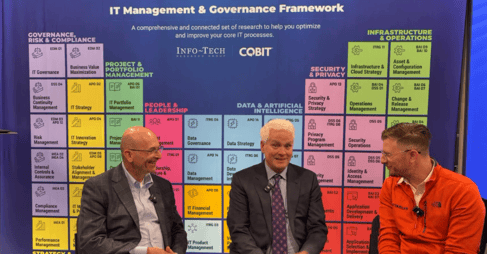
John O'Brien on AI slop, the CIO's seat at the table, and why kindness should guide what comes next.
John O'Brien said the line I haven't stopped thinking about:
"If all we needed was answers, we have machines for that."
John has led EDUCAUSE since 2015. Mark, a longtime CIO himself, has known him for over a decade.
I asked Mark what I should ask John. Then I spent 2 days asking CIOs the same thing. The mailbag kept circling one question: if AI turns knowledge into a commodity, what are colleges and universities actually for?
The messy middle is the product
John's answer starts with students. Ask them on day 1 why they're there, and many say they're there to get a job.
Ask them at the end what they got out of it. They say they learned how to learn, how to adapt, how to be creative, how to be a better person.
The crazy part? Those are exactly the skills an AI-everywhere world will reward.
In her EDUCAUSE keynote, future-of-work strategist Heather McGowan put the point on a single slide. Learning starts on the left as squiggly lines and slowly resolves into one clean line on the right. AI lets students jump straight to the clean line.
"AI just allows you to jump to the solution and miss the whole messy middle, which we call learning." — John O'Brien
Mark came at it as a mathematician. If knowledge is a commodity, teaching at the lower levels of Bloom's taxonomy stops delivering much value.
Institutions have to teach at a higher level of abstraction.
The catch? That asks faculty to change and to do harder work at the same time. Mark called it a non-trivial change, all the way down to K-12.
Then he told my favorite story of the episode. When his daughter started her thesis, he suggested she use AI to summarize her reading. She said no. She wanted to internalize it.
When she finished, she admitted she did use AI after all. It was her "Hemingway," there to cut her long draft down.
She kept the messy middle. She let the machine do the trimming.
High-human for the few, AI slop for the rest
Then John said the thing I think every campus leader should sit with. His deep worry is a new digital divide.
"The elite experiences will be low tech, high human. And then the rest of us get AI slop." — John O'Brien
He was upfront that he was being provocative. AI can cut costs and work at scale.
His hope is that every institution uses it for the tactical work that wastes big brains, then gives that time back to people for better and different things. But he named the risk out loud: it could go sideways.
He also floated a twist. As technology fades into the background, campuses might see a renaissance of tech-free spaces, the way the Great Books movement once pushed back.
Mark added the part IT leaders will feel first. We're moving from deterministic systems to probabilistic ones.
A general ledger gives you the same right answer every time you ask. An AI model might answer the same question 2 different ways. Using it takes a different set of attitudes and a different sense of responsibility.
The CIO's seat at the table
When John arrived at EDUCAUSE, the complaint was how few CIOs reported to the president or sat on the cabinet.
He told presidents, shame on you for not listening to your CIOs. He told CIOs they had to earn the right to be at that table.
Then COVID hit. Suddenly everyone understood that IT isn't plumbing. It's a strategic asset.
"And now it's how do you stay at the table, and that's a different conversation." — John O'Brien
How you stay? Amy McLaughlin, CIO at the University of Wyoming, told me on the podcast this week that she has to be the chief storyteller.
John said EDUCAUSE has pushed a version of that for years under the name "the integrative CIO." He even pitched it to the board when he interviewed for the job: "The future of IT is not IT talking to itself more intensively."
Where the role goes next, the conversation landed on 2 paths:
- Up. Mark says the CIO sees everything, from alumni systems to HR to teaching and learning. That makes the role a natural path to COO. It's already happening: David Weil at Ithaca College recently moved from CIO to VP of strategic services.
- Deep. Some CIOs love the technology and will stay close to it. Mark's warning: 150 years ago, organizations had a vice president of electricity. We don't anymore.
John's bet for the next 12 years is the first path. He told me to wheel him back on the podcast then to check his work.
I'm holding him to it.
Widening the tent
I asked John for the one thing he's most proud of. He'd just joked that media training taught him he doesn't have to answer the question he's asked, so naturally he gave me 2.
The first is the bigger tent. EDUCAUSE now welcomes faculty, instructional designers, institutional researchers, CIOs and CISOs into the same conversation. It defines itself "not by who we turn away but by who we welcome."
The second came out of his first-year listening post. The 2 least happy groups were corporate members, now called industry partners, and young professionals.
So in year 1 he created a corporate engagement advisory committee and the Young Professional Advisory Committee, YPAC.
The best part? About 10 years later, 2 of the 12 voting members of the EDUCAUSE board are YPAC alumni. One of them is the current board chair, Tara Hughes, CIO at Cal State Monterey Bay.
Start with kindness
My last question was what he wants to leave the next generation. With about a year to go, John's answer had nothing to do with technology.
He's seen what the last few years have taken out of people. At this conference, he asked 4 or 5 recently promoted people if they were still doing their old job. Every one of them laughed and said yes.
Add falling public trust in higher ed, do more with less, and a climate where being mean is almost expected. Values stop being the last slide in the strategic plan.
Mark was a CIO for a long time. Now he talks to a dozen of them, hears their challenges, and thinks, "Thank God I don't do that job anymore." It's gotten incredibly hard.
The prescription comes from Brandie Nonnecke at EDUCAUSE's first AI summit: start with your values. If your campus is focused on sustainability, look hard at how AI can help with that.
Mark's addition is the accountability part. Write your values down, review them, and look in the mirror every few months.
The messy middle, over a BBQ
My grandfather taught history at UC Santa Barbara (UCSB) for 50 years, specializing in Brazilian and Portuguese history. In high school, I got to audit his classes, sitting in with all the college kids.
At every family barbecue, he'd be talking history. Portuguese history, world history, all of it.
None of that was about answers. It was the messy middle, out loud, over a grill. That's what I hope every campus protects.
So here's a simple test to bring back to your campus:
- What part of your curriculum still teaches the messy middle?
- Who at your leadership table can turn AI's probabilistic answers into judgment?
- What single value will you use as the cutoff for deploying new technology?
Listen to episode 245 here: John O'Brien (CEO of EDUCAUSE) on AI slop, the future of the CIO, and skipping the messy middle
New here? Subscribe now to stay ahead.