---
title: "#235: The Edu-pocalypse Is Here - What Higher Ed CIOs Need to Do Now | Info-Tech LIVE NOLA |"
description: Mark Roman & Carlos Thomas from Info-Tech break down the enrollment cliff, AI disruption, and why the CIO is best positioned to navigate what comes next.
image: https://techtables.com/hubfs/EP%20235%20Final%20Podcast%20Cover%20Art.png
---
[Skip to content](https://techtables.com/podcast/235-the-edu-pocalypse-is-here-what-higher-ed-cios-need-to-do-now#main-content)
[All posts](https://techtables.com/podcast/all)
May 20, 2026
# #235: The Edu-pocalypse Is Here - What Higher Ed CIOs Need to Do Now | Info-Tech LIVE NOLA |
 Joe Toste · 16 minute read
[mailto:email@email.com](mailto:email@email.com)
### 📬 **The TechTables Newsletter**
TechTables connects public sector technology leaders — CIOs, CISOs, and CTOs — through darn good conversations and peer-driven community. The best place to start is the newsletter.
**Subscribe now.👇**
### **Episode Summary**
In this episode, we head to Info-Tech LIVE in New Orleans, where Mark Roman and Carlos Thomas from Info-Tech Research Group break down why the enrollment cliff, AI disruption, and cultural skepticism toward Higher Ed are colliding at once - and why the CIO is the leader best positioned to navigate what comes next.
### **Featuring**
[Mark Roman](https://www.linkedin.com/in/markromanlinkedin/) is Managing Partner for the Education Business at Info-Tech Research Group - supporting universities, colleges, and K-12 institutions around the world, and a self-described electric guitar player (results may vary).
[Carlos Thomas](https://www.linkedin.com/in/carlos-thomas-ph-d-1798112/) is an IT Executive Consultant at Info-Tech Research Group, entering his fifth year - a former CIO and university administrator with 21 years in Higher Ed, and who checked off his bucket list item of running a 1,600-pound-capacity barbecue operation before Info-Tech pulled him back in.
### **Timestamps**
([1:45](https://www.youtube.com/watch?v=5w-6eoMnUlA&t=105s)) What CIOs are excited about in Higher Ed - the question that flips the conversation
([3:20](https://www.youtube.com/watch?v=5w-6eoMnUlA&t=200s)) AI, Agentic AI, and Bloom's Taxonomy - why the CIO is becoming a campus leader
([5:00](https://www.youtube.com/watch?v=5w-6eoMnUlA&t=300s)) The CIO as technology-informed COO - Carlos on the elevation of the role
([6:30](https://www.youtube.com/watch?v=5w-6eoMnUlA&t=390s)) The enrollment cliff and South Africa - how demographics are reshaping institutions worldwide
([9:00](https://www.youtube.com/watch?v=5w-6eoMnUlA&t=540s)) CIO to COO - why the person who sees everything is the one who should run the organization
([11:00](https://www.youtube.com/watch?v=5w-6eoMnUlA&t=660s)) The diplomat skillset - navigating faculty politics and getting things done
([13:00](https://www.youtube.com/watch?v=5w-6eoMnUlA&t=780s)) The "edu-pocalypse" - DOGE, the Department of Education, and cultural skepticism toward Higher Ed
([15:00](https://www.youtube.com/watch?v=5w-6eoMnUlA&t=900s)) AI token data - two-thirds of all AI tokens are being consumed in education
([19:00](https://www.youtube.com/watch?v=5w-6eoMnUlA&t=1140s)) The podcast topics they'd love to do next - students and responsible AI
Whenever you’re ready, there are 3 ways you can connect with TechTables:
#### **1. 📬 The TechTables Newsletter**
Thanks for reading TechTables! Get early access to new episodes, insights, upcoming events, and more — straight to your inbox.
Join now: [https://www.techtables.com/](https://www.techtables.com/)
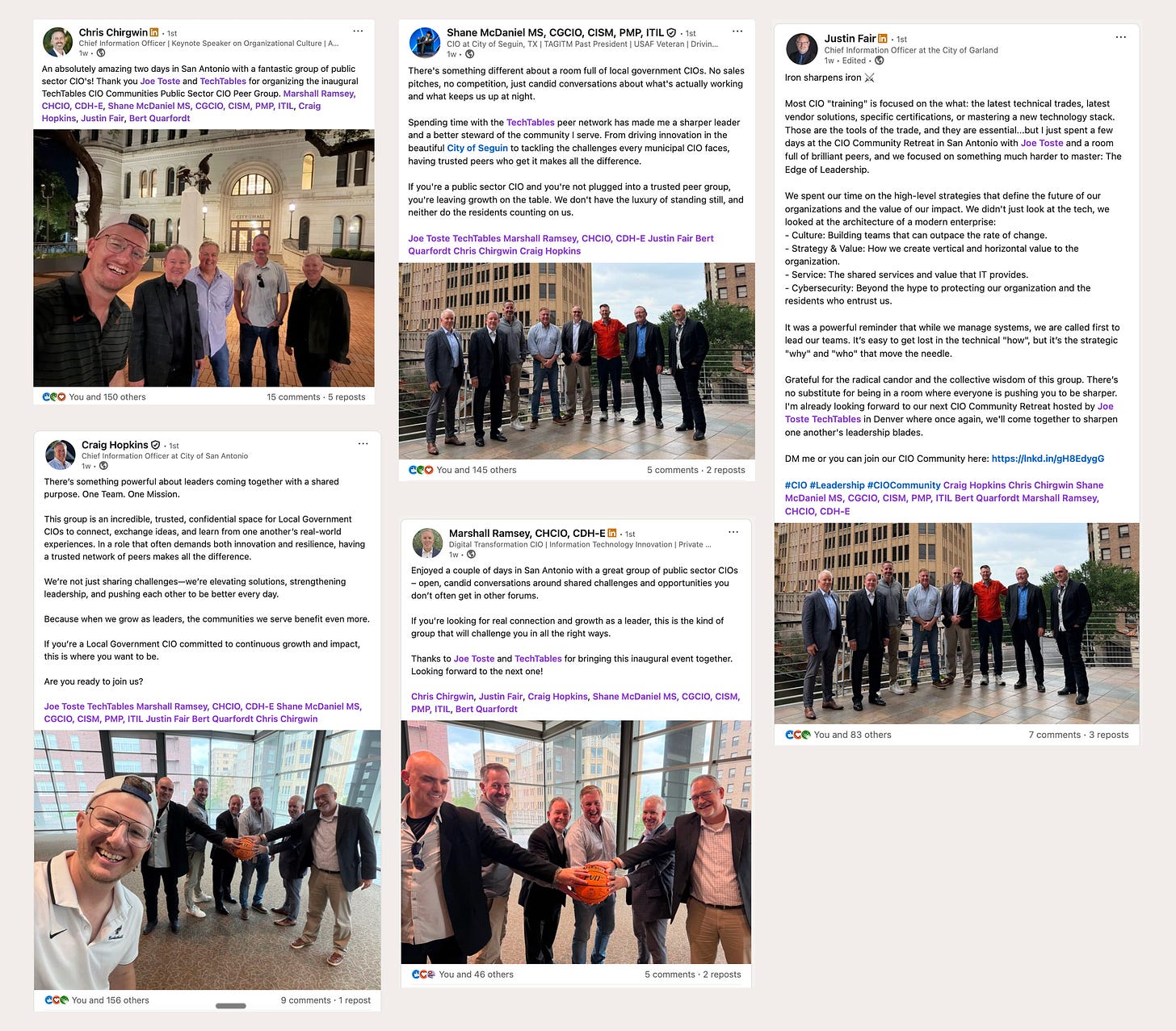
2\. 🤝 Are you a local government CIO who wants to become a better leader?
Check out our high-trust, vendor-free peer group built for local government CIOs tackling real challenges, honest conversations, and an authentic desire to become a better leader — our next retreat is November 2026!
Learn more → [https://techtables.com/communities-local-government](https://techtables.com/communities-local-government)
### 🤝 The Better Together Series (Virtual & On-Site)
The narrative-driven series bringing together industry partners and public sector CXOs. Discover the compelling stories that unfold when we stop working in silos and start building together.
»»» Email [joe@techtables.com](mailto:joe@techtables.com) to learn more.
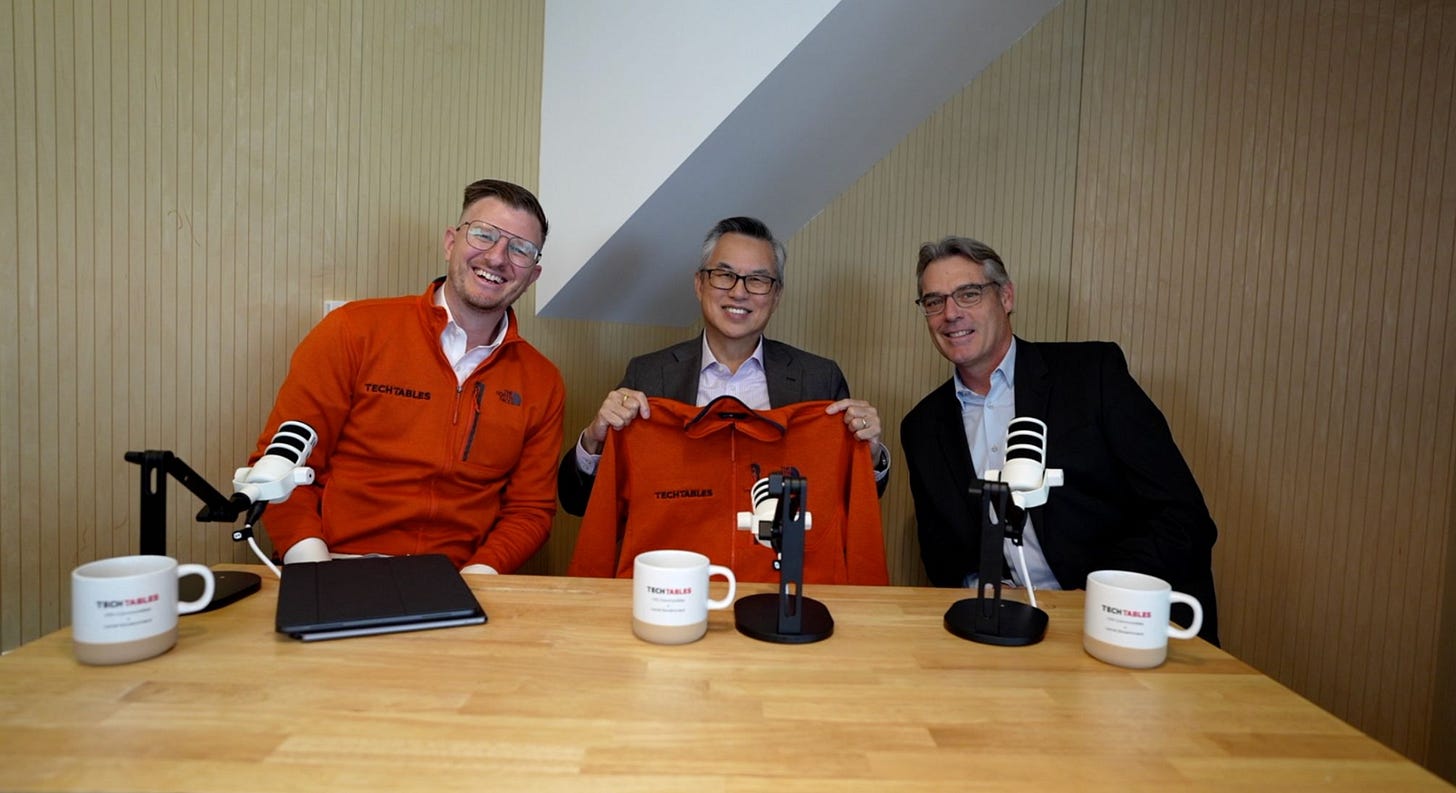
> TechTables Better Together On-Site with Peter Loo, CIO, LA County & Hannes Scheidegger, Chief Global Delivery Officer at Info-Tech Research Group
### Platinum Newsletter Sponsor:

Join TechTables & Info-Tech Research Group at [**Info-Tech LIVE 2026 - New Orleans**](https://preview.convertkit-mail2.com/click/dpheh0hzhm/aHR0cHM6Ly93d3cuaW5mb3RlY2guY29tL2V2ZW50cy9uZXctb3JsZWFucy1saXZl) (February 3 - 4, 2026) and/or [**Info-Tech LIVE 2026 - Las Vegas**](https://preview.convertkit-mail2.com/click/dpheh0hzhm/aHR0cHM6Ly93d3cuaW5mb3RlY2guY29tL2V2ZW50cy9sYXMtdmVnYXMtbGl2ZQ==) (June 9 - 11, 2026)!
Learn more about upcoming Info-Tech events here: [**https://www.infotech.com/events**](https://preview.convertkit-mail2.com/click/dpheh0hzhm/aHR0cHM6Ly93d3cuaW5mb3RlY2guY29tL2V2ZW50cw==)
### Gold Newsletter Sponsor:
****
> **[SentinelOne](https://assets.sentinelone.com/ghe/sentinelone-empowers)**—Learn how SentinelOne empowers this state to stay secure.
>
> **[Verizon Frontline](https://www.verizon.com/business/solutions/public-sector/public-safety/)**[—](https://www.verizon.com/business/solutions/public-sector/public-safety/)The advanced network that keeps first responders connected when it matters most.
>
> **[Carahsoft](https://www.carahsoft.com/)**—The Trusted Public Sector IT Solutions Provider™, supports government agencies and education/healthcare markets. Contact your Carahsoft rep today to access special discount pricing exclusively through the TechTables + Carahsoft partnership!
#### **Transcript**
Joe Toste: \[00:00:00\] Welcome to the TechTables Podcast, Live at Info-Tech. Live in New Orleans. Alright, super excited to have the both of you here.
Mark Roman: Great.
Joe Toste: Let's kick off with some short intros.
Mark Roman: I'm Mark.
Mark Roman: I work at Info-Tech. I'm a managing partner for the education business and support universities, colleges, and K to 12, literally around the world.
Joe Toste: And a fun fact that I already know about you, but is it electric guitar? It is an electric guitar.
Joe Toste: That's my fun fact. Yes. Yeah. And so you play I never said I play well, but I do play Okay. And I enjoy it. It's fun for me. I don't know about others. I love that Carlos.
Carlos Thomas: Carlos Thomas executive counselor with Info-Tech starting my fifth year. Yeah.
Joe Toste: And where were you before this?
Carlos Thomas: I was actually selling barbecue for a living before I started with Info-Tech. I retired as a professor and administrator at university level after 21 years and decided I wanted to cook barbecue for a living. Someone continued to badger me about coming to work at Info-Tech and I finally bought into it and it's the best job I've ever had in my life,
Joe Toste: more \[00:01:00\] than the barbecue.
Carlos Thomas: That's a booking list item. So you can't really compare the two, but to be working for somebody else, yeah. This is the top of the line for me. Absolutely.
Joe Toste: I love it. And I know we're short on time, but I do gotta ask what was the operation like? Like how big of a cooker did you have?
Carlos Thomas: So yeah I had a I could cook 1600 pounds of meat at a time, double barrel. It's a family owned business in Sikeston, Missouri called Heartland Cookers. We bought it and had it shipped down. They brought it on in and we would roll from 4:30 in the morning I'm going on and on, but we would cook the the briskets and the pork shoulders the ribs and the and the chicken.
Carlos Thomas: Yep. Lots of fun.
Joe Toste: No. So the reason why this is coming top of mind is if you are in the state of Texas, and they will watch this later I know several CIOs who they've got smokers.
Joe Toste: Sure. They got an operation going on, and so I know it's therapy. Appreciate that's,
Carlos Thomas: yeah. It's therapy, man. And
Mark Roman: I'm getting hungry.
Carlos Thomas: I owe you a few ribs for over the last five years. I keep promising. I'll bring, but I'm gonna bring it eventually, so maybe in \[00:02:00\] March when you're here.
Mark Roman: Okay. I'm looking forward to it.
Joe Toste: I love that. Okay, so topic we were talking about this offline. What are CIOs excited about in Higher Ed? I said, I really like that because a lot of times CIOs talk about what's not working. Here are the problems, here are the challenges. And that's great. And also what are the opportunities, right?
Joe Toste: Yeah. How can we have a optimistic and positive mindset? Yeah. And normally I have. A CIO or a C-level executive on here on the podcast. And this is actually one of the rare opportunities 'cause I think you two both have extraordinary insights from traveling around the country.
Carlos Thomas: Sure.
Joe Toste: That we can.
Joe Toste: I don't wanna say unpack 'cause we don't have enough time to maybe unpack Yeah. But maybe just give a taste, maybe a little barbecue taste.
Carlos Thomas: But we also were CIOs in Higher Education. Yeah. So that being able to walk the walk and talk. Yeah. Similarly is has been important for us.
Joe Toste: So the both of you can empathize, which is really
Carlos Thomas: great.
Carlos Thomas: Absolutely.
Mark Roman: We've walked a mile in their shoes
Carlos Thomas: and we've got the battle scars.
Joe Toste: And the battle scars. Yes. And
Mark Roman: the lack of \[00:03:00\] hair.
Carlos Thomas: And the lack of hair.
Joe Toste: So Mark, we'll kick off with you. Sure. What came top of mind for you when you said that you said this is a topic that you would love.
Joe Toste: What are, what do you think CIOs are excited about in Higher Ed today?
Mark Roman: Yeah. It gets complicated, but if you think historically in Higher Ed the value of IT is not perceived as being as high as the value of IT in almost any other industry. And it's not just Higher Ed. Higher Ed and K-12. IT has just not had the same amount of respect.
Mark Roman: It's the Rodney Dangerfield problem. I get no respect, but a lot of IT organizations in the education space haven't been getting the kind of respect that their peers get in other industries. What we're seeing with the implementation of AI, and particularly with Agentic AI. It's the realization that AI will change pedagogy.
Mark Roman: So the fundamental way in which we teach, in which we learn is being impacted by technology. So the value of technology is being recognized by the institutions as being incredibly \[00:04:00\] important and it's changing everything. It's moving everybody to teach at a higher level of abstraction. It's moving us up, Bloom's Taxonomy to a higher order of abstraction, forcing teaching to change.
Mark Roman: And so the role of IT is becoming more important. Folks around the campus are turning to the CIO and going, we can't keep up with all this stuff. We don't understand what's going on with Generative AI. We don't get Agentic AI. You're the technology person. You understand the art of the possible. How do we make this happen?
Mark Roman: And so the role of the CIO is shifting from sometimes a peer, sometimes an order taker to a leader, someone who's actually leading the organization through a period of a vast technological change, which is changing the fundamental core of what universities are all about, which is teaching, learning, and research.
Mark Roman: It's getting exciting for CIOs.
Joe Toste: It is. So a topic related that I'm hearing across verticals would be the role of the CIO. Sure. So Carlos, I would love to hear from you \[00:05:00\] in the Higher Education space. What do you think the role of the both now and then, let's take, maybe five or 10 years, what does that role look like?
Carlos Thomas: To Mark's point about education in general, being a laggard in adopting technology and innovation associated with technology, when you look at the role of the CIO for the future in education, that person is really a technology-informed COO, right? They have to know all the aspects of the education experience on the operations side, as well as the teaching and learning side.
Carlos Thomas: And so what I'm excited about is, again, the elevation of the role of the CIO beyond just keeping the lights on, keeping the internet up to someone who's actually driving innovation and adoption across all aspects of education.
Carlos Thomas: That's it.
Mark Roman: We're becoming technology-first enterprise.
Carlos Thomas: We absolutely are. Yeah, we absolutely are. And I, Mark, I think you're gonna touch on this also, but. From my perspective, from my experience in the field, right? We service \[00:06:00\] institutions literally around the world, right?
Carlos Thomas: So I've got clients in the UK, in South Africa, in North America, and it's been interesting to one, take a zoom out and see what's going on from a demographic perspective as far as education goes, and to see how demographic shifts are impacting different parts of the world. So I'll give you an example.
Carlos Thomas: In the US we have the proverbial enrollment cliff that really starts to manifest this fall, right? So 2008, 2009, during a great recession, people stopped having children. We don't have as many 18 year olds each year as we did, five, 10 years ago. And as a result, there won't be enough butts in seats to actually meet all the enrollment needs for all the universities.
Carlos Thomas: And so that kind of put a crisis on universities and colleges to make strategic decisions, right? How do you actually maintain the \[00:07:00\] revenue source and and keep things going? And so we've seen consolidation of colleges. We've also seen colleges utilize technology more to optimize their operations.
Carlos Thomas: I'll give you an example. Lincoln Technical university or school. They are a publicly traded entity that we service based in New Jersey, but they have campuses all over the country. They actually have built an optimization program to help with financial aid packaging to optimize the amount of financial aid that a student can get without increasing their debt burden, right? That's important because they're publicly traded. They are a private entity and they're gonna be scrutinized by the Fed. So they have to be able to demonstrate due diligence. That's one of the ways that they can actually distinguish themselves in the marketplace. Let's pivot to South Africa.
Carlos Thomas: That also has a demographic challenge, but it's quite opposite to the US. They have annually about a hundred thousand \[00:08:00\] students that cannot enroll, that won't enroll in colleges and universities. And so they are looking at technologies like AI and optimization programs to actually maximize their operations for efficiency, to get as many students they possibly can service as well as to improve course and service delivery.
Carlos Thomas: So it's interesting to see. How different parts of the world utilizing technology for basically existence. Yep. Yeah.
Mark Roman: And so what we're seeing is this notion of we're becoming in, in, in the education space, both K-12 and Higher Ed, we're becoming technology-first enterprises. And so you start to see the emergence of multiple C-suite roles.
Mark Roman: So Western University has a Chief AI officer. But they also have a Chief Data officer and a CIO and a CTO in these multiple roles because there's so much technology that's part and parcel of the organization that you need to have multiple C-suite roles. \[00:09:00\] Sometimes that makes CIOs uncomfortable, but one of the examples we're seeing and this is some something we've seen a couple cases of this in the education space where the CIO gets promoted into the Chief Operating Officer role, right? When the CIO becomes the Chief Operating Officer, some people go, it doesn't make sense, but the reality is the only person who sees how everything works, how everything connects in the institution, whether it's HR, whether it's finance, whether it's pedagogy, whether it's the research side of the institution and alumni, it's the CIO that's delivering systems there.
Mark Roman: It's the CIO that understands how it all works together. And so we're seeing this notion of the CIO becoming the Chief Operating Officer. It's an evolution of the role, a natural evolution. Absolutely. Given the, if you're a technology-first enterprise, it makes sense for the guy who understands, or the girl who understands technology to start running the organization.
Joe Toste: Yeah. No, this is really great. We heard this earlier this morning, Tom had said: one, CIO is the hardest job. And then two, absolutely tech, \[00:10:00\] technology-first organizations or enterprises. Every organization or enterprise needs to become, whether you're mowing grass or, whatever needs to become a first a technology organization.
Mark Roman: Yeah.
Joe Toste: Which is interesting because now you think about the role of the CIO and how far up could they go in Higher Education because. It would be tough to hire, I don't know if it's a chancellor or for some organizations, CEO, if you don't have any understanding of technology, ' cause it's everywhere.
Joe Toste: It's embedded. Everywhere.
Mark Roman: It's ubiquitous.
Carlos Thomas: And similarly, I think it's important to understand that if you are a CIO aspiring to be aspiring to become a CIO, your skill sets have to transcend just technology. You have to understand human dynamics, organizations, small group behavior. And political landscape.
Carlos Thomas: That's very important. Yeah. Hey, I'm a former egghead. I can speak to the the Higher Ed environment. We have politics for politics. Okay. So you've never been in a place more \[00:11:00\] politically charged than a faculty senate meeting or something to that effect. You gotta understand how to navigate that and overcome it or to utilize it to your to your advantage if you are a technology leader in Higher Education, because that's the nature of the environment, right? Those that have, that, those capabilities can very often navigate in and out of certain circles to get influence and to get things done for the organization.
Carlos Thomas: So that really is a key element of, yeah, of development, skill development for technology leaders.
Mark Roman: Universities are managed. This is a quote from a provost I used to work for.
Carlos Thomas: Okay.
Mark Roman: Universities are managed by a vast array of interwoven matrices. He was an economist, and it sounds awfully highfalutin, but the reality is ,
Mark Roman: That's how universities work, right? Absolutely. It's a matrix of decisions and everybody needs to be engaged in the conversation, which means you need to be a diplomat. Absolutely. Get anything done. And I think it's the quote from Henry Kissinger that really resonates. He longed \[00:12:00\] for this simplicity of the Middle East after going to work for Harvard.
Mark Roman: Right,
Carlos Thomas: Mark? Wow. Mark I'd add to the diplomat skillset to also look at some old Billy Graham. Or Martin Luther King sermons, because you also have to be a huge evangelist for what it is that you do. Oh,
Mark Roman: yeah.
Carlos Thomas: You have to know how to touch people where they are, and to invoke a response that's going to get them to believe that what you're doing is valid and should be bought into.
Carlos Thomas: That's a massive undertaking for some folks who are in technology, but if you can master those skills, you can get a lot of stuff done.
Mark Roman: I have an academic dream.
Joe Toste: Wow. But no, I think there's actually a lot, there's actually a lot to be learned there. Yeah. Because think about the jobs. So technology. Politics, being able to make the business case. Yeah. When budget is, a huge theme, right? Yeah. Everyone's budget is getting slashed.
Joe Toste: Yeah. I think Higher Ed's probably in the toughest position.
Mark Roman: We're seeing the "edu-pocalypse", right? So we're seeing a number of factors coming together. Tom talked about the uncertainty of the world, \[00:13:00\] whereas IT is the only place where we are seeing certainty right now.
Carlos Thomas: Sure.
Mark Roman: The uncertainty translates a big way into universities, right? We're seeing, the DOGE efficiency measures. We're seeing changes to the Department of Education. We're seeing changes to cultural attitudes towards Higher Education. One of which is maybe universities aren't so useful.
Mark Roman: Maybe an education isn't as important because the return on investment for an education isn't there. So we're seeing scrutiny at a cultural level that we've never seen before, right? We're seeing AI changing everything that we do, right? Teaching. Learning and research administration, all the core aspects are changing within an institution.
Mark Roman: By AI. Around AI. Everything's changing at once. The political environment, the technical environment, the throughout the institution and the students' attitudes are changing as well. So we need to rethink how we run our institutions. And this is a non-trivial problem, and this is where leaders emerge. The diplomats absolutely emerge the ones that can provide \[00:14:00\] a convincing vision of the future. And then act on it.
Carlos Thomas: I'll give you an example that Mark alluded to around value proposition that universities and colleges are being tasked with presenting. We had a conversation a few weeks ago with the CIO of a system in the tri-state area of New York, New Jersey, Connecticut.
Carlos Thomas: He told us that, the students, the potential students that are coming to their system, schools are asking, what AI skills will I be able to acquire during my time here? And if they can't actually give them a cogent response, they are going to schools at, in, in Connecticut and New Jersey and not thinking about schools in the New York area.
Carlos Thomas: That's real, that is tangible. And kudos to the students for for showing agency and saying, we wanna make sure that the investment we're putting in because although many of them are able to get some degree of grant funding, they still have to take out loans. \[00:15:00\] How can I pay this back?
Carlos Thomas: That's really important for every institution to understand that value proposition has to be at the fore.
Mark Roman: And you know what, and I think part of that is that, that the, we're seeing this notion of measuring AI use by number of AI tokens consumed. Yeah. And in the education space, or sorry, in according to Open AI, two thirds to three quarters of all AI tokens are being used in education, right? And most of those are students, right? So there's gonna be a tsunami I used this language earlier, but a tsunami of AI immersed students coming your way. And so it's not just the education space that's changing, but they're going to influence all of the folks that are hiring them, and they're gonna come work for the companies that are AI fluent.
Mark Roman: They're going to ignore the ones that aren't. So we need to prepare not only our workforce, but we need to prepare our companies that are hiring our economy for this influx of AI immersed students.
Joe Toste: Right \[00:16:00\] now there are six generations in the workforce. Right now. But that's gonna change as we
Mark Roman: cover at least five of 'em, right? I think so, yeah. I think,
Carlos Thomas: yeah,
Joe Toste: as some of the older folks start to retire, younger folks will come in. And I'm thinking right now you said this suit, tsunami of, and like it's, I'm thinking about my 7-year-old who now asks me everything is Dad, can you go to Chat GPT?
Mark Roman: Yeah.
Joe Toste: I grew up and I had a, AOL was just a thing, and I had a Gateway, this huge Gateway computer with a,
Mark Roman: I don't miss that.
Joe Toste: No. Neither do I, and you guys are you gentlemen are older than me,
Mark Roman: so I'm not old.
Mark Roman: I'm immortal.
Joe Toste: Yeah,
Carlos Thomas: I'm old.
Joe Toste: But Google did not exist. YouTube did not exist. Chat GPT didn't exist. iPhone didn't come out until I graduated high school. And so now you have all this stuff and all these students. And like what you said, I think the word or kind of the word or phrase is re-imagining what this is gonna look like.
Joe Toste: Sure.
Carlos Thomas: For the, at the sake of sounding \[00:17:00\] like I'm proselytizing and preaching the old paradigm of education is quickly, quickly dissipating. It's gone. It's going away. And so the educators that we have, K-12, they have to be malleable and open to new forms new ways to teach and to assess learning, teaching and learning.
Carlos Thomas: Again, Mark talks about going up Bloom's Taxonomy and they have to be trained likewise in Higher Education, the notion of being the sage on the stage. Although I love that, that that method of teaching in many ways it's passe. It's not completely obsolete, but it's, in many ways, it's passe because the students have access to so much information through the internet, through other tools that can actually, in many ways, supplement what's going on in the classroom.
Carlos Thomas: That being the case, decision makers have to really think hard about what education looks like in the future and be open to change. And here's something that I \[00:18:00\] experienced firsthand working in the industry. So during my graduate work, in my, on my on my doctoral studies.
Carlos Thomas: In information systems and data science, I actually supported myself and my family by teaching at online universities and for-profit universities. And at the same time I'm going to a traditional brick and mortar school and I'm listening to administrators and professors talk about, really degrading that sort of service delivery, until they realized that their continuation continuing ed dollars were going to other for-profit institutions and they saw what they were missing out on.
Carlos Thomas: We don't have to sit there and wait to see what we're missing out on from teaching and learning. We can go ahead and engage in the practice, learn the skills, learn the tools, and incorporate them in the classroom. It's just the reality. I have a 16-year-old and a 19-year-old, he'll be 19 this Saturday, and they run loops around me \[00:19:00\] when it comes to technology because they are tech natives.
Carlos Thomas: I had a Commodore 64, is my first computer in 1984. So it's not even a comparison man. These kids are so far advanced and we want to be relevant to them in the classroom.
Joe Toste: So my last question. I'm just curious about is, what's a round table or a podcast topic? That you would love to hear about, learn about right now, or participate in Carlos? We'll, we can kick off with you and then we finish, but
Carlos Thomas: coming piggybacking on what I just said, I'd love a podcast that was informed by students and them talking about what they would like to see in the classroom or what they are utilizing in the classroom as it pertains to AI and next generation tools.
Mark Roman: Yeah, I I'd like to see a podcast about how we can effectively think about imagine AI is like letting a thousand flowers bloom on a campus, right? So we've got a lot of people doing a lot of different things and we talk \[00:20:00\] about responsible AI being that picket fence, that white picket fence around all those flowers that are blooming.
Mark Roman: But is that practical? And I'd like to see a podcast that talks about how you really encourage the use of AI while concurrently managing a responsible use of it within the context of the mission of the university, because I suspect it's starting to change the mission of the institution. We used to exist.
Mark Roman: Universities used to exist because we managed a scarce resource, which was knowledge. When knowledge becomes a commodity, it's no longer scarce. How does that change the institution? What is our role in the value chain in the economy? I think AI is changing the fundamental purpose of institutions.
Joe Toste: I love that.
Joe Toste: With that, thank you for coming on the TechTables podcast at Info-Tech Live in New Orleans. Appreciate you both.
Carlos Thomas: Thanks
Mark Roman: for having us. Thanks for having us. Yeah. That was awesome.
Carlos Thomas: Alright. Yeah.
Mark Roman: We'll do this anytime.
Share: [facebook-f icon](http://www.facebook.com/share.php?u=https://techtables.com/podcast/235-the-edu-pocalypse-is-here-what-higher-ed-cios-need-to-do-now) [linkedin-in icon](http://www.linkedin.com/shareArticle?mini=true&url=https://techtables.com/podcast/235-the-edu-pocalypse-is-here-what-higher-ed-cios-need-to-do-now) [twitter icon](https://twitter.com/intent/tweet?url=https://techtables.com/podcast/235-the-edu-pocalypse-is-here-what-higher-ed-cios-need-to-do-now) [envelope icon](mailto:?body=https://techtables.com/podcast/235-the-edu-pocalypse-is-here-what-higher-ed-cios-need-to-do-now)
## Recommended Next Episodes
[](https://techtables.com/podcast/225-csu-ut-system-palo-alto-networks-on-ai-access-cybersecurity-at-scale-the-csu-promise)
[2025 EDUCAUSE Live Podcast Tour](https://techtables.com/podcast/tag/2025-educause-live-podcast-tour)
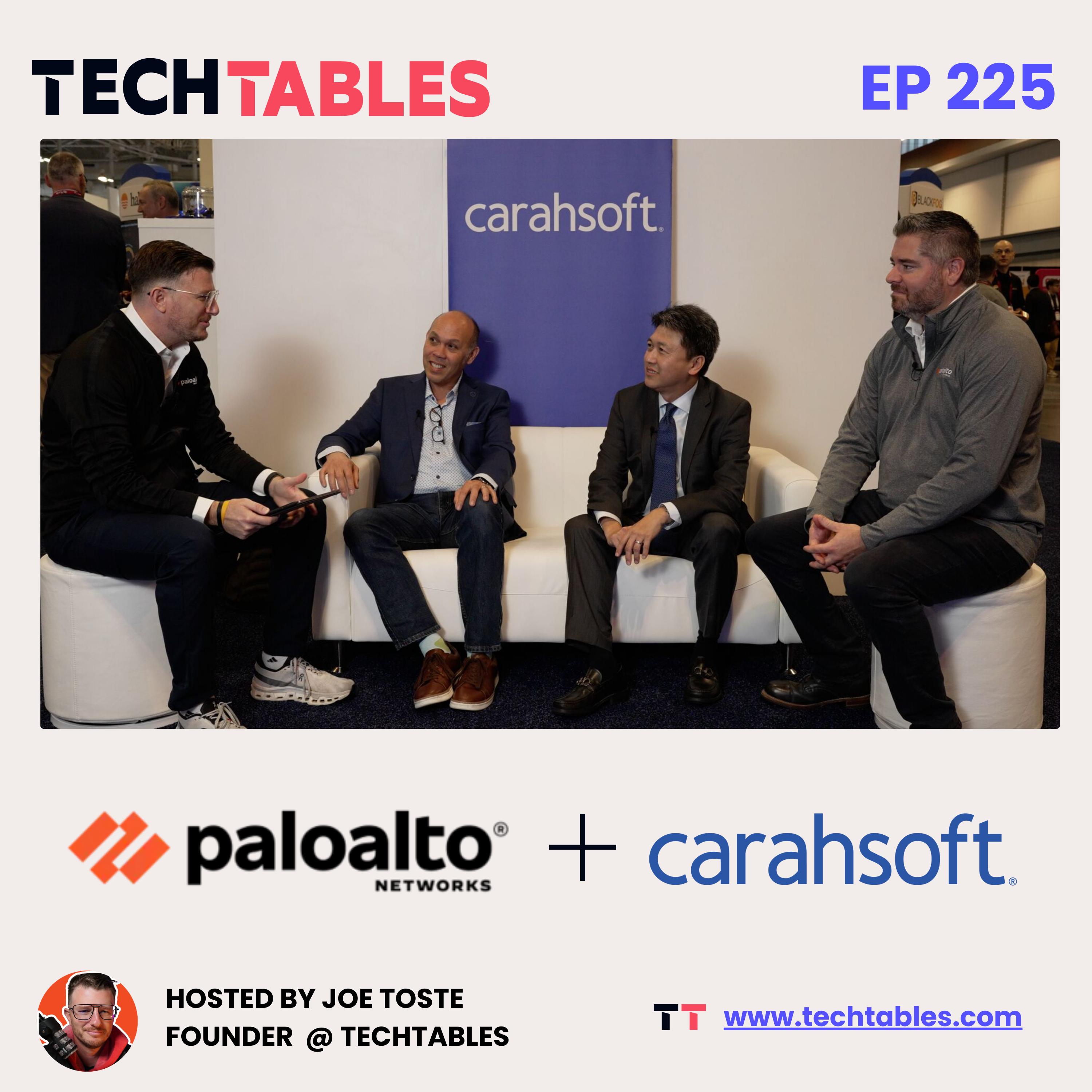
#### [#225: CSU, UT System & Palo Alto Networks on AI Access, Cybersecurity at Scale & the CSU Promise](https://techtables.com/podcast/225-csu-ut-system-palo-alto-networks-on-ai-access-cybersecurity-at-scale-the-csu-promise)
[](https://techtables.com/podcast/226-asu-cloudflare-idc-on-ai-governance-in-the-higher-ed-wild-west)
[2025 EDUCAUSE Live Podcast Tour](https://techtables.com/podcast/tag/2025-educause-live-podcast-tour)
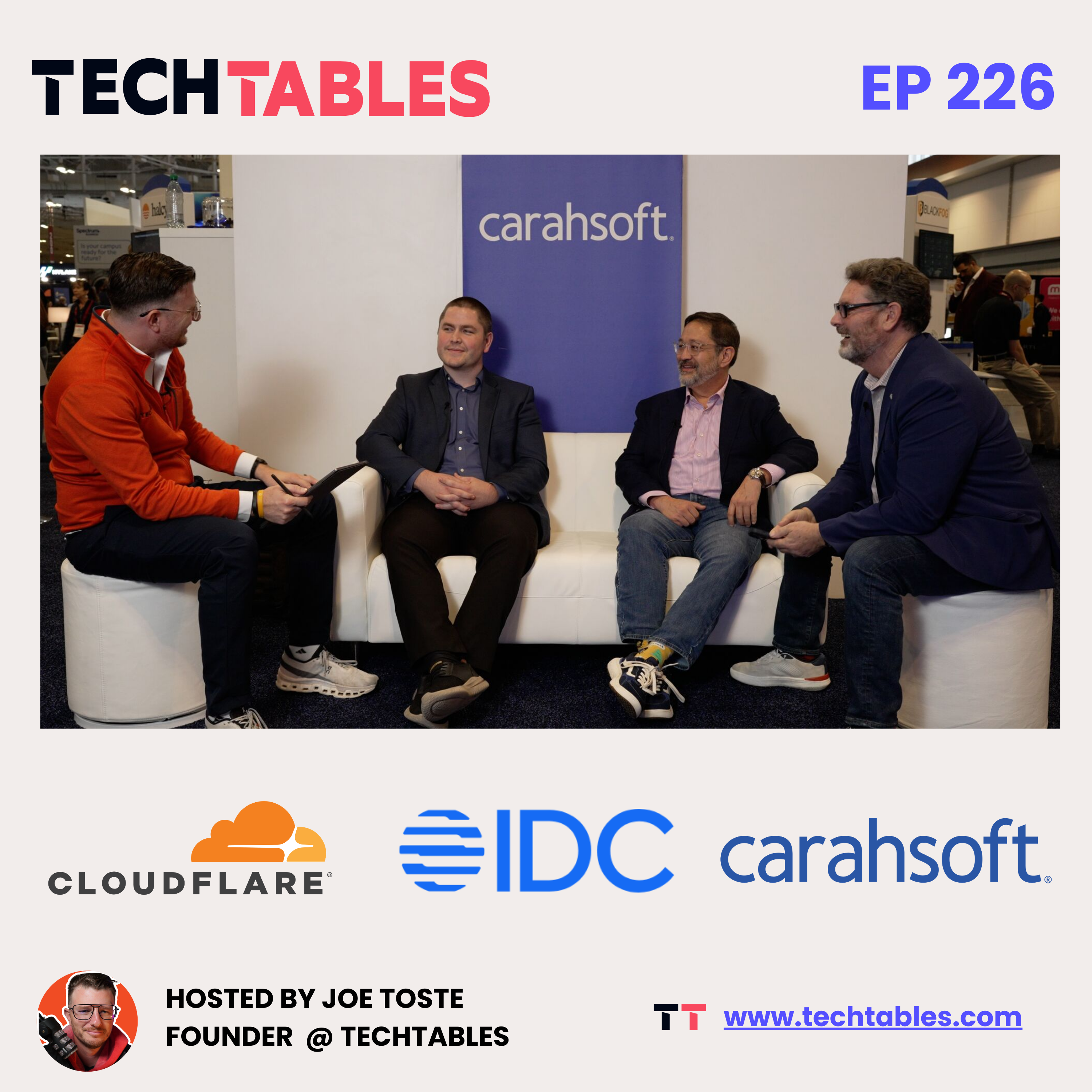
#### [#226: ASU, Cloudflare & IDC on AI Governance in the Higher Ed Wild West](https://techtables.com/podcast/226-asu-cloudflare-idc-on-ai-governance-in-the-higher-ed-wild-west)
[](https://techtables.com/podcast/232-the-cio-who-doesnt-adapt-gets-demoted-info-tech-live-nola-tom-zehren-and-john-burris)
[The Better Together Series](https://techtables.com/podcast/tag/the-better-together-series)
#### [#232: The CIO Who Doesn't Adapt Gets Demoted | Info-Tech LIVE NOLA | Tom Zehren & John Burris](https://techtables.com/podcast/232-the-cio-who-doesnt-adapt-gets-demoted-info-tech-live-nola-tom-zehren-and-john-burris)
[](https://www.techtables.com/)
### The #1 Video Podcast for Senior Public Sector Leaders
Join 250K+ Public Sector Leaders—from State and Local Government to Higher Education—including CIOs, CISOs, City Managers, and Executive Directors—by subscribing to exclusive podcasts, live events, and invites to private meetups and more!
[linkedin-in icon](https://www.linkedin.com/in/jtoste/) [twitter icon](https://twitter.com/thejoetoste) [Follow us on Facebook](https://www.youtube.com/@techtables/) [Follow us on Facebook](mailto:joe@techtables.com)
```json
{
"@context" : "https://schema.org",
"@type" : "BlogPosting",
"author" : {
"@type" : "Person",
"name" : "Joe Toste",
"url" : "https://techtables.com/podcast/author/joe-toste"
},
"dateModified" : "2026-06-24T19:15:57.558Z",
"datePublished" : "2026-05-20T12:15:00.000Z",
"headline" : "#235: The Edu-pocalypse Is Here - What Higher Ed CIOs Need to Do Now | Info-Tech LIVE NOLA |",
"image" : [ "https://techtables.com/hubfs/EP%20235%20Final%20Podcast%20Cover%20Art.png" ],
"mainEntityOfPage" : {
"@id" : "https://techtables.com/podcast/235-the-edu-pocalypse-is-here-what-higher-ed-cios-need-to-do-now",
"@type" : "WebPage"
},
"publisher" : {
"@type" : "Organization",
"logo" : {
"@type" : "ImageObject",
"url" : "https://techtables.com/hubfs/TechTables%20Black%20&%20Red%20Logo%202023-1.svg"
},
"name" : "Levity Media LLC"
}
}
```